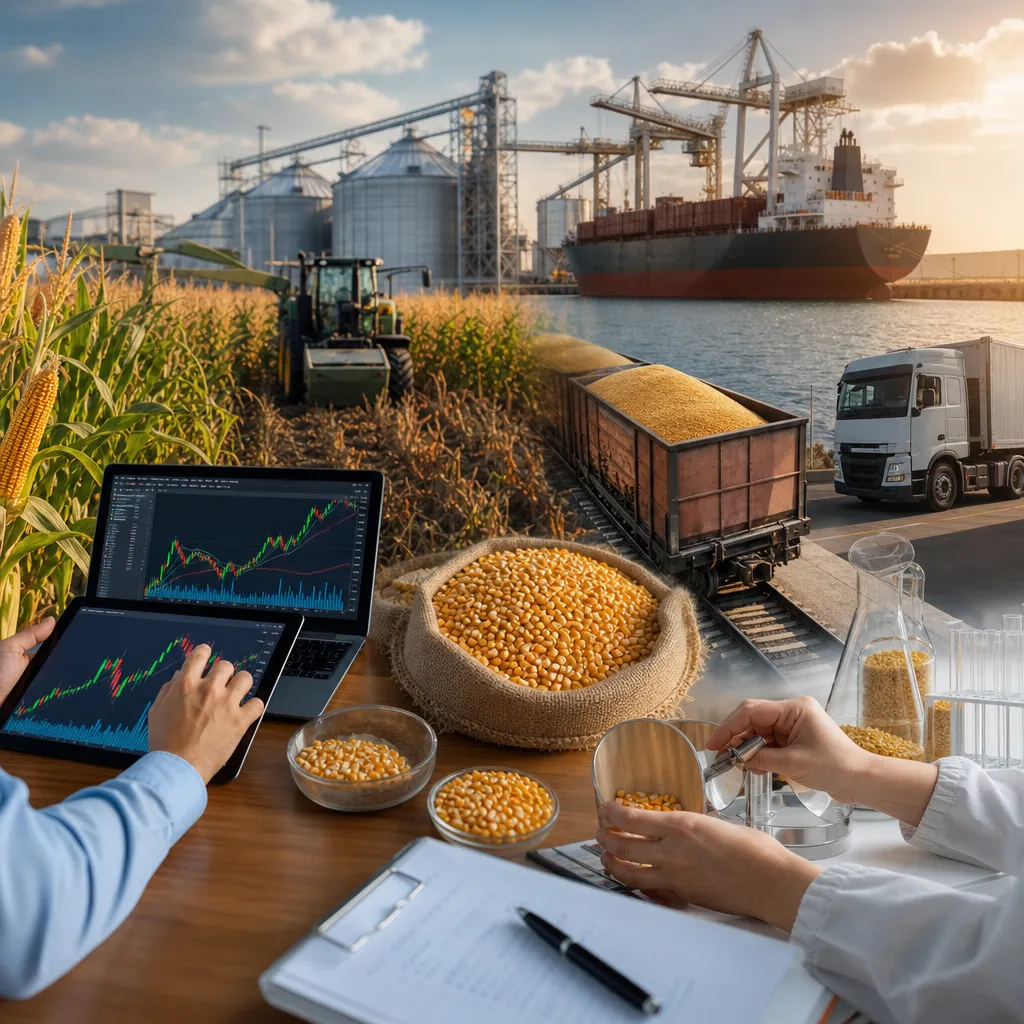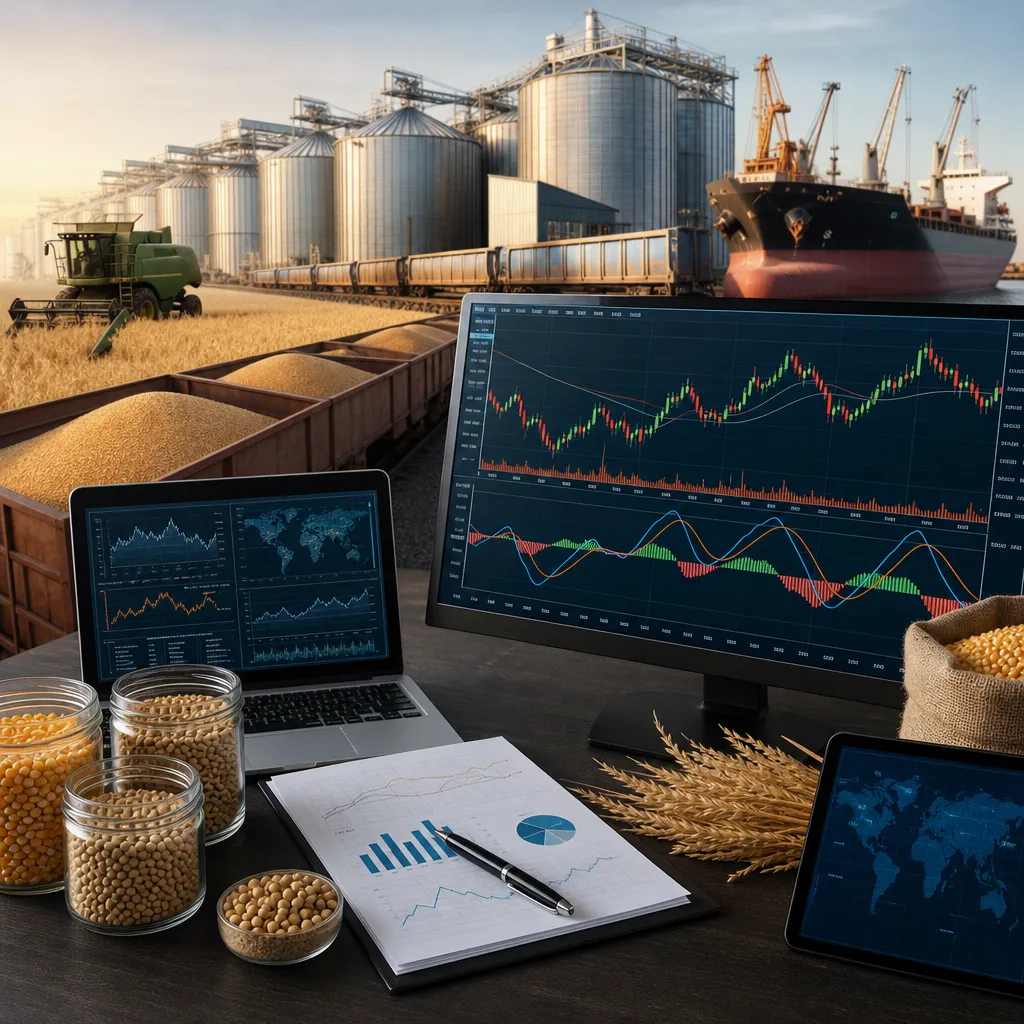
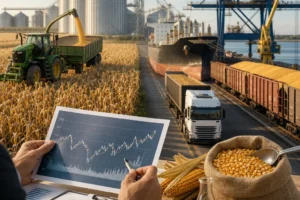
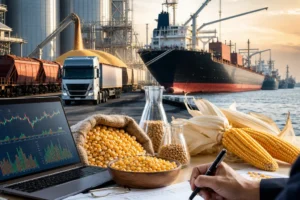
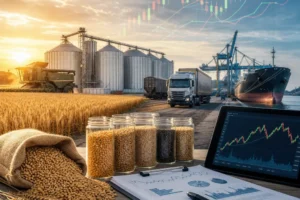
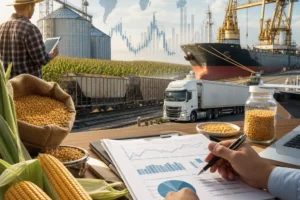

The European Union corn market is a large, integrated grain system rather than a single local marketplace. In EU usage, corn usually refers to maize, traded and consumed mainly as feed grain, with additional demand from starch, food processing, and ethanol. The market operates across member states such as France, Romania, Hungary, Poland, Italy, and Spain, but pricing is strongly influenced by the wider Black Sea, South American, and global feed grain balance. For anyone following EU corn supply and demand, the practical task is to connect production and consumption inside the EU with import needs, export competitiveness, logistics, currency moves, and benchmark futures.
Geographically, the most important producing areas are in Central, Eastern, and Southern Europe, while major deficit zones include livestock-dense regions and ports that rely on imported feed grains. Prices are usually discussed in euros per metric tonne in the physical market, while the main regional benchmark for grain futures is Euronext, especially the Paris market for feed grains and milling wheat. However, local cash corn values in the EU are never identical to a futures price: they also reflect basis, quality, delivery location, transport costs, and the balance between nearby sellers and buyers.
What “EU corn supply and demand” means
EU corn supply and demand refers to the balance between how much maize the European Union produces, carries in stocks, imports, consumes, and exports during a marketing year. This balance matters because the EU is important in global grain trade but is not always structurally self-sufficient in corn. In some years, strong harvests in key member states reduce import dependence. In poorer crop years, the EU can become a significant corn importer.
On the supply side, the market looks at harvested area, yield, weather, crop condition, harvest timing, opening stocks, and imports. On the demand side, the biggest driver is usually feed use, especially for poultry, pigs, and cattle. Industrial use also matters, including starch, sweeteners, and ethanol, while food use is smaller in aggregate terms. Analysts then compare total availability with domestic use and export demand to estimate ending stocks and the need for imports.
Because the EU is a customs union with a common trade framework, corn can move internally between member states without the same barriers seen in cross-border trade outside the bloc. But physical grain still depends on real logistics such as road, rail, river, and port capacity. So the EU corn market is integrated, but not frictionless.
Where the EU corn market operates
The EU corn market operates at several levels at once. First, there is the local physical market, where farmers sell to elevators, cooperatives, merchants, feed mills, starch plants, or ethanol plants. Second, there are inland merchant and processor markets where grain is bought on an ex-farm, delivered, or stored basis. Third, there are port and import/export markets where cargoes are bought and sold for shipment. Finally, there is the derivatives market, where participants hedge price risk using futures and options.
France and Romania are often central to discussions of EU corn production, although crop importance varies by season. Hungary, Poland, and Italy are also relevant. Spain is a major feed-consuming country and often a key import destination because of its livestock sector. Northern European feed compounders and processors can also be major buyers of imported maize or alternative feed grains.
Physically, the market can be divided into:
- Producing regions: inland farming areas where corn is grown and first sold.
- Deficit consuming regions: livestock and industrial zones where demand exceeds local supply.
- Ports: entry points for imported corn and exit points for exportable surpluses.
- Cross-border inland corridors: routes linking surplus and deficit member states.
This geography explains why two EU cash prices can differ substantially even when they refer to the same crop and the same week.
How EU corn prices are formed
EU corn prices are formed by the interaction of international benchmarks, local basis, quality, transport, and immediate supply and demand. There is no single “EU corn price” that perfectly represents the whole bloc.
In practical terms, market participants often start with a benchmark and then adjust for local conditions. The benchmark may be a Euronext grain futures contract, a Black Sea export indication, or a delivered import value into a major EU destination. From there, the market applies a basis, which is the local premium or discount to the benchmark.
| Price type | Meaning | Typical use in the EU corn market |
|---|---|---|
| Futures price | Exchange-traded reference price for a standardized contract | Benchmark for hedging and market direction, not the exact farm-gate price |
| Cash bid | Price offered by a local buyer for physical grain | What farmers or local merchants actually compare when selling nearby grain |
| Delivered price | Price with transport to a named destination included | Used by feed mills, processors, and some export chains |
| FOB price | Free on board price at the export port before ocean freight | Relevant when EU-origin corn is exported |
| CIF price | Cost, insurance, and freight included to destination port | Important for import parity into EU consuming regions |
| Basis | Difference between local cash price and benchmark futures or reference market | Shows local tightness, freight, quality, and buyer competition |
Several factors shape EU corn values:
- Weather and yield: drought and heat are especially important in parts of Southern and Eastern Europe.
- Feed grain substitution: corn competes with feed wheat, barley, and imported alternatives.
- Currency: the euro matters because imported corn and global grain trade are heavily influenced by dollar-denominated markets.
- Imports: if imported corn lands competitively at EU ports, inland prices may face pressure.
- Quality: moisture, test weight, mycotoxin risk, and condition can widen discounts or premiums.
- Logistics: rail bottlenecks, low river levels, port congestion, or expensive trucking can sharply affect local values.
Supply side: production, stocks, and imports
The EU corn supply picture starts with domestic production, but import availability is often just as important. Maize yields in the EU can vary widely across years because the crop is vulnerable to summer heat and moisture stress. This means that harvested volume may swing more sharply than in cooler grain systems.
When domestic production is strong, the EU can rely more on internal grain movement from surplus regions to feed users. When production is weak, the EU may need larger imports, especially into countries with large livestock sectors or insufficient domestic corn. Import origins depend on price, phytosanitary compliance, trade flows, and geopolitical conditions. In practical market terms, traders watch import parity very closely: if imported corn can land cheaper than local grain after freight and handling, it can reset inland price expectations.
Ending stocks also matter, but their market impact depends on where the grain is held and in what quality. A seemingly adequate stock level on paper may not fully protect the market if grain is tied up in distant locations, held by reluctant sellers, or unsuitable for certain end users.
Demand side: feed, industry, and trade flows
Feed demand is usually the dominant component of EU corn consumption. Poultry and pig sectors are especially important because they consume large compound feed volumes and can shift formulations depending on relative prices of corn, wheat, barley, and protein meals. If feed wheat becomes cheaper relative to maize, some rations may use more wheat and less corn. That substitution can soften corn demand even when livestock output remains stable.
Industrial demand provides another layer of support. Starch processors, sweetener producers, and ethanol plants can be important local buyers. Their procurement behavior depends on product demand, margins, energy costs, and competition with feed compounders. In some areas, a processor can materially tighten the nearby cash market because it creates year-round demand close to production zones.
Export demand exists but is not always the central driver for the EU as a whole. In some seasons and regions, surplus corn is marketed outward through ports or neighboring countries. In others, internal deficits mean the bloc functions more as a net importer than an exporter. That is why EU corn analysis has to stay flexible: the same region may look export-oriented one year and import-sensitive the next.
Where to check EU corn market information online
If you want a current view of EU corn prices or supply and demand, the key is to combine futures data, official balance sheets, and physical market indications. You should not rely on a single number.
For benchmark and market structure information, readers commonly watch Euronext for grain futures and options. Even where corn itself is not priced locally off a single futures screen, Euronext remains central to European grain risk management and price discovery.
For supply, demand, trade, and balance-sheet analysis, practical official sources include the European Commission, especially market observatories and agricultural reporting, and Eurostat for production and trade statistics. International participants also use USDA reports, particularly global supply and demand publications and foreign market analysis, because they place the EU in the wider world grain context.
For local cash market guidance, farmers and traders normally check:
- cooperative and elevator bid sheets,
- merchant and processor purchase indications,
- port market comments from brokers or trade publications,
- national agriculture ministries or statistical services where available,
- analyst and brokerage notes comparing imported and domestic replacement values.
A local cash bid may differ from a futures market for perfectly normal reasons: quality specs, moisture, delivery month, distance to end user, storage charges, and local buyer competition. A futures quote is a benchmark; it is not automatically the exact ex-farm price.
| Source type | What it helps you check | Why it matters |
|---|---|---|
| Euronext | Benchmark futures and options information | Shows tradable price references and hedging tools |
| European Commission | EU agricultural market reports and policy context | Useful for balance-sheet direction and trade framework |
| Eurostat | Production, area, and trade statistics | Helps track regional supply and trade trends |
| USDA | Global and EU grain outlooks | Places EU corn in the global supply and demand picture |
| Local buyers | Cash bids, quality discounts, delivery terms | Determines the real physical selling price available nearby |
How corn is actually bought, sold, imported, exported, or hedged in the EU
In the physical market, corn is bought and sold through bilateral contracts between farmers, collectors, cooperatives, merchants, processors, feed manufacturers, and exporters. Contracts may be spot, forward, or storage-based. The main commercial details are quantity, quality specification, moisture, delivery window, delivery point, price basis, and payment terms.
A farmer in the EU usually does not sell physical grain by clicking a futures screen. The farmer more often sells to a local buyer that posts a bid for ex-farm pickup or delivered tonnage. That buyer may then aggregate grain, dry or store it, and resell to a feed mill, processor, or export channel.
Imported corn enters through traders and importers who buy cargoes on an international basis, often discussed in CIF terms into EU ports. Once landed, the grain is sold on to inland consumers or merchants. Exported EU-origin corn is typically priced against port values and global alternatives, often using FOB logic before ocean freight is added for the final buyer.
Hedging is different from physical trade. A merchant, processor, or sophisticated farmer may use futures or options through a broker to reduce price risk. This normally happens on an organized exchange account with margin requirements. A futures hedge protects against adverse market moves, but it does not remove basis risk. That means the hedge may offset the benchmark price movement while the local cash differential still changes.
In short:
- Physical grain trade transfers ownership of real corn and depends on quality, logistics, and counterparties.
- Futures and options trading transfers financial price exposure and is mainly used for hedging or speculation.
Confusing the two is one of the most common mistakes in grain market discussions.
Key drivers to watch for the EU corn outlook
The EU corn outlook should be approached through scenarios rather than certainty. A bullish or bearish view can change quickly if weather, imports, or competing feed grains shift.
The most important variables usually include:
- Spring planting and summer weather: these drive production potential.
- Harvest quality: poor quality can reduce usable feed or industrial output value.
- Import competitiveness: if imported corn is cheaper than domestic replacement, buyers can cap local rallies.
- Feed demand: livestock margins and feed substitution affect corn usage.
- Energy and industrial margins: these influence ethanol and starch demand.
- Currency: euro strength or weakness changes import and export competitiveness.
- Policy and trade rules: tariffs, sanitary rules, and geopolitical developments can redirect flows.
A practical way to think about the market is scenario-based:
- Tight EU crop, expensive imports: domestic corn prices may strengthen, especially in deficit regions.
- Large EU crop, weak feed demand: local harvest pressure can weigh on inland cash bids.
- Cheap imported supply, adequate logistics: port and nearby inland values may soften relative to futures.
- Weather damage plus logistics stress: basis can strengthen sharply even if benchmark futures move less.
Common market misunderstandings
One common misunderstanding is treating the EU as a uniform corn market. In reality, a producer in Romania, a feed mill in Spain, and a processor in Northern Europe may all face different practical prices at the same time.
Another mistake is assuming that a futures benchmark equals a local physical price. It does not. A local bid can trade above or below a futures-derived reference depending on basis, transport, and quality. Similarly, an import parity calculation can matter more to a feed buyer near a port than an inland farmer’s harvest sale level.
It is also wrong to think that all “corn demand” is identical. Feed users, ethanol plants, starch processors, and exporters each respond differently to price changes. A market can look oversupplied in one channel and still look tight in another nearby channel because the logistical and quality requirements differ.
Where can I check EU corn prices today?
For benchmark pricing, check Euronext grain market information. For actual physical values, check bids from local cooperatives, merchants, feed mills, processors, and port market reports. The real nearby cash price depends on location, quality, delivery terms, and timing.
Is there one official EU corn price?
No. There is no single physical price that fits all EU locations. Corn in the EU trades through local cash markets, processor demand zones, and import/export channels, so prices vary across regions.
What currency and unit are usually used in the EU corn market?
Most EU physical corn prices are discussed in euros per metric tonne. International trade comparisons may also refer to dollar-based values, especially when import parity or global export competition is being assessed.
How is EU corn different from Euronext futures?
Euronext futures are a financial benchmark used for hedging and price discovery. EU physical corn is actual grain bought and sold under quality and delivery terms. The two are connected through basis, but they are not the same thing.
Why can local EU corn cash bids differ from futures?
Because local bids include basis. Basis reflects freight, storage, quality, moisture, buyer competition, location, and local supply and demand. A futures market cannot capture all of those local factors on its own.
Is the EU mainly a corn exporter or importer?
It depends on the season and the regional crop outcome. The EU can export surplus corn from some areas in some years, but in tighter crop years it can be a significant importer, especially for feed demand in deficit regions.
How is imported corn priced into the EU?
Imported corn is often assessed on a landed basis, commonly using CIF logic into destination ports. Buyers then compare that landed cost with domestic alternatives and inland transport costs to determine whether imports are competitive.
Can farmers or traders hedge EU corn online?
Yes, but hedging and physical selling are different activities. Hedging is done through a futures or options account with a broker, while physical grain is usually sold separately to a local buyer, merchant, cooperative, processor, or exporter.
Sources
- European Commission
- Eurostat
- Euronext