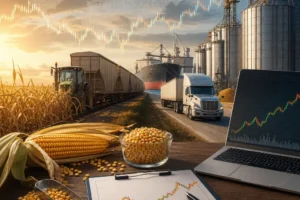
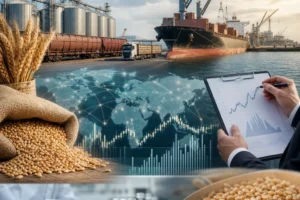
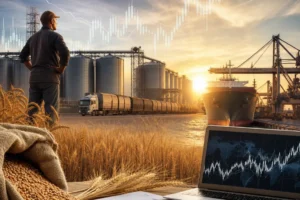
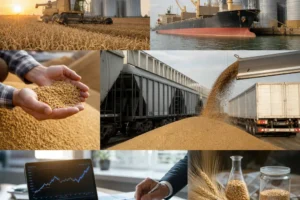

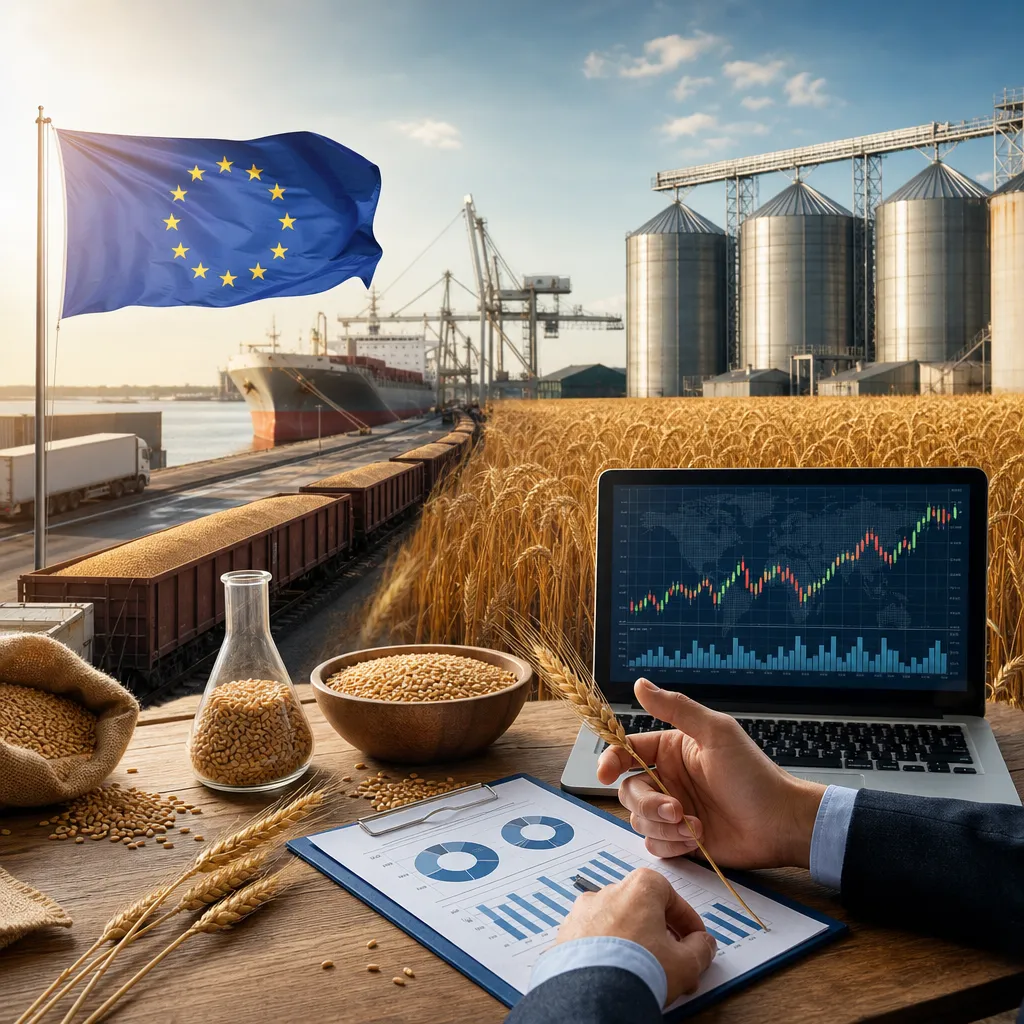
The EU wheat import market is the market through which wheat is bought from non-EU origins and brought into the European Union for milling, feed, blending, or strategic supply. It operates across the entire EU single market, but the most visible pricing points are import ports, destination consumer markets, and the futures market used as a benchmark for hedging. In practice, imported wheat is not priced by a single “EU import price”; it is priced through a combination of world export values, freight, insurance, currency, quality, and destination demand. For anyone following this market, it is essential to separate benchmark futures prices from actual CIF import offers and from inland cash prices paid by mills or feed users.
The geography matters first. The European Union is a major wheat producer, but it is also an importer in some years, especially for specific qualities, feed wheat needs, or regional supply gaps. Imports enter through seaports and land borders and then move into member-state markets where buyers compare imported wheat with domestic EU wheat. Because the EU is a customs union, policy, tariffs, and trade measures are set at EU level, while physical purchasing, logistics, and end-use demand are often highly local.
What the EU wheat import market means
The EU wheat import market refers to purchases of wheat from outside the European Union by EU-based buyers. Those buyers can include flour millers, feed compounders, grain merchants, importers, integrated processors, and traders supplying deficit regions. The wheat may be imported for bread flour production, feed use, industrial processing, or to balance domestic shortages in certain qualities or locations.
In market language, imported wheat is commonly discussed as a destination market rather than a producing origin market. That means the key question is not only what is wheat worth globally, but also what is it worth delivered into a specific EU destination. This is why import trade often revolves around CIF values, discharge port economics, customs rules, and quality compatibility with local demand.
The main commodity is wheat, but in commercial practice buyers distinguish between milling wheat and feed wheat. Quality characteristics can include protein, test weight, moisture, falling number, and specific sanitary or phytosanitary requirements. Those details matter because an imported cargo that looks cheap on headline price may not fit the end user’s quality specification.
Where the market operates in practice
The market operates across the EU, but not all member states play the same role. Some are large wheat producers and exporters in normal years, while others are structurally more dependent on imports or on flows from neighboring member states. Even in a net-exporting bloc, imports still matter because the EU may need different qualities, competitive feed wheat, or regional replacement supplies.
Operationally, the import market is most visible in:
- Seaport markets, where wheat is discharged from vessels and sold into domestic use or onward distribution.
- Border and inland destination markets, where imported grain competes with local wheat.
- Merchant and processor procurement markets, where mills and feed users tender for wheat based on delivered specifications.
- Financial benchmark markets, especially Euronext wheat futures, which are widely watched as a pricing reference for European wheat.
Because the EU is integrated, imported wheat may enter one member state and then move to another. A cargo discharged at a coastal port can influence inland prices if transport economics allow the wheat to compete with domestic supplies. For this reason, logistics and internal freight are central to understanding the true import market.
How prices are formed
EU wheat import prices are formed from a chain of values rather than from a single quote. At the international level, the starting point is often the export value at origin. To that are added ocean freight, marine insurance, handling costs, financing, currency effects, and destination-specific costs. The resulting import value is often discussed in CIF terms, meaning cost, insurance, and freight to the destination port.
Once wheat reaches the EU, the price can change again based on discharge costs, customs treatment, inland transport, storage, and the urgency of local demand. A flour mill buying delivered wheat will care about the full delivered cost and quality compliance, not just the headline vessel value.
| Price type | Where quoted | What it means |
|---|---|---|
| Futures price | Exchange benchmark, mainly Euronext for European wheat | A standardized financial reference used for pricing and hedging, not the exact physical import cost at a port or mill. |
| Cash price | Spot physical market | The value of actual wheat at a particular location and quality specification. |
| CIF import price | Import trade and merchant offers | The cost of wheat delivered to an EU port including freight and insurance. |
| Delivered buyer price | Mill, feed plant, or inland consumer market | The all-in cost at the end user’s facility after discharge, transport, and handling. |
| FOB export price | Origin export market | The value loaded at the exporting port, before ocean freight to the EU destination. |
The difference between a local physical price and the benchmark futures price is called the basis. In the EU import context, basis reflects quality, protein, location, freight, storage, local supply-demand balance, and buyer competition. A mill in a wheat-deficit region may pay a stronger delivered basis than a mill located near abundant domestic supply.
The usual currency framework is mixed. Physical trade may be discussed in euro per metric tonne for EU destinations, while some international trade references may still be watched in U.S. dollars per metric tonne depending on origin and freight practice. Currency movements, especially EUR/USD, can materially change import competitiveness even when the world wheat market itself is steady.
The benchmark market: Euronext and the role of futures
The most relevant exchange benchmark for much of the European wheat market is Euronext milling wheat futures. This contract is not the same thing as an EU import quote, but it is central to how many merchants, processors, and risk managers think about price exposure. It provides a transparent reference for pricing, hedging, and comparing imported wheat with domestic alternatives.
Futures are used for risk management, not only for speculation. A merchant importing wheat into the EU may hedge part of the price exposure on Euronext if the imported wheat will compete directly with European milling wheat values. A processor may also use futures to lock in part of the grain cost while still negotiating physical quality and logistics separately.
However, futures do not remove all risk. Importers still face basis risk, freight risk, currency risk, quality risk, and counterparty risk. An importer can hedge the broad wheat price trend through a futures market, but the exact economics of one vessel into one EU port remain physical-market specific.
How wheat is actually bought, sold, imported, and hedged
Physical import trade in the EU is usually conducted by professional counterparties rather than through a public exchange order book. Common participants include international grain houses, EU grain merchants, importers, millers, feed manufacturers, and brokers. Trade can be done as spot business, forward cargoes, or structured supply programs.
Physical market process
- Buyer identifies a need by quality, volume, and arrival period.
- Importer or trader sources wheat from an external origin.
- Parties negotiate terms such as quality specification, shipment window, Incoterms, discharge location, and payment terms.
- The wheat is shipped, inspected, and discharged.
- The cargo may be sold directly to an end user or broken into smaller inland movements.
Common commercial forms include:
- CIF purchase: buyer pays for wheat delivered to the destination port.
- FOB purchase plus freight booking: buyer or trader manages ocean freight separately.
- Delivered inland contract: merchant supplies wheat to the mill or feed plant at an agreed delivered price.
- Formula-based contract: price linked to a benchmark future plus or minus an agreed basis.
Inland resale depends on storage, truck or rail availability, and regional economics. Buyers also examine tolerance clauses, quality claims, discharge timing, and documentary compliance. In practice, these details can have just as much financial importance as the nominal grain price.
Futures and options process
Financial hedging takes place through a regulated broker or clearing member, not through the physical grain contract itself. A participant opens an account, posts margin, and trades futures or options to manage price risk. This creates financial exposure to wheat prices but does not by itself transfer ownership of physical grain.
That distinction is crucial:
- Physical trade = ownership, shipment, quality, logistics, and payment.
- Futures/options trade = price-risk management or speculation on a standardized exchange contract.
| Market channel | Main users | What happens there |
|---|---|---|
| Physical import market | Importers, merchants, mills, feed companies, exporters | Cargoes are negotiated by quality, shipment period, destination, and payment terms. |
| Local cash market | Domestic buyers and sellers inside member states | Imported wheat competes with EU-grown wheat in delivered or ex-store form. |
| Futures market | Hedgers, funds, traders, processors | Participants manage price exposure using standardized contracts. |
| Brokered OTC trade | Professional trade counterparties | Specific cargoes or formulas are negotiated privately, often around benchmarks. |
Where to check EU wheat import prices and market information
There is no single official “live EU wheat import price” that covers every location and quality. Readers should use a combination of benchmark, policy, and trade information.
Practical places to check include:
- Euronext for milling wheat futures benchmarks and contract information.
- European Commission for EU market policy, trade measures, and agricultural market context.
- Eurostat for trade statistics, including import flows by member state and origin, though not as a real-time physical bid screen.
- USDA, especially global grain supply and trade publications, for international balance-sheet context and exporter competition.
- Local grain merchants, flour mills, feed manufacturers, and cooperatives for actual destination bids or procurement indications in a given member state.
- Broker and market-intelligence services used by trade professionals for CIF offers, freight assumptions, and comparative origin values.
When checking prices, always verify four things: the commodity type, the quality specification, the location, and the pricing basis. A futures settlement price on Euronext is not the same as a CIF Black Sea-origin cargo into an EU port, and neither is the same as a delivered mill bid in a landlocked region.
Main drivers of the EU wheat import market
The import market moves when imported wheat becomes more or less competitive against domestic EU wheat. Several factors matter repeatedly.
- EU crop size and quality: a large domestic crop can reduce import demand, while quality problems can increase demand for blending wheat.
- Regional shortages inside the EU: even with adequate overall supply, some areas may need imports because of logistics or local deficits.
- Origin competitiveness: prices from major exporters affect whether imports clear economically into EU destinations.
- Freight and logistics: ocean freight, port congestion, inland trucking, and rail economics can materially alter landed cost.
- Currency: a weaker euro can make non-EU wheat more expensive for EU buyers.
- Trade policy: tariffs, quotas, sanitary rules, and emergency measures can reshape flows quickly.
- Feed demand versus milling demand: when feed grains are tight, wheat imports may rise for ration use in some regions.
Weather also matters beyond the EU itself. Drought, excessive rain, or export disruptions in major supplier regions can lift import values even if EU domestic conditions are stable.
Import market outlook: practical scenarios rather than fixed forecasts
Any outlook for the EU wheat import market should be scenario-based. The reason is simple: imports depend on the interaction between domestic EU supply and the relative economics of external origins.
| Scenario | Conditions | Likely implication for imports |
|---|---|---|
| Large EU crop, good quality | Domestic wheat is abundant and suitable for local users | Import demand may weaken except for niche qualities or regional gaps. |
| Large crop, uneven quality | Volume exists but some milling specs are harder to meet | Selective imports may rise for blending or premium flour needs. |
| Tighter EU supply | Weather or acreage reduces local availability | Import opportunities improve if external origins remain competitive. |
| Weak euro | Imported wheat becomes costlier in local currency | Imports may slow unless domestic prices rise even more. |
| Disrupted external supply | Freight, policy, or origin supply issues tighten availability | CIF prices can rise sharply and local buyers may seek alternative origins or substitute grains. |
For practical forecasting, watch EU crop conditions, harvest quality, Euronext structure, origin export competitiveness, freight direction, and currency moves together. Looking at only one of these usually gives an incomplete picture.
What matters most for buyers, sellers, and risk managers
For a physical buyer in the EU, the key issue is not the exchange headline but the delivered replacement cost of the right wheat. That includes quality, timing, freight, and reliability of execution. For an importer or merchant, margin depends on buying the cargo correctly, managing basis and currency risk, and reselling into the most competitive destination.
For financial traders, the key distinction is that wheat futures provide exposure to price direction, but not full exposure to the economics of one import flow. Basis can widen or narrow independently of the futures market. That is why professional grain trade always treats futures and physical pricing as connected, but not interchangeable.
What is the main benchmark for the EU wheat market?
Euronext milling wheat futures are the main benchmark watched across much of Europe, but imported wheat is ultimately priced in the physical market through CIF or delivered values adjusted for quality and logistics.
Is there one official EU wheat import price today?
No. There are many import values depending on origin, protein, freight, destination port, and delivery terms. Readers should check benchmark futures, trade statistics, and local merchant or processor indications rather than expect one single EU-wide spot price.
In what currency and unit is EU wheat usually priced?
Within Europe, wheat is commonly discussed in euro per metric tonne. International trade references may also appear in U.S. dollars per metric tonne depending on the origin and shipping context.
Where can I check wheat market information online?
Useful institutional sources include Euronext for futures benchmarks, the European Commission for market and policy information, Eurostat for trade data, and USDA for global supply and trade context. Actual physical bids usually come from merchants, mills, processors, or commercial market services.
How does imported wheat compete with domestic EU wheat?
Buyers compare the landed or delivered import cost against local wheat of similar quality. The decision depends on price, freight, protein, milling performance, availability, and urgency of demand.
Can I buy EU wheat imports through a futures exchange?
No. A futures exchange gives financial exposure to benchmark wheat prices. Actual import cargoes are bought in the physical market through traders, merchants, brokers, or direct commercial contracts.
Why can local cash prices differ from Euronext futures?
Because cash prices include basis, which reflects quality, location, transport, storage, local supply-demand conditions, and buyer competition. A futures contract is standardized; a local wheat parcel is not.
What are the biggest risks in the EU wheat import market?
The major risks are price volatility, basis changes, freight swings, currency moves, quality disputes, policy changes, and counterparty performance. Managing only the futures price is not enough to manage the full import trade risk.
Sources
- European Commission
- Euronext
- Eurostat