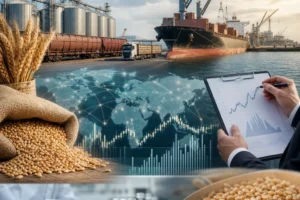
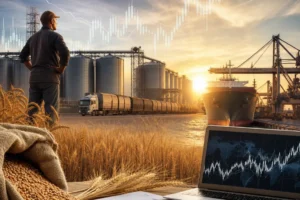
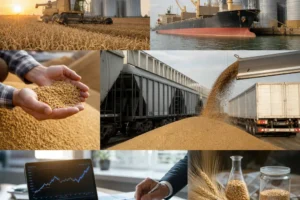
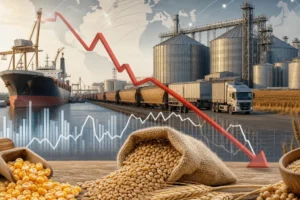

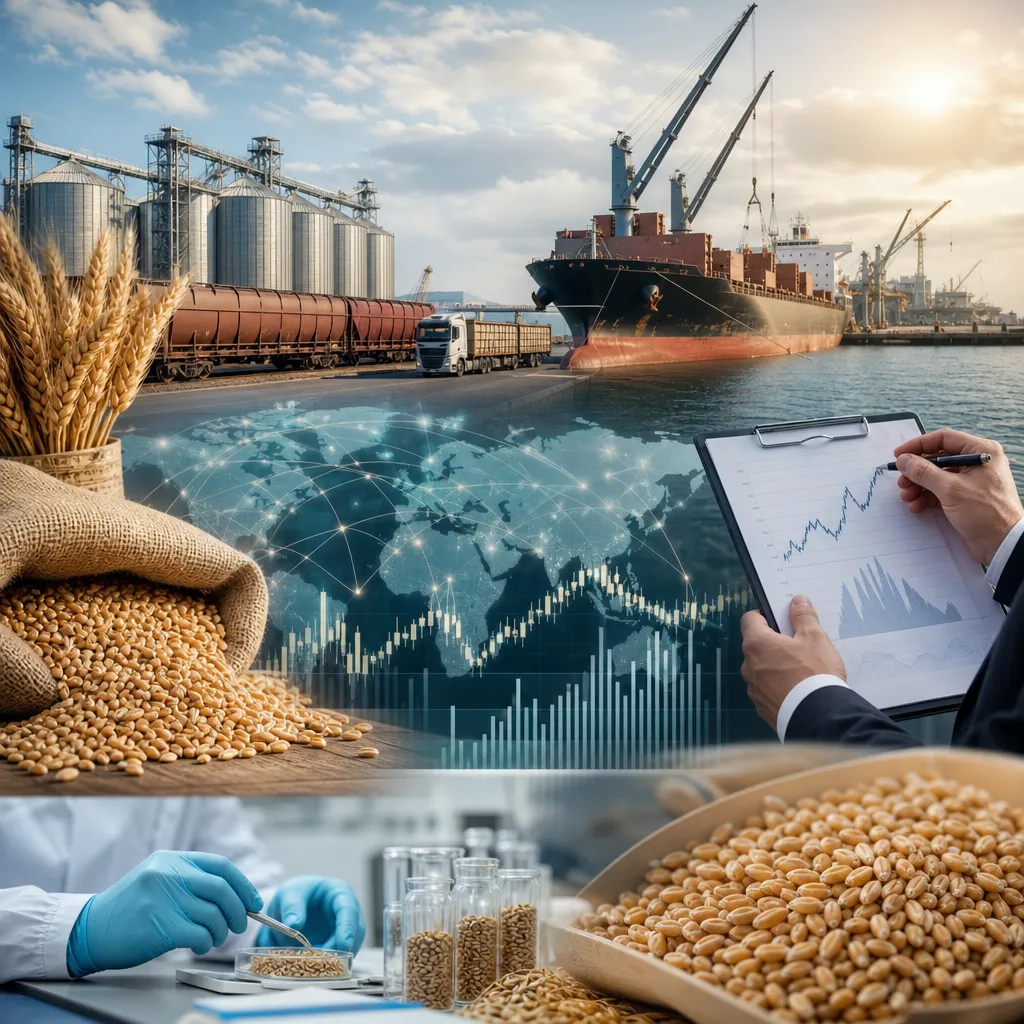
The EU wheat export market is the trade in wheat shipped from European Union member states to buyers in North Africa, the Middle East, sub-Saharan Africa, and other destinations. In practice, this is not one single local market but a network of inland cash markets, port markets, exporters, shipping routes, and financial benchmarks centered mainly on France, Romania, Germany, the Baltic region, Bulgaria, and other surplus-producing areas. Prices are usually discussed in euros per metric tonne, while international trade often references FOB export values and futures on Euronext wheat. To understand this market properly, readers need to separate futures pricing, local cash bids, port premiums, and the actual export transaction terms used between merchants and overseas buyers.
What the EU wheat export market means
The European Union is one of the world’s major wheat producers and exporters, especially for common wheat used in milling and feed. The export market refers to wheat moving out of the EU customs area to third countries, not trade between EU member states themselves.
In commercial terms, the market includes:
- Farm and elevator purchases in producing regions.
- Domestic merchant and cooperative origination.
- Movement by truck, rail, barge, or short-sea shipping to export terminals.
- Port-based offers, often quoted FOB.
- Tenders and private purchases by foreign importers, millers, feed manufacturers, and state buying agencies.
The EU wheat export market matters because it links European grain balances to global competition from Russia, Ukraine when available, the United States, Canada, Australia, and Argentina. Even when wheat is grown inland, the export price available at a port can influence farm-level values through basis, transport cost, and buyer demand.
Where the market operates
The market operates across the EU, but not all member states play the same role. Some are structural exporters, while others are more balanced or import-dependent in some years. France has long been a key origin for export wheat, especially into North Africa. Romania and Bulgaria are important Black Sea-area exporters within the EU. Germany and the Baltic states also contribute to export flows depending on crop size, quality, and logistics.
Major export activity is concentrated where inland grain can be assembled efficiently and loaded onto ocean-going vessels. In that sense, the export market exists at two levels:
- Inland physical markets where farmers sell to cooperatives, merchants, or processors.
- Port export markets where grain is accumulated, quality-checked, blended if necessary, and sold to overseas buyers.
Wheat in this market is normally priced in euros per metric tonne. However, importers comparing origins globally may also assess offers in US dollars per tonne once freight and exchange rates are considered. This is why currency moves, especially euro-dollar changes, can materially shift EU export competitiveness.
| Market layer | Where it operates | Typical quotation concept | Main users |
|---|---|---|---|
| Farm or local cash market | Producing regions across EU member states | Cash bid, ex-farm, delivered elevator, or local cooperative price | Farmers, cooperatives, local merchants |
| Inland wholesale market | Storage and logistical hubs | Delivered price by quality and location | Traders, mills, feed users, exporters |
| Port export market | Main EU export terminals and loading zones | FOB offer or export bid | Exporters, importers, brokers, vessel charterers |
| Futures market | Euronext | Standardized wheat futures price | Hedgers, traders, funds, brokers |
How prices are formed
EU wheat export prices are formed by the interaction of global benchmarks, local supply and demand, grain quality, logistics, and currency. No single number represents the whole market.
A practical way to read the market is to break price formation into layers:
- Futures price: Often the first reference point for European wheat risk management is the Euronext milling wheat futures contract. This is a financial benchmark and a hedging tool, not the exact price a farmer receives or an exporter pays at a port.
- Basis: The basis is the difference between the local cash or export market price and the futures price. It reflects local supply, quality, transport cost, storage, timing, and buyer competition.
- Cash bid: This is a physical buying price offered by a cooperative, elevator, merchant, mill, or feed company. It may be ex-farm or delivered to a named location.
- Delivered price: This includes transport to a specific inland destination or export point.
- FOB price: Free On Board means the value of grain loaded at the export port. It is a standard export market reference.
- CIF price: Cost, Insurance and Freight refers to the delivered import price at destination, which includes freight and marine costs beyond the FOB value.
For example, a strong Euronext wheat futures market does not guarantee equally strong farm bids if inland transport is disrupted, quality is poor, harvest pressure is heavy, or export demand is weak. Conversely, a modest futures market can still coincide with firm cash values in a specific export zone if port demand is active and vessel lineups are strong.
Main price drivers
- EU production size and quality, especially protein, test weight, and falling number where relevant.
- Weather during planting, development, and harvest.
- Competition from other exporting origins.
- Euro exchange rate against the US dollar.
- Freight and logistics costs from inland origin to port.
- Import tender demand from major destination countries.
- Domestic feed and milling demand within the EU.
- Stocks, farmer selling pace, and storage availability.
- Government policy, phytosanitary rules, and trade measures where applicable.
| Price type | What it means | Why it matters |
|---|---|---|
| Euronext wheat futures | Exchange-traded benchmark for milling wheat | Used for hedging and market direction |
| Local cash bid | Physical price offered in a local area | Relevant to growers and inland buyers |
| Delivered price | Price including transport to named destination | Important for mills, feed users, and exporters |
| FOB export price | Price for grain loaded on vessel at port | Key measure of export competitiveness |
| CIF import price | Delivered cost at destination port | How importers compare origins |
The benchmark market: Euronext wheat
The most relevant exchange benchmark for the EU wheat market is Euronext milling wheat, often still informally called MATIF wheat. It is the principal futures reference used by merchants, exporters, processors, and financial participants to hedge price exposure or express a market view.
This futures market is not the same as the physical export market. A futures contract is standardized, exchange-cleared, and traded through a broker. Physical export wheat is negotiated privately between commercial counterparties, often with detailed terms for origin, quality, shipment window, tolerances, and payment.
Who uses Euronext wheat?
- Exporters to hedge inventory or sales risk.
- Cooperatives and merchants to manage flat price exposure while buying from farmers.
- Millers and feed manufacturers to lock in part of future raw material cost.
- Speculators and funds to trade price direction without owning physical grain.
Access to Euronext futures normally requires a futures broker or an intermediary offering exchange access. That is financial participation, not direct ownership of export cargoes. A trader can buy or sell futures online without ever loading a vessel, while an exporter can physically ship wheat and use futures only to reduce price risk.
How wheat is physically bought, sold, and exported
Physical grain trading in the EU export market usually starts inland. Farmers sell to local cooperatives, merchants, or collectors under spot, forward, pool, or storage-linked arrangements. The grain is tested for quality and then moved into storage or directly into a logistical chain.
From there, merchants or exporters assemble larger lots that meet export specifications. They may blend grain to reach a required quality profile, depending on contract terms and regulations. Export sales are then made to foreign importers, international trading houses, mills, feed buyers, or government purchasing agencies through tenders or direct negotiation.
A typical physical export chain may include:
- Farmer sells wheat ex-farm or delivers to a collection point.
- Merchant or cooperative aggregates volume from multiple origins.
- Grain is moved by truck, rail, or barge to an inland hub or port.
- Exporter manages storage, testing, documentation, and vessel scheduling.
- Wheat is sold FOB at an EU port or under another negotiated trade term.
- Importer arranges or receives shipment depending on contract structure.
Key commercial details in physical grain trading include moisture, protein, test weight, specific sanitary requirements, loading period, delivery window, payment terms, and dispute resolution. Counterparty risk also matters. In real trade, the cheapest headline price is not always the best offer if contractual performance or quality reliability is uncertain.
Where to check prices and market information online
If a reader wants the current EU wheat export market price, the first step is to define which price they want. There is no single live number for “EU wheat.” A futures quote, a French inland cash bid, a Romanian port offer, and an FOB export assessment are all different market values.
Reliable places to monitor the market include:
- Euronext for milling wheat futures prices and contract information.
- European Commission for EU market monitoring, trade information, and agricultural context.
- Eurostat for official trade and agricultural statistics.
- USDA, especially global grain balance and trade outlook reporting, for comparison with other exporters and importers.
- Local cooperatives, merchants, and grain buyers for actual inland cash bids.
- Broker and commercial market-reporting services for port indications, export offers, and tender coverage where users have access.
Readers should be careful not to treat an exchange futures price as the same thing as a local physical bid. Local cash prices can trade above or below futures because of quality, location, freight, storage pressure, vessel demand, and local buyer competition.
What moves the export outlook
Forecasting the EU wheat export market requires scenarios rather than certainty. Export performance depends not only on the EU crop, but on what competing exporters produce and how aggressively they price into destination markets.
The main scenarios usually revolve around the following questions:
- Is the EU harvest large enough in both volume and exportable quality?
- Are Black Sea and other global competitors offering cheaper wheat?
- Is the euro weak enough to improve EU competitiveness in dollar-based trade?
- Is demand from North Africa and the Middle East active through tenders?
- Are inland logistics smooth enough to move wheat to ports efficiently?
| Scenario | Conditions | Possible implication for EU exports |
|---|---|---|
| Supportive export market | Good crop quality, active overseas demand, favorable euro, manageable logistics | Stronger port demand and firmer export basis |
| Competitive pressure | Cheaper rival origins or weak destination demand | Reduced export pace and softer port premiums |
| Quality-sensitive market | Variable harvest quality across EU regions | Wider price spreads between feed and milling wheat |
| Logistics constraint | Transport bottlenecks, storage pressure, or port congestion | Weaker inland prices relative to export values |
How hedging works in this market
Hedging in the EU wheat export market usually combines physical contracts with futures or, in some cases, options. The purpose is risk management, not guaranteed profit.
Physical grain side: A cooperative or merchant may buy wheat from farmers and then sell it to an exporter or overseas buyer. Until that physical grain is resold or priced, the holder faces price risk.
Futures side: To reduce that risk, the holder may sell Euronext wheat futures against expected or owned physical stock. If the market falls, the futures position may gain value and offset part of the weaker cash market. If the market rises, the physical stock may gain while the futures hedge loses.
This is why basis matters. A hedge can reduce flat price risk, but it does not eliminate basis risk. A merchant may be correct on the futures hedge and still face unexpected changes in port demand, quality spreads, or freight costs.
Options can also be used to manage downside or upside exposure while keeping some pricing flexibility, but they add premium cost and require understanding of strike prices, expiry, and volatility.
Practical points for buyers, sellers, and traders
For anyone using the EU wheat export market, a practical approach is to separate commercial decisions into physical and financial layers.
For physical sellers:
- Check local cash bids from real buyers, not only exchange screens.
- Confirm quality specifications and delivery terms.
- Understand whether the quote is ex-farm, delivered, or linked to a future month.
- Assess buyer creditworthiness and payment terms.
For exporters and commercial buyers:
- Watch both Euronext futures and port market differentials.
- Track destination tenders and rival origin offers.
- Pay close attention to logistics and loading windows.
- Manage basis risk, not only outright futures direction.
For futures traders:
- Use a regulated broker with access to Euronext.
- Understand margin, leverage, and contract expiry.
- Remember that futures exposure is not the same as physical ownership.
- Know that delivery mechanics exist even if many participants close positions before expiry.
FAQ
What is the main benchmark for EU wheat prices?
The main benchmark is Euronext milling wheat futures. It is widely used for hedging and price discovery, but it is not the exact same thing as a local cash bid or FOB export price.
In what currency and unit is EU wheat usually quoted?
EU wheat is commonly discussed in euros per metric tonne. In international trade comparisons, values may also be viewed in US dollars per tonne after accounting for exchange rates and freight.
Where can I check current EU wheat prices?
For futures, check Euronext. For market context, check the European Commission, Eurostat, and USDA reporting. For actual physical prices, readers usually need local bids from cooperatives, merchants, processors, or commercial reporting services covering export ports and tenders.
Why is a futures price different from a local wheat cash price?
Because futures are a standardized benchmark, while cash prices reflect local supply and demand, quality, transport cost, storage, timing, and buyer competition. The difference between the two is the basis.
How is wheat actually exported from the EU?
Wheat is bought inland from farmers or collectors, assembled by merchants or cooperatives, moved to export terminals, and sold to overseas buyers under negotiated contract terms such as FOB. The process involves quality checks, logistics, documentation, and shipment scheduling.
Can an investor trade the EU wheat market online?
Yes, through a broker offering access to Euronext futures and options. That gives financial exposure to wheat prices, but it does not mean the investor is buying physical grain cargoes.
What factors most affect EU wheat export competitiveness?
The largest factors are crop size and quality, the euro exchange rate, prices from competing exporters, freight and inland logistics, and demand from major importing regions such as North Africa and the Middle East.
Sources
- Euronext
- European Commission
- USDA Foreign Agricultural Service