








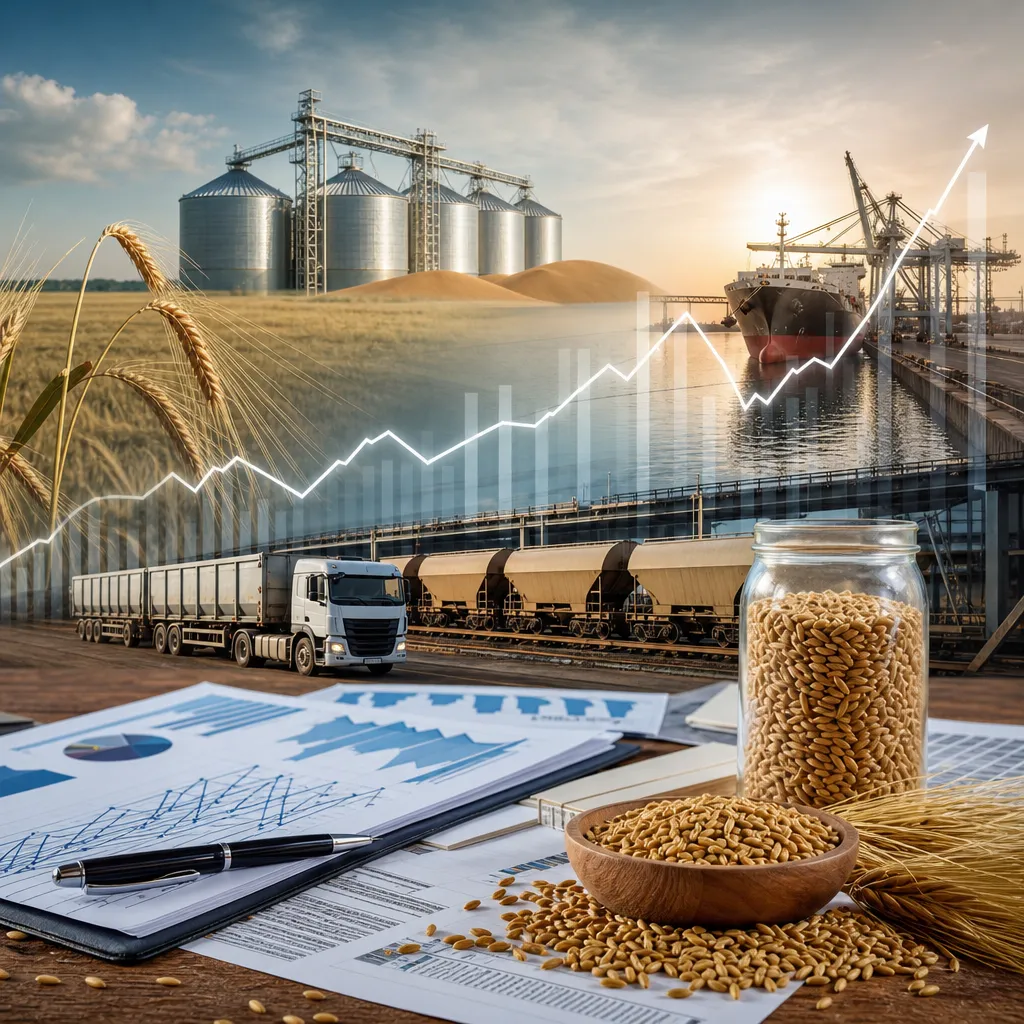
Barley price trends are driven by the same broad forces that move other grains, but barley has its own market structure: it is smaller than corn or wheat, quality matters more, and local cash prices often depend heavily on nearby feed demand, malt demand, and export access. In practice, there is no single “barley price” that applies everywhere. A reader who wants to understand barley prices needs to separate international benchmarks, futures-related signals from other grains, and actual local cash bids from elevators, maltsters, feed mills, merchants, and export buyers. That distinction is the key to using barley market information correctly whether you are farming, buying physical grain, hedging exposure, or analyzing trends.
What barley price trends really mean
Barley price trends refer to the direction and pattern of prices over time in both the physical grain market and related benchmark markets. Barley itself is widely traded in cash markets, but in many regions its price is also influenced by corn and wheat futures because feed users can substitute between grains, and because exporters compare barley against competing feed grains in world trade.
The practical point is that barley pricing usually has two layers:
- Reference market signals: broader grain market indicators such as wheat futures, corn futures, export demand, ocean freight, and currency moves.
- Local cash market pricing: the actual bid or offer for barley at a specific delivery point, with a specific quality specification, for a specific delivery period.
For a farmer or merchant, the local cash market matters most. For an analyst or trader, the trend often starts with broad grain fundamentals and then narrows to regional supply, quality, and logistics.
Where barley prices are quoted and checked
Unlike some grains with more concentrated benchmark futures activity, barley prices are often assessed through a mix of local physical bids, merchant indications, government reporting, and export market intelligence. Where you check prices depends on what you need.
Local cash prices
Farmers and physical grain sellers usually check barley bids through:
- local grain elevators and cooperatives,
- regional grain merchants,
- maltsters and brewers buying malting barley,
- feed mills and livestock integrators buying feed barley,
- exporters at port locations,
- agricultural market reporting services where available.
These bids may be posted on buyer websites, mobile apps, emailed bid sheets, or quoted directly by phone. In many physical markets, the most actionable price is still obtained by calling local buyers because barley quality specifications can vary significantly.
Exchange and benchmark signals
Barley does not always have a globally dominant futures contract equivalent to the role Chicago corn or wheat futures play in their markets. As a result, market participants often monitor:
- wheat futures and corn futures on regulated exchanges such as CME Group,
- regional exchange contracts where barley-related grain pricing exists,
- cash market assessments from trade publications or data vendors,
- government export and crop reports.
These are not the same as a local barley bid. They are indicators that help explain price direction.
Official and public data sources
Readers looking for broader market context normally use:
- USDA for global supply and demand, export sales, and crop data where relevant,
- FAO for international cereal market context,
- European Commission and national agricultural ministries for EU and country-level cereal information,
- national statistical agencies for production, area, stocks, and trade data,
- customs and trade databases for import and export flows.
| Price source | What it shows | Who uses it | Main limitation |
|---|---|---|---|
| Local elevator or cooperative bid | Actual nearby cash buying price at a delivery point | Farmers, local traders, feed buyers | Applies only to specific quality, location, and timing |
| Merchant or maltster quote | Bid for feed or malting barley under contract terms | Commercial growers, grain merchants | May require negotiation and quality approval |
| Futures market in related grains | Broader market direction for feed grain values | Traders, analysts, hedgers | Not a direct local barley price |
| Government crop and trade reports | Supply, demand, exports, imports, and production trends | Analysts, grain firms, producers | Published periodically, not a live bid |
How barley prices are formed in the physical market
Physical barley transactions are usually negotiated around a delivered or ex-farm cash price. The buyer may be an elevator, a cooperative, a merchant, a maltster, a feed compounder, a cattle feeder, or an exporter. Price formation depends on several practical terms, not just the market headline.
Key physical pricing variables
- Type of barley: feed barley and malting barley can trade at very different values.
- Quality: protein, moisture, test weight, germination, screenings, and contamination can all affect price.
- Delivery point: farm pickup, inland elevator, processor intake, or export terminal.
- Freight: trucking or rail costs can widen or narrow net farm prices.
- Timing: harvest movement, nearby demand, and storage availability matter.
- Payment terms: prompt payment, deferred pricing, or forward contracts change commercial appeal.
In export-oriented regions, barley may move from farm to local elevator, then to merchant storage, then by rail or truck to port. At each step, costs and margin requirements affect the value the original seller receives. A strong export market does not automatically produce a high farmgate price if inland freight or elevation costs are high.
Malting barley versus feed barley
This difference is critical. Malting barley may earn a premium, but only if it meets strict specifications and passes buyer acceptance. If the crop misses quality standards, it may be downgraded into feed channels. That quality risk is one reason barley price trends can look misleading if someone compares headline malting values with what average grain is actually trading for.
Main drivers of barley price trends
Barley prices usually move because of a combination of supply, substitution, and logistics. Forecasting should be approached as a set of scenarios rather than a certainty.
| Driver | Typical effect on barley | How market participants check it |
|---|---|---|
| Weather during planting and grain fill | Changes yield potential and can affect malting quality | Crop reports, weather services, satellite and field intelligence |
| Corn and wheat prices | Influences feed substitution and export competitiveness | Exchange futures data, cash grain quotes, merchant analysis |
| Malting demand | Supports premiums for suitable quality lots | Maltster contracts, brewing sector demand, merchant bids |
| Export demand and trade policy | Can tighten local supplies or depress values if export routes weaken | Customs data, government trade reports, port market intelligence |
| Currency moves | Affects competitiveness in international tenders | FX markets, export offers, trade desk commentary |
| Freight and storage capacity | Changes basis and farmgate realization | Local logistics providers, elevator capacity, port lineups |
In a bearish scenario, a large crop, weak malt demand, lower corn prices, and congested storage can pressure barley values. In a bullish scenario, weather problems, tight exportable supplies, premium malting quality, and strong nearby feed demand can all support prices. The trend often depends less on one global number than on the interaction between local quality and downstream demand.
Barley futures, related hedging tools, and their limits
In many regions, barley users do not hedge with a highly liquid local barley futures contract. Instead, they may use related grain futures, over-the-counter contracts, or fixed-price physical contracts with merchants. This is common but it creates basis risk, meaning the hedge instrument and the actual physical barley price may not move together perfectly.
How hedging works in practice
A farmer, feed mill, or merchant may use:
- related grain futures on a regulated exchange through a futures broker,
- options to protect against adverse price moves while retaining some upside,
- forward cash contracts with an elevator, cooperative, or merchant,
- OTC agreements negotiated directly with a commercial counterparty where permitted.
To trade futures or options, a participant normally needs a brokerage account with a firm that offers exchange access. That is financial trading, not the same as selling a truckload of physical barley. Futures involve margin, daily mark-to-market, and leverage risk. They are not a simple substitute for a local grain contract.
Why hedging barley is imperfect
If barley is hedged using wheat or corn futures, the hedge may protect general grain market direction but not local basis, barley-specific quality spreads, or malting premiums. A feed buyer may gain some protection against broad feed grain inflation, yet still face a regional shortage of acceptable barley. A grower may hedge nearby downside but still be exposed to grading risk if the crop does not meet malting standards.
Where buyers and sellers actually transact barley
Most barley is bought and sold in the physical market rather than by retail-style online commodity trading. The route depends on volume, quality, and end use.
Common physical market channels
- Grain elevators: aggregate farmer grain, set daily bids, arrange storage and onward shipment.
- Cooperatives: provide marketing, handling, and sometimes forward contracting for members.
- Grain merchants: buy, store, blend, and resell into domestic or export channels.
- Maltsters: contract malting barley directly or through approved supply chains.
- Feed mills and livestock operations: buy feed barley spot or under supply programs.
- Exporters: source inland grain for shipment through port facilities.
- Brokers: in some markets, arrange transactions between commercial counterparties without taking title.
Typical transaction flow
- The seller requests bids from one or more buyers for a specific quality and delivery period.
- The buyer quotes a cash price, often subject to quality, moisture, and weight confirmation.
- The parties agree on delivery point, freight responsibility, and payment terms.
- The grain is delivered, sampled, graded, and weighed.
- The final settlement is adjusted for quality premiums or discounts where applicable.
International trade adds more layers: export specification, inspection, vessel loading terms, and Incoterms. In that setting, a port price is still not the same as an inland farm bid because transport, elevation, financing, and risk costs sit between them.
How to analyze barley price trends properly
A sound barley market view usually combines cash intelligence with public data and cross-grain comparison.
Useful public reports and datasets
- USDA WASDE: broad global grain balance sheets and price context.
- USDA Production and related crop reports: useful when the United States or major competitors matter to feed grain balances.
- USDA Export Sales: relevant when comparing feed grain export demand.
- CFTC Commitments of Traders: useful for sentiment and positioning in related futures markets such as corn and wheat.
- FAO market updates: international cereal supply-and-demand context.
- National agriculture ministries or statistics offices: acreage, crop conditions, harvest estimates, and domestic stocks.
Commercial users often add subscription market-data services, physical cash assessments, weather analytics, and farm or grain merchandising software. Those tools help compare local bids, freight spreads, storage economics, and forward opportunities. They are designed more for decision support than for executing exchange trades.
What to compare week by week
- local cash barley bids,
- corn and wheat futures direction,
- quality spread between feed and malting barley,
- export tender activity and port basis where relevant,
- crop condition and harvest pace,
- currency and freight changes.
This approach is usually more informative than following a single headline chart.
Storage, basis, and seasonal price behavior
Barley price trends often show seasonal pressure at harvest and then depend on storage economics. If many sellers move grain at the same time, nearby prices can weaken. If storage is limited, the discount can deepen. If quality stores well and demand remains steady, deferred opportunities may appear later in the season.
But storage is not automatically profitable. The holder must consider:
- shrink and quality risk,
- aeration and conditioning requirements,
- warehouse or on-farm storage cost,
- interest on inventory,
- basis risk,
- the chance that feed grain markets fall while grain is being held.
Malting barley adds another layer: storage can preserve or damage premium value depending on handling and condition. If germination quality deteriorates, grain can lose malting status and fall back into feed channels.
Common mistakes when interpreting barley prices
- Assuming a futures quote equals a farmgate price: it does not.
- Ignoring quality terms: malting and feed barley are not interchangeable from a pricing standpoint.
- Overlooking freight: transport can explain a large gap between regions.
- Using only one data source: local bids, official reports, and related grain benchmarks should be cross-checked.
- Treating hedging as risk-free: margin calls, basis divergence, and grading outcomes still matter.
- Confusing online market data with executable physical offers: a chart is not a contract.
Where can I check current barley prices?
The most practical source is usually local buyers: elevators, cooperatives, merchants, maltsters, or feed mills posting cash bids or quoting directly. For broader context, use official crop and trade reports, exchange data in related grains, and national market reporting systems where available.
Is there a single global barley price?
No. Barley prices vary by country, quality, delivery point, and end use. Export values, port values, feed barley bids, and malting barley contract prices can all differ materially at the same time.
Can I trade barley online through a broker?
You may be able to trade related grain futures or options through a regulated futures broker, depending on your jurisdiction and broker offering. That is a financial market activity and is different from buying or selling physical barley through a merchant or elevator.
Why does my local barley bid differ from wheat or corn futures?
Your local bid includes regional supply and demand, basis, freight, storage, and quality factors. Wheat or corn futures only provide a broader market reference and may not track barley exactly.
How do farmers usually sell physical barley?
Most sell to nearby elevators, cooperatives, grain merchants, feed buyers, or maltsters. Sales can be made spot at current cash bids, forward under contract, or after storage if the seller believes the later price structure is favorable.
What should a buyer verify before purchasing barley?
Check quality specifications, grading method, moisture, test weight, contamination risk, delivery location, freight responsibility, storage condition, and payment terms. For malting barley, confirm the acceptance standards and rejection provisions in the contract.
Which reports matter most for barley trend analysis?
Use USDA balance-sheet and export reports for global feed grain context, FAO for international cereal developments, and local government crop and trade data for regional accuracy. Related futures positioning from CFTC can also help explain speculative sentiment in substitute grains.
Does storing barley always improve the selling price?
No. Storage may help if harvest pressure is temporary and quality is maintained, but costs, spoilage risk, financing, and weaker later markets can eliminate the benefit. The correct comparison is the expected future net price after all carrying costs.
Sources
- USDA World Agricultural Supply and Demand Estimates
- CME Group
- Food and Agriculture Organization of the United Nations