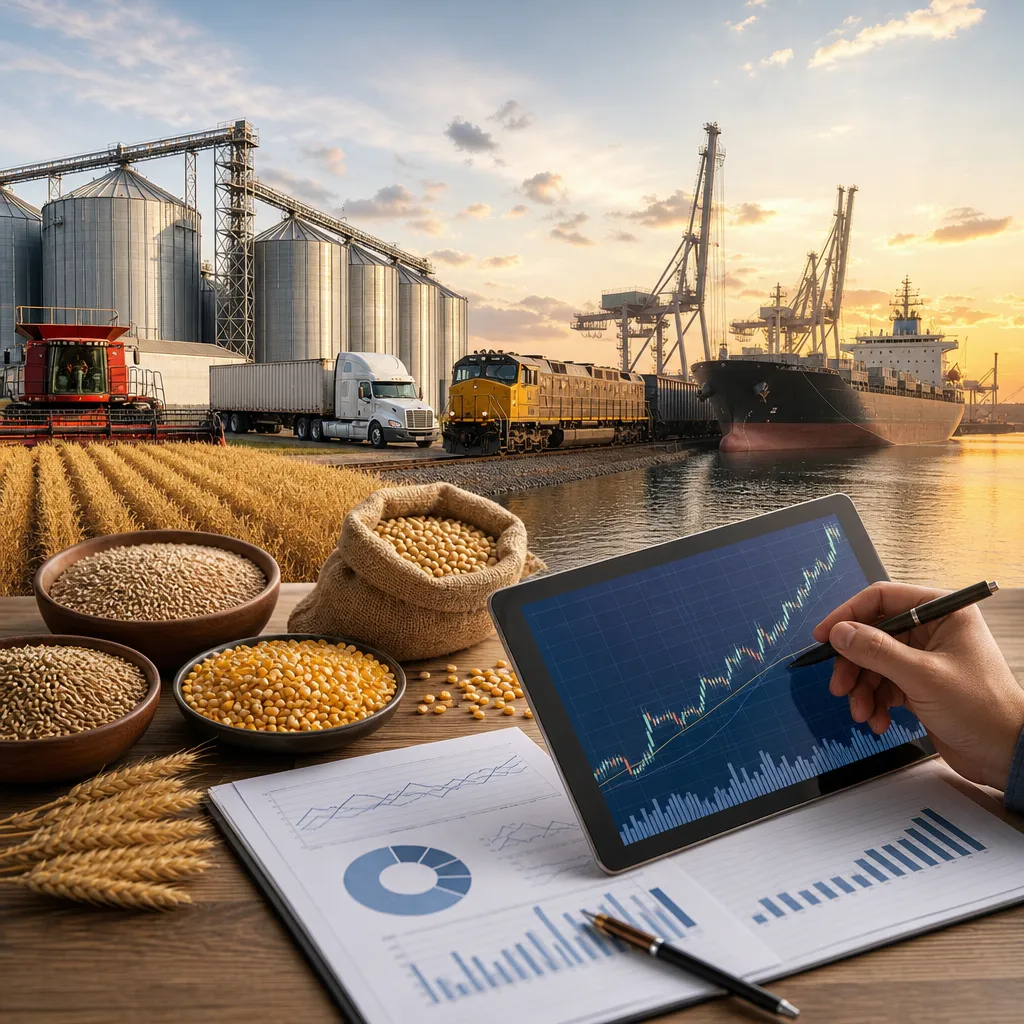






Wheat price trends are driven by a constant interaction between exchange-traded futures, local cash bids, weather, crop size, trade flows, currency moves, and logistics. For most readers, the key practical point is that the “wheat price” is not one single number: the futures market gives a benchmark, while the physical market determines what a farmer, miller, exporter, or feed buyer actually pays or receives at a specific location. To understand wheat price trends properly, you need to know where benchmark prices are quoted, where local bids are posted, and how basis, quality, freight, and timing change the final price. The most reliable way to track the market is to combine futures data from a regulated exchange with official crop and trade reports and local cash market information from elevators, cooperatives, merchants, or processors.
What wheat price trends really mean
When people talk about wheat price trends, they may be referring to several different markets at once. A futures chart may show whether wheat is trending higher or lower on a major exchange. A cash market report may show whether bids at country elevators or export terminals are improving. An import buyer may focus more on freight and export offers than on futures alone.
In practice, wheat prices move through two linked but different systems:
- Futures market: standardized contracts traded on regulated exchanges, used for price discovery, hedging, and speculation.
- Physical cash market: actual grain traded between farmers, elevators, cooperatives, merchants, millers, feed companies, and exporters.
A wheat trend can therefore be bullish in futures but weak in local cash terms if basis widens because of transport bottlenecks, storage pressure, or quality issues. The reverse can also happen if local demand is strong or export channels tighten nearby supplies.
Where wheat prices are quoted and how to read them
The most widely watched benchmark wheat prices are usually futures contracts traded on major commodity exchanges. In the United States, many market participants monitor wheat contracts listed by CME Group. These are financial and delivery instruments, not automatic cash purchase prices for every region.
Local physical wheat prices are usually checked through:
- country elevators and grain cooperatives,
- grain merchants and exporters,
- mills and feed manufacturers,
- brokered cash markets,
- government or regional agricultural market reporting services.
A local cash bid normally reflects:
- the relevant futures month,
- plus or minus a basis,
- adjustments for protein, moisture, test weight, or other quality factors,
- freight and handling costs,
- delivery period and destination.
This is why a reader should never assume that a headline futures quote is the same as a local farmgate or elevator price.
| Market type | What it shows | Where readers usually check it | Main limitation |
|---|---|---|---|
| Futures market | Benchmark price for standardized wheat contracts | Exchange websites, broker platforms, market data vendors | Does not equal local cash price |
| Local cash bid | Actual buying price at a delivery point | Elevators, cooperatives, merchants, mills, local reports | Varies by grade, location, timing, and freight |
| Export offer | Seller offer for shipment at port or destination terms | Export merchants, tender results, trade reporting services | Includes logistics and trade-term differences |
| Government market report | Reference prices and market commentary | USDA and other official reporting agencies | May be delayed or regional |
The main factors behind wheat price trends
Wheat prices are highly sensitive to changes in supply and demand, but the market reacts not just to current conditions. It also reacts to expectations. Traders, farmers, and buyers frequently price in likely outcomes before harvest or before official reports confirm them.
Supply-side drivers
- Acreage: more seeded area can increase expected production, though weather still matters.
- Yield: yield risk is often the biggest source of price volatility during the growing season.
- Weather: drought, freeze, excessive rain, heat, and harvest delays can all move prices quickly.
- Stocks: low carryout stocks generally make the market more sensitive to shocks.
- Quality: protein, falling number, moisture damage, and milling quality can separate one wheat market from another.
Demand-side drivers
- Food demand: milling demand is relatively steady but can shift by region.
- Feed demand: wheat competes with corn and barley in feed rations.
- Exports: import tenders, export taxes, sanctions, and freight changes can alter trade flows.
- Substitution: buyers may switch between classes of wheat or between wheat and other grains when price relationships change.
Macro and market structure drivers
- Currency movements: exchange rates affect export competitiveness.
- Energy and fertilizer: they shape production costs and farmer selling behavior.
- Freight and logistics: rail, barge, truck, and port disruptions can widen basis.
- Government policy: trade restrictions, quotas, subsidies, or phytosanitary rules can quickly affect values.
How wheat price discovery works in practice
Price discovery starts on exchanges but does not end there. Futures markets react instantly to news, forecasts, and order flow. Physical buyers then convert that benchmark into cash bids based on local conditions. A country elevator may post a bid linked to a nearby or deferred futures month, then add a basis level that reflects local supply, storage space, truck demand, and transportation economics.
For example, during harvest, local bids can weaken even if futures stay stable because elevators are flooded with deliveries and storage becomes scarce. Later in the season, basis may strengthen if on-farm stocks decline or if export or milling demand improves.
For exporters, physical price discovery may involve:
- origin procurement from elevators or merchants,
- quality aggregation and inspection,
- rail or truck movement to a terminal,
- port elevation and vessel loading costs,
- sale on FOB, CFR, or other Incoterms depending on trade practice.
That means international wheat values can diverge from inland prices even when futures appear unchanged.
Where farmers, traders, and buyers normally check wheat markets
Different users need different sources. A farmer looking to sell stored grain needs a local bid more than a global headline. A futures trader needs exchange data and positioning reports. A miller needs quality-specific supply information and delivered offers.
| Source type | What it provides | Typical users | How it is used |
|---|---|---|---|
| CME Group market data | Futures prices, contract specifications, expiry details | Traders, hedgers, analysts | Tracking benchmark price trends and hedging decisions |
| USDA reports | World and U.S. supply, demand, crop progress, export sales | Farmers, merchants, analysts, end users | Assessing fundamentals and changes in balance sheets |
| CFTC Commitments of Traders | Positioning by trader category in futures markets | Analysts, speculators, hedgers | Measuring speculative length or commercial hedging activity |
| Elevator or cooperative bid sheets | Cash bids by location and delivery period | Farmers and local buyers | Deciding whether to deliver, store, or forward contract |
| Commercial data services | Charts, news, export offers, basis data, analytics | Professional traders, procurement teams, researchers | Faster monitoring across regions and products |
Online, readers usually find benchmark prices on exchange or broker interfaces and official reports on agency websites. In the physical market, readers usually get actionable prices from elevator bid boards, merchant offers, cooperative contracts, mill bids, or brokered conversations.
Wheat futures, options, and hedging
Wheat futures allow market participants to hedge price risk or speculate on market direction. A futures contract is a standardized agreement listed on an exchange. It has a contract size, delivery specification, and expiry month. To trade it, a participant normally needs an account with a regulated futures broker or intermediary that offers exchange access.
Options on wheat futures give the right, but not the obligation, to buy or sell a futures contract at a set strike price before expiry. They are often used to manage downside or upside price risk while limiting exposure to some extent compared with outright futures.
Important practical distinctions:
- Hedging: a farmer may sell futures against expected production; a miller may buy futures against expected grain needs.
- Speculation: a trader without physical grain may trade futures purely for market exposure.
- Cash contract: a farmer selling to an elevator is entering a physical grain transaction, even if the buyer hedges that exposure on an exchange.
Main risks include margin calls, basis risk, contract mismatch, and timing risk. A futures hedge may protect against a broad market decline, but it does not eliminate changes in local basis or quality discounts. Exchange trading is online, regulated, and standardized; physical grain selling is location-specific, quality-specific, and often negotiated.
How physical wheat is bought and sold
Physical wheat trade usually starts with a seller offering grain to a local elevator, cooperative, merchant, processor, or feed buyer. The buyer quotes a cash bid for a certain delivery window and grade. The seller then chooses whether to sell spot, forward contract, store unpriced grain, or use another contract structure if offered.
A typical physical transaction may involve:
- Price inquiry: seller checks bids from elevators, cooperatives, or merchants.
- Contract decision: spot cash sale, forward cash contract, basis contract, hedge-to-arrive structure, or storage arrangement where available.
- Delivery: grain moves by truck, rail, or other local logistics to the contracted point.
- Inspection and grading: moisture, protein, foreign material, test weight, and damage are measured.
- Settlement: payment is made according to agreed terms, less any quality or service deductions where applicable.
Export trade is more complex and may include inland procurement, warehouse storage, blending, official inspection, phytosanitary requirements, port handling, and marine freight. Buyers and sellers may use brokers, but much international grain also trades directly through merchants and tender systems.
Storage, logistics, and their effect on trends
Wheat price trends are not just about production and demand. Storage and transport shape seasonality. Harvest pressure often pushes cash prices lower, especially where on-farm storage is limited. Later in the marketing year, if grain is tied up in farm bins or if transport capacity is constrained, basis can strengthen and support local prices even without a major futures rally.
Storage decisions depend on:
- carry in the futures market,
- local basis outlook,
- interest and financing cost,
- shrink and quality risk,
- bin condition, aeration, and pest control,
- available commercial storage and its terms.
Wheat quality can deteriorate in storage if moisture and temperature are not managed. A seemingly attractive delayed sale may become less profitable if grain loses grade or if storage, handling, and interest costs outweigh the later price improvement.
How to analyze wheat price trends intelligently
A practical wheat market analysis combines benchmark pricing, fundamental reports, and local conditions. A good workflow is:
- Check the futures trend: identify which exchange contract and delivery month the market is reacting to.
- Check the local basis: compare elevator or processor bids with the futures month used in the bid.
- Review official reports: use USDA balance sheets, crop progress, and export sales to understand broad supply and demand.
- Monitor weather: especially in major exporting regions during planting, dormancy break, heading, and harvest.
- Watch competing grains: corn and barley can affect feed wheat demand; currency changes can affect export competitiveness.
- Track logistics: port congestion, rail issues, river levels, and freight costs may explain basis changes better than futures charts alone.
For more advanced users, position data from the CFTC can help show whether speculative funds are heavily long or short. That does not predict price by itself, but it helps explain volatility and vulnerability to sharp reversals.
FAQ
Where can I check current wheat prices?
For benchmark futures, use a regulated exchange such as CME Group or a licensed broker or market-data platform that displays exchange prices. For the actual local price a farmer can receive, check elevator bid sheets, cooperative postings, merchant offers, processor bids, or regional official cash market reports. The local cash price may be very different from the futures quote because of basis, freight, and quality.
What is the difference between wheat futures and a cash wheat bid?
Wheat futures are standardized exchange-traded contracts used for price discovery and hedging. A cash wheat bid is a physical buying offer at a specific location and delivery period. The cash bid usually equals the relevant futures reference plus or minus basis, with quality and freight adjustments.
Can I buy physical wheat through a futures broker?
Usually, a futures broker provides access to financial contracts, not routine truckload or export grain procurement. Physical wheat is normally bought through grain merchants, elevators, cooperatives, mills, feed manufacturers, or import-export firms. Some futures contracts are deliverable, but exchange delivery is not the same as ordinary commercial grain purchasing.
What reports matter most for wheat price trends?
USDA reports are among the most important for many global participants, especially WASDE, Crop Progress, and Export Sales. CME Group contract information is essential for understanding the benchmark market. CFTC Commitments of Traders data helps analysts assess fund and commercial positioning in futures.
Why do local wheat prices sometimes fall during harvest even if futures are steady?
Harvest often increases immediate supply at delivery points. Elevators may lower basis because they are full, because trucking is congested, or because they must cover drying, handling, or storage pressure. In that case, the futures market may be unchanged while local cash bids weaken.
How do farmers usually hedge wheat prices?
Many farmers hedge by selling futures, buying put options, or using cash contracts offered by elevators or cooperatives that are linked to futures and basis. The exact method depends on storage, expected production, risk tolerance, and lender or merchandising arrangements. Hedging reduces some price risk but does not remove basis risk or production risk.
What should a buyer or seller check before making a physical wheat deal?
Check grade and quality specifications, protein and moisture terms, delivery location, basis or fixed price formula, freight responsibility, payment timing, inspection method, and any discounts or premiums. In export trade, parties should also confirm trade terms, shipment window, and documentation requirements.
Are wheat prices quoted in the same units everywhere?
No. Futures and cash markets may use different units such as bushels or metric tons, and protein or quality standards also vary by region. Before comparing prices, confirm the unit, currency, Incoterm if relevant, and whether the quote is futures, local cash, or export basis.
Sources
- USDA World Agricultural Supply and Demand Estimates
- CME Group wheat contract specifications and market data
- U.S. Commodity Futures Trading Commission Commitments of Traders