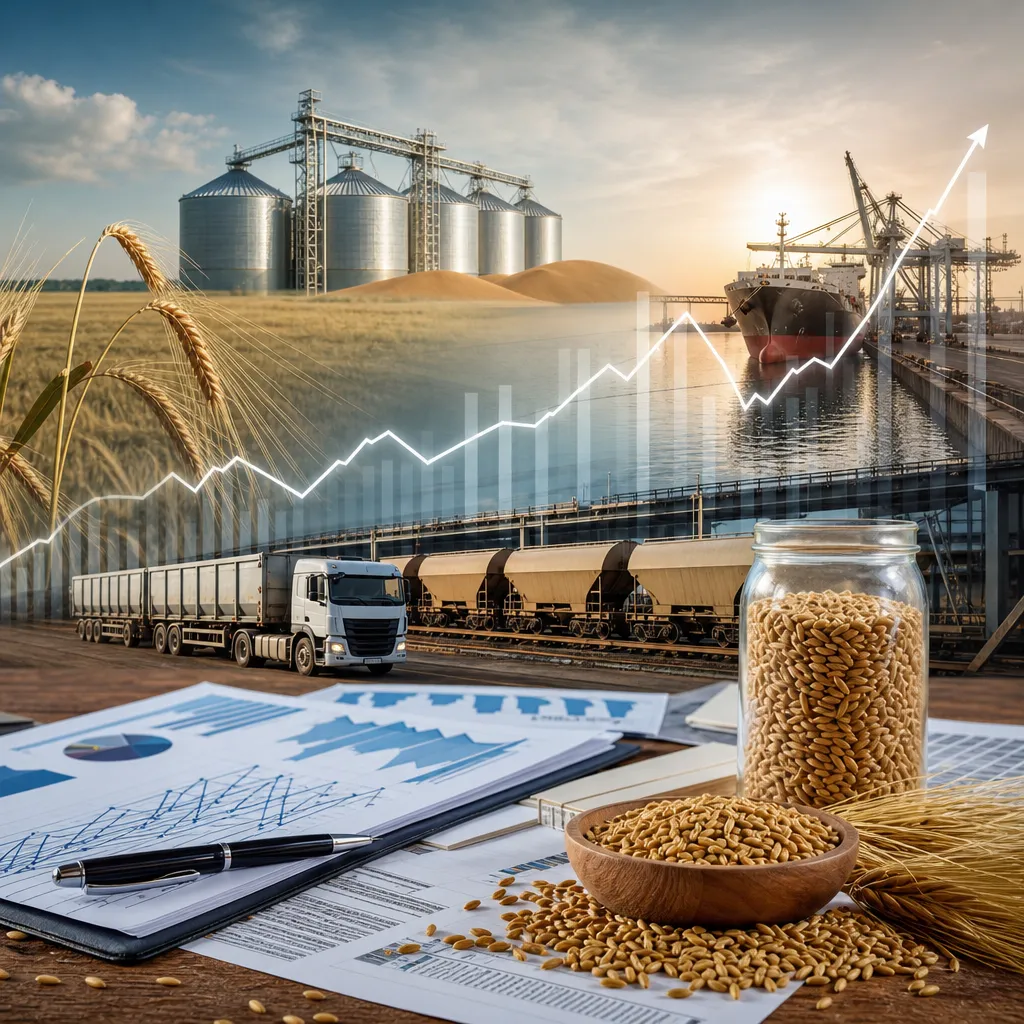

The EU grain price forecast refers to outlooks for wheat, corn, barley and related cereals traded across the European Union, with the most visible benchmark usually being Euronext grain futures and the most important physical reference points being inland collection markets, feed and milling demand centers, and export ports such as Rouen and other major shipping locations. The market operates across many countries, but France, Germany, Romania, Poland, Spain and Italy are especially important in price discovery because they are large producers, consumers, importers, or exporters depending on the crop and season. EU grain prices are normally discussed in euros per metric tonne, while global comparisons often involve Black Sea, US Gulf, or other FOB export benchmarks. Any forecast must be treated as a scenario, not a certainty, because weather, yields, policy, currency, logistics and global competition can all shift prices quickly.
For most market participants, there is no single “EU cash grain price” valid everywhere. A farmer in northern France, a feed mill in Spain, a merchant in Romania, and an exporter loading wheat for North Africa may all be looking at different prices for the same crop because location, quality, freight, and buyer competition matter. That is why understanding the difference between futures, basis, inland cash bids, and export values is essential before using any forecast or headline market comment.
What the EU grain market includes
The European Union is not one uniform grain market. It is a connected regional market made up of national and local physical markets linked by common trade rules, transport flows, and a shared currency in much of the bloc. The main grains followed in EU pricing are common wheat, corn, barley, and sometimes durum wheat, with rapeseed often watched alongside grains because it competes for acreage and influences farm marketing decisions.
France is central because it is a major wheat producer and exporter, and Euronext wheat futures are widely used as the benchmark for EU milling wheat price discussion. Germany and Poland are large producers with important inland markets. Romania and Bulgaria matter strongly in export competition through the Black Sea region of the EU. Spain and Italy are significant consumers and can be structurally import-dependent in some crops or qualities, especially when domestic production is reduced by drought.
In practical terms, the EU grain market includes:
- Farm-gate and silo bids in local cash markets
- Delivered prices to mills, feed plants, ethanol plants, or starch users
- Export bids at ports, usually discussed on an FOB basis
- Import prices into deficit regions, sometimes discussed on a CIF basis
- Futures and options used for hedging and price discovery
Where EU grain prices are formed
EU grain prices are formed through the interaction of physical supply and demand and financial price discovery. The benchmark most often followed for milling wheat is the Euronext wheat contract, historically associated with the old MATIF market. It is a futures market, not a local farm bid, but it provides a transparent reference used by merchants, processors, exporters, and risk managers.
Physical prices then adjust from that benchmark. A local cash bid may be above or below the futures market depending on basis. Basis is the difference between the local physical price and the relevant futures price. In the EU, basis is shaped by quality, transport cost, local competition among buyers, export demand, storage availability, and how urgently grain is needed in that location.
Major pricing layers include:
- Futures price: Exchange-traded benchmark for a standard contract month
- Cash bid: Immediate or near-term physical buying price in a local market
- Delivered price: Price including transport to a specified user or warehouse
- FOB price: Value of grain loaded at an export port, excluding ocean freight
- CIF price: Value delivered to an importing destination including freight and insurance concepts
| Price type | Where it is quoted | What it means |
|---|---|---|
| Euronext futures | Exchange screen | Benchmark futures value for a standardized contract month |
| Local cash bid | Elevator, cooperative, merchant, processor | Price a physical buyer offers in a specific inland market |
| Delivered mill/feed price | Private physical contracts | Price including delivery to the end user |
| FOB export bid | Port/export market | Price for grain loaded at port for export shipment |
| CIF import price | Import market tenders or trade offers | Delivered import value into a destination market |
How to read an EU grain price forecast properly
An EU grain price forecast is usually a directional view based on crop and trade scenarios rather than a precise number that every market will trade. A useful forecast asks whether EU wheat, corn or barley prices are more likely to strengthen, weaken, or stay range-bound under certain conditions. It should also separate old crop from new crop, because nearby supply can be tight while the next harvest outlook is comfortable, or the reverse.
For example, wheat prices in the EU may firm if production in key member states falls, export demand improves, and the euro weakens. The same market may soften if yields recover, imports become more competitive, or global wheat exporters offer cheaper grain. Corn may react more strongly to feed demand, import needs, and competition from Ukraine or other origins when logistics permit. Barley can be especially sensitive to feed substitution and regional export programs.
A practical forecast framework for the EU usually considers:
- Autumn and spring weather across major producing countries
- Winter survival and crop condition for wheat and barley
- Planting pace and summer stress for corn
- Harvest quality, especially protein, test weight, and moisture issues
- Export competitiveness into North Africa, the Middle East, and other destinations
- Import demand in deficit EU regions
- Euro exchange rate versus the US dollar
- Energy and fertilizer costs affecting margins and acreage decisions
- Biofuel, feed, milling, and livestock demand
- Competition from Black Sea, US, and South American exporters
Main drivers of the EU grain outlook
The biggest price driver is usually production risk. EU grain prices can change significantly when France, Germany, Romania or Poland face poor weather, or when Spain and Italy need more imported feed grain because of drought. Yield and quality both matter. A large crop with weak milling quality can still leave the high-quality wheat segment tight.
Currency is also crucial. Grain in the EU is mostly priced in euros, but international grain trade is heavily influenced by dollar-denominated competition. A weaker euro can support EU export competitiveness and sometimes raise internal price levels. A stronger euro can have the opposite effect by making EU grain less attractive to world buyers.
Logistics matter more than broad market commentary often suggests. Inland trucking, rail availability, river conditions, and port capacity can all shift local basis. So can policy and regulation, especially if trade flows are redirected or if phytosanitary, sustainability, or import control issues affect movement.
| Forecast factor | Typical effect on EU prices | Why it matters |
|---|---|---|
| Poor EU weather | Usually supportive | Reduces production or quality, tightening supply |
| Strong export demand | Usually supportive | Ports and exporters compete harder for grain |
| Weak euro | Often supportive | Improves EU competitiveness versus other exporters |
| Large global crops | Usually bearish | Limits export prices and caps rallies |
| High freight or internal logistics problems | Mixed | Can weaken farm bids inland while supporting destination prices |
| Strong feed demand | Supportive for feed grains | Boosts consumption of corn, feed wheat, and barley |
Where to check EU grain prices and market information online
For benchmark futures, Euronext is the core reference for EU wheat and related agricultural futures. Prices there reflect exchange trading, not the exact physical bid in a local market, but they are essential for understanding broader sentiment and hedging levels.
For European supply, demand and trade balance information, the European Commission is a key source, especially through its agriculture market information and monitoring materials. Eurostat is useful for official trade and agricultural statistics, although it is generally better for structured data than for day-to-day market timing. USDA reports are also widely used by traders because they place the EU in the global grain balance and allow direct comparison with other exporters and importers.
For local physical prices, farmers and local traders usually check:
- Cooperative and merchant bid sheets
- Processor buying indications from mills, feed compounders, starch plants, or ethanol users
- Broker market commentary and cash indications
- Port market reports where available
- National market reporting services when a member state publishes them
Readers should keep in mind that online futures prices may update continuously, while physical cash bids may change less often and can be private, negotiated, or dependent on quality. A futures quote is therefore not the same as the price a farmer receives at loading.
How grain is actually bought and sold in the EU physical market
Most grain in the EU is traded physically through cooperatives, grain merchants, processors, feed mills, and exporters. A farmer usually sells to a local buyer under a spot contract, a forward contract for future delivery, or a pool arrangement depending on the country and commercial structure. The contract normally specifies the commodity, quality terms, delivery period, location, and payment terms.
Quality matters a great deal. Milling wheat may require standards for protein, Hagberg falling number, specific weight, moisture, and impurities. Feed wheat and feed barley typically have different commercial priorities. Corn often trades with close attention to moisture, drying cost and mycotoxin risk when relevant.
Export grain moves from inland stores to ports by truck, rail, barge, or combinations depending on geography. Exporters buy inland, assemble volume, manage quality, hedge flat price risk, and sell to overseas buyers on an FOB basis. Importers in deficit regions may buy on CIF or delivered terms, especially when they need grain brought into a consumption zone rather than sourced locally.
In short:
- Physical trade transfers ownership of real grain
- Contract terms define quality, delivery and payment
- Location changes the price significantly
- Export parity and import parity can anchor inland values depending on regional balance
How futures and options are used for EU grain hedging
Futures and options are mainly risk-management tools, although they are also used by speculators. In the EU grain context, a merchant, processor or exporter may use Euronext futures to hedge flat price exposure while continuing to negotiate the local basis physically. This is why someone can be active online in the futures market without taking delivery of exchange grain.
A farmer or cooperative may watch futures to decide when to price part of a crop. An exporter may buy grain physically from inland sellers and sell futures to protect against a drop in benchmark prices before the export shipment is completed. A mill may buy futures or options to manage input price risk while still sourcing physical wheat from its normal suppliers.
Key distinctions are important:
- Futures require a brokerage account and involve margin and leverage
- Options can provide price insurance-like structures with different risk profiles
- Physical grain contracts are commercial agreements outside the exchange
- Basis risk remains even when futures are hedged, because local cash values can move differently from the benchmark
For many commercial participants, the real task is not predicting the exact futures settlement but managing the relationship between the benchmark and their local physical exposure.
Practical forecast scenarios for EU grain
A balanced EU grain price forecast should present scenarios rather than one fixed outcome. The same benchmark can behave differently depending on whether the market is focused on weather risk, export pace, global competition, or currency.
Bullish scenario: adverse weather cuts yields or quality in major EU producers, export demand improves, competing origins lose competitiveness, and the euro softens. Under this setup, futures and export values may strengthen, while local bids in surplus regions improve if exporters and domestic users compete.
Neutral scenario: production is adequate, stocks are manageable, and global supply is not tight enough to trigger a major move. Prices may then trade in a range, with local basis doing more work than the futures market.
Bearish scenario: EU harvest results are strong, export demand is slower, imports are competitively priced into deficit areas, and global crops are comfortable. In that case, benchmark futures can soften and inland cash bids may come under seasonal pressure, especially during harvest or in areas with storage constraints.
These scenarios are most useful when matched to the crop calendar. Pre-harvest, weather risk dominates. During harvest, quality and logistics become critical. After harvest, export pace, internal consumption, and stockholding behavior take larger roles.
Frequently asked questions
What is the main benchmark for EU wheat prices?
The benchmark most widely followed is Euronext milling wheat futures, quoted in euros per metric tonne. It is a futures market benchmark, not a universal physical cash price for every EU region.
Where can I check EU grain prices today?
For benchmark futures, check Euronext. For wider supply and trade context, check European Commission market information and USDA global grain reports. For actual local cash bids, check cooperatives, merchants, processors, or regional market reporting services in the relevant EU country.
Why is my local grain bid different from the futures price?
Because your local bid reflects basis, which includes transport, quality, buyer demand, storage, handling costs, and regional supply-and-demand conditions. Futures are only the benchmark portion of the price.
Are EU grain prices always quoted in euros?
Most EU benchmark discussion is in euros per metric tonne, especially on Euronext and in euro-area physical trade. However, international comparisons and some export trade analysis may also be discussed in US dollars.
How is grain exported from the EU?
Exporters buy grain inland, assemble and store it, move it to port by truck, rail or barge where possible, and sell it to overseas buyers, often on an FOB basis. Port values then influence inland prices after freight and handling are considered.
Can a farmer hedge EU grain prices online?
Yes, but that usually means using futures or options through a broker, not selling physical grain directly on an exchange screen. Many farmers instead hedge indirectly through merchants, pools, or forward cash contracts linked to exchange benchmarks.
What matters more for EU grain prices: local weather or world markets?
Both matter. Local weather can sharply affect EU yields and quality, while world markets influence export competitiveness and the broader price ceiling or floor. EU prices often reflect the interaction of local crop conditions with global grain balances.
What is the difference between FOB and CIF in the grain trade?
FOB refers to the price at the export port before ocean freight. CIF refers to the cost of grain delivered to the importing destination, including freight and related delivery components. The two prices are connected but not interchangeable.
Sources
- Euronext
- European Commission, Agriculture and Rural Development
- USDA Foreign Agricultural Service