




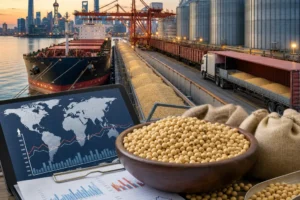

China’s rice market is one of the world’s most important grain markets because China is both a major producer and the largest rice-consuming country. The market operates mainly inside mainland China, where paddy rice is grown, milled, stored, traded, and distributed through a large domestic system shaped by government policy, reserve management, import controls, and regional supply differences. Prices are usually discussed in Chinese yuan, often on a per metric ton basis in wholesale trade, while farm and retail markets may also use local units or pack prices. For international comparison, traders often watch Asian export rice benchmarks such as Thai, Vietnamese, or Indian offers, but China’s domestic rice prices are not a simple copy of those export quotes.
To understand the China rice market outlook, it helps to separate three layers: the physical paddy and milled rice market inside China, the policy and reserve system that strongly influences supply and pricing, and the smaller but still important import channel that links China to world rice trade. Readers looking for “current” prices should be careful: a futures quote, a wholesale quote, an import offer, and a farm-gate paddy price are different things. The outlook depends not only on crop conditions and demand, but also on procurement policy, stocks, regional logistics, currency moves, and the competitiveness of imported rice.
What the China rice market means
In practical terms, the China rice market covers several connected products and stages:
- Paddy rice, bought from farmers after harvest.
- Milled rice, sold by mills into wholesale, foodservice, retail, and institutional channels.
- Rice by-products, including bran and broken rice, which affect milling economics.
- Imported rice, which competes in some segments of the market.
Geographically, rice production is spread across major growing regions in southern and central China and parts of the northeast. The market is not perfectly uniform. Quality, variety, harvest timing, freight costs, and local government actions can create significant regional differences between northeast japonica rice areas and southern indica rice markets.
China is primarily a domestic rice market rather than a classic export-driven market. Its role in global trade matters because even modest changes in Chinese imports can influence Asian exporters, but the center of gravity remains internal consumption, reserve management, and regional redistribution within the country.
Where the market operates inside China
China’s rice market functions through a chain that starts in producing provinces and ends in urban consumption centers. Paddy is sold by farmers to local collectors, cooperatives, mills, or state-linked buyers. Mills then process and distribute rice to wholesalers, retailers, food companies, public institutions, and catering channels.
Production patterns differ by region:
- Southern and central provinces are important for indica rice.
- Northeastern provinces are important for japonica rice, often associated with premium table rice segments.
- Urban coastal markets are key consumption and distribution centers and may also receive imported rice through ports.
Logistics matter. Rice moves by truck, rail, and inland waterways depending on origin and destination. Freight costs can widen the gap between origin-market paddy values and delivered rice prices in consumption areas. Because rice is bulky and quality-sensitive, storage, drying, and milling infrastructure also affect local price behavior.
| Market layer | Where it operates | Main users | Typical pricing basis |
|---|---|---|---|
| Farm-gate paddy market | Producing counties and local collection points | Farmers, collectors, local mills, procurement entities | Yuan per metric ton, adjusted for moisture and quality |
| Wholesale milled rice market | Regional and urban wholesale hubs | Mills, wholesalers, distributors, institutional buyers | Yuan per metric ton or packaged trade price |
| Import market | Ports and coastal distribution channels | Importers, traders, processors, distributors | CIF or landed price, then domestic delivered basis |
| Policy and reserve transactions | State reserve system and organized auctions | Government-linked entities, mills, qualified buyers | Auction or policy-guided pricing |
How rice prices are formed in China
Rice prices in China are formed through a mix of market forces and policy influence. This is not a purely free-market grain system, especially for staple grains with strategic importance. The most important drivers are:
- Domestic production and harvest quality
- Government procurement and reserve policy
- Stocks held in commercial and state channels
- Consumer demand by variety and quality segment
- Import availability and import policy
- Freight, storage, drying, and milling costs
- Competition among mills, wholesalers, and distributors
In the physical market, paddy rice is usually priced according to variety, moisture, impurity, grain quality, and location. A buyer offering for paddy in a producing area is not buying the same thing as a wholesaler buying milled rice in a city market. Milling yield matters: the mill converts paddy into saleable rice and by-products, so its bid reflects expected sale prices for all outputs and processing costs.
China’s market can also be affected by minimum purchase policies or other support mechanisms when they apply. Reserve buying can put a floor under some segments of the market, while auction releases from reserves can increase available supply and weigh on prices in consuming channels. Because of this, local rice prices may not always move in line with world export rice prices.
Cash prices, import prices, and futures: how to avoid confusion
Readers often mix together several very different prices. In China’s rice market, these are not interchangeable:
| Price type | What it means | Why it differs from another price |
|---|---|---|
| Farm-gate cash price | What a local buyer offers for paddy at origin | Reflects local supply, quality, moisture, and nearby buyer competition |
| Wholesale rice price | Price for milled rice sold into regional or urban trade | Includes milling economics, packaging, transport, and demand by grade |
| Delivered price | Price including transport to a named destination | Depends on freight, distance, and handling costs |
| Import CIF or landed price | Cost of imported rice delivered to port before or after import charges and inland distribution | Reflects global export offers, ocean freight, currency, and trade policy |
| Futures price | Exchange-traded benchmark for a standardized contract | Not the same as local cash rice because quality, delivery point, and basis differ |
The difference between a benchmark and a local cash price is often called basis. Basis reflects location, transport, quality, timing, storage, and local supply-demand conditions. Even if a relevant futures market is watched by traders, a farmer or mill in China still buys and sells physical grain on a cash basis.
It is also important not to treat a futures quote as the exact price paid in a Chinese county market. Futures are standardized financial and commercial hedging instruments; physical prices are negotiated around the realities of local supply chains.
Where to check China rice prices and market information online
If you need up-to-date rice market information, the safest approach is to use official or institutional sources and then compare them with physical trade indications from local market participants. Reliable places to monitor the market include:
- National Bureau of Statistics of China for production and broader agricultural statistics.
- National Food and Strategic Reserves Administration for policy, reserve-related information, and market-relevant notices.
- USDA Foreign Agricultural Service for structured reporting on China’s rice production, consumption, stocks, and trade outlook.
- FAO for international rice market context and global benchmark trends.
- Local grain exchanges, wholesale market bulletins, mills, and merchants for practical spot-market indications where available.
For a current physical price, readers should check the exact market type: paddy at origin, wholesale milled rice, or imported landed rice. These can move differently on the same day. Local cash prices are best confirmed by contacting mills, grain merchants, cooperatives, or regional wholesale markets, because online benchmark data may lag or may describe a different quality or location.
How rice is actually bought and sold in China
The physical rice trade in China is still relationship-driven and quality-driven. Online information helps with price discovery, but actual transactions normally occur through established commercial channels.
Physical market
Farmers usually sell paddy after harvest to one of several buyers:
- Local collectors or assemblers
- Rice mills
- Cooperatives
- Policy-related procurement channels where applicable
The sale terms can include delivery at the farm, collection point, warehouse, or mill. Buyers assess moisture, impurities, variety, and expected milling quality. Payment terms, weighbridge procedures, and quality deductions matter as much as the headline price. For larger commercial trade, merchants and mills may contract forward with suppliers or negotiate delivered terms to urban customers.
Imported rice enters through licensed trade channels, moves through ports, and is then sold into wholesale or processing channels depending on the product segment. Importers and distributors compare landed cost with domestic alternatives and with the quality preferences of end users.
Futures and hedging
Where an exchange-traded rice contract is relevant, futures are used mainly for price risk management and trading exposure rather than for ordinary consumers or most small physical sellers. Access normally requires a brokerage account, margin funding, and an understanding of contract expiry, delivery terms, and basis risk.
A hedger does not need to deliver or receive physical rice in every case. For example, a commercial firm may use futures to offset part of its price exposure while continuing to buy and sell real grain in the cash market. This is very different from simply purchasing physical paddy or milled rice from a merchant.
Anyone studying China’s rice outlook should keep the distinction clear: physical grain ownership happens through mills, merchants, warehouses, and logistics; financial price exposure happens through exchange-traded instruments and brokerage accounts.
China’s import role and connection to global rice trade
Although China is a giant producer, imports still matter in some years and market segments. Imported rice can be competitive because of price, quality, or availability in particular classes. This gives the domestic market an external reference point, especially in coastal and trading centers.
Global benchmarks often come from Asian export origins where rice is quoted on an FOB basis. Importers then convert those offers into a landed or CIF cost for China, adjusted for ocean freight, insurance, currency, import policy, port costs, and inland distribution. That imported rice price is then compared with domestic alternatives.
For this reason, changes in Asian export offers, exchange rates, and freight conditions can affect China’s rice outlook even when domestic supply is large. But the impact is filtered through policy and market segmentation. A low international quote does not automatically force all Chinese domestic prices lower.
Market outlook: the main scenarios to watch
A practical outlook for China’s rice market should be framed in scenarios rather than certainty. The market can move differently depending on weather, policy, stocks, and trade conditions.
| Scenario | Conditions | Possible market implication |
|---|---|---|
| Stable crop and stable policy | Normal weather, manageable stocks, steady demand | Prices may remain relatively range-bound with regional quality spreads |
| Weather stress or quality problems | Flooding, heat, disease, harvest delays, lower milling quality | Tighter local supply and stronger premiums for preferred quality |
| Heavy reserve releases | More grain made available through state channels | Additional supply may soften some domestic price segments |
| Cheaper imports | Lower world prices, favorable freight or currency conditions | Imported rice may pressure certain coastal or price-sensitive segments |
| Higher logistics or processing costs | Rising freight, energy, labor, or storage expenses | Delivered and wholesale prices may firm even without a major crop problem |
The most important practical variables to monitor are crop weather during planting and grain filling, harvest progress, reserve auction activity, import economics, and consumer demand by quality segment. In China, policy signals can matter almost as much as agronomy.
Practical guidance for traders, mills, and market observers
For commercial users, the right approach depends on whether the goal is physical procurement, merchandising, import analysis, or hedging.
- For physical buyers: track local paddy availability, moisture, and milling quality; compare origin and delivered costs; verify counterparty reliability and warehouse conditions.
- For mills: watch not only paddy cost but also milled rice selling prices, by-product values, and inventory turnover.
- For import-focused traders: compare global offers with Chinese landed economics after currency and logistics adjustments.
- For hedgers: understand that futures reduce price exposure but do not remove basis risk, quality risk, or execution risk in the physical market.
- For analysts: separate policy-driven price moves from purely supply-demand moves.
In short, the China rice market outlook is best read as a combination of domestic crop conditions, state management, and selective linkage to world trade. It is a large internal market first, and an international trade story second.
Where can I check current rice prices in China?
Check official Chinese statistical and policy bodies for market context, then confirm spot values through local mills, merchants, wholesale markets, and trade bulletins. USDA and FAO are useful for broader context, but local cash prices must be verified within the specific region and product type.
Are China rice prices quoted in yuan or dollars?
Domestic prices are usually discussed in Chinese yuan, commonly per metric ton in wholesale and commercial trade. International import comparisons may involve U.S. dollars for FOB or CIF offers before conversion into landed domestic cost.
Is there a single national rice price for all of China?
No. Prices vary by province, variety, grade, moisture, milling quality, and freight distance to the buyer. Northeast japonica markets and southern indica markets can behave differently.
How do imported rice prices affect the domestic market?
Imported rice affects the market mainly through segments where imported product is competitive on price or quality. The impact is usually strongest in tradable, coastal, or price-sensitive channels rather than every inland market.
Can a farmer or merchant hedge China rice price risk with futures?
Potentially yes, if a relevant exchange contract and brokerage access are available, but futures hedge benchmark risk rather than every local cash-market risk. Basis, quality, and delivery differences remain important.
What is the difference between paddy rice price and milled rice price?
Paddy rice is the rough grain bought from farmers before processing. Milled rice is the finished product after processing, so its price includes milling yield, by-product value, processing cost, packaging, and distribution.
What are the biggest drivers of the China rice market outlook?
The main drivers are domestic production, weather, reserve policy, stock levels, regional logistics, consumer demand by quality segment, and the competitiveness of imports.
Sources
- USDA Foreign Agricultural Service
- National Bureau of Statistics of China
- Food and Agriculture Organization of the United Nations