

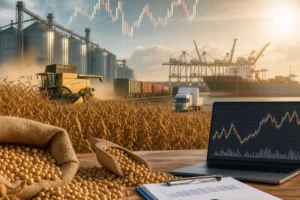








China is the world’s most important soybean import market and one of the key drivers of global oilseed pricing. In practical terms, “China soybean supply and demand” refers to the balance between domestic production, crushing demand, feed demand, edible oil consumption, inventories, imports, and policy influence inside mainland China. The market operates mainly through China’s inland crushing and feed sectors, major import-oriented coastal zones, and the Dalian Commodity Exchange for soybean-related futures. For anyone following price risk, the essential point is that China’s soybean market is shaped by both global benchmarks and domestic realities such as import margins, currency, logistics, and government policy.
Geographically, this is a mainland China market topic, with supply linked to domestic producing provinces in the northeast and demand concentrated around crushers, feed mills, and livestock production centers. China usually trades soybeans physically in metric tons, while futures and international benchmarks may use different quote conventions depending on the market. Domestic prices are commonly discussed in renminbi, also known as yuan, while imported soybeans are strongly influenced by U.S. dollar-denominated international trade values. Because China is a major importer rather than a major soybean exporter, the country’s soybean balance depends heavily on seaborne arrivals and crushing economics.
Anyone analyzing this market should separate three layers: global soybean benchmarks, China import economics, and local delivered or plant-level prices. A futures quote is not the same as a crusher’s delivered soybean cost, and a port offer is not the same as an inland user’s final purchase price. Understanding those distinctions is essential for reading the market correctly.
What China soybean supply and demand means
At country level, soybean supply in China comes from two main sources: domestic production and imports. Domestic output matters, especially for local food-use beans and some regional supply, but imported soybeans usually dominate the overall balance because China’s crushing sector requires large volumes for soymeal and soybean oil production.
Demand is best understood through end-use channels:
- Crushing demand: Soybeans are processed into soymeal and soybean oil.
- Feed demand: Soymeal is a major protein ingredient for hog, poultry, and aquaculture feed.
- Food demand: Some soybeans are used directly for tofu, soy foods, soymilk, and specialty products.
- Inventory demand: Commercial stocks at ports, crushers, and downstream users can tighten or loosen nearby market conditions.
Because China’s livestock and feed sectors are so large, soybean demand is closely connected to animal production margins and feed consumption. Soybean oil demand also matters, particularly for the edible oil balance. As a result, soybean prices in China often react not only to soybean supply itself, but also to hog margins, feed demand, crush margins, palm oil values, rapeseed supply, and the condition of the broader vegetable oil market.
Where the market operates inside China
China’s soybean market is not a single location. It functions through a network of producing areas, import gateways, crushers, feed mills, storage facilities, and futures trading venues.
On the supply side, domestic soybeans are associated mainly with northeastern provinces, where the crop has long been part of regional agriculture. On the import side, the most commercially important market activity is tied to coastal receiving areas where soybeans arrive by vessel, enter port storage, and move to crushing plants or inland consumers.
In market practice, participants often watch several locations at once:
- Northeast production zones: relevant for domestic crop conditions and internal supply.
- Coastal import and crushing zones: relevant for imported bean arrivals, port stocks, and crush demand.
- Inland feed and livestock regions: relevant for soymeal demand and replacement economics.
- Dalian Commodity Exchange: relevant for futures-based price discovery and hedging within China.
Major logistics are typically seaborne imports into coastal China, followed by storage, crushing, or inland transportation. The exact delivered value paid by a feed mill or processor depends on port costs, inland freight, timing, and local competition among buyers.
China’s role in the global soybean market
China is structurally important because it is a leading buyer of globally traded soybeans. That means Chinese demand influences export programs in major supplier countries and can affect international futures and export basis levels. When Chinese import demand is strong, global exporters, freight markets, and oilseed traders pay close attention. When China slows purchases, changes import pace, or crush margins weaken, the global market usually notices quickly.
Domestic production is meaningful for local balance and policy, but China’s overall soybean supply is still strongly tied to foreign origins. In practical terms, the country’s import role means that its soybean market is highly exposed to:
- International soybean prices
- Ocean freight and arrival timing
- Currency movements between the renminbi and the U.S. dollar
- Trade policy and phytosanitary rules
- Competitive availability from major exporting countries
For this reason, China soybean analysis is never purely domestic. It is a domestic demand story layered onto a global import chain.
| Market element | Where it operates | Why it matters |
|---|---|---|
| Domestic soybean production | Mainly northeastern producing provinces | Supports internal supply, especially for domestic channels and local market sentiment |
| Imported soybeans | Coastal receiving and crushing areas | Core source of beans for China’s crushing sector |
| Soymeal demand | Feed mills and livestock production regions | Main driver of crush demand and bean consumption |
| Soybean oil demand | Edible oil supply chain nationwide | Influences crush margins and product values |
| Futures price discovery | Dalian Commodity Exchange | Provides domestic risk-management reference for market participants |
How soybean prices are formed in China
China soybean prices are formed through a combination of international and domestic factors. The starting point for imported soybeans is usually the global market, particularly export values from major origins and internationally watched futures benchmarks. But the final price inside China is not simply “the world price translated into yuan.”
Several layers shape the local price:
- Global benchmark: international soybean futures and exporter offers help set the basic market direction.
- Import basis and origin premium: physical export values differ from futures based on origin availability, loading conditions, and buyer demand.
- Freight and insurance: seaborne import cost affects landed value.
- Currency: a weaker renminbi can raise local import costs even if dollar prices are unchanged.
- Port and logistics costs: unloading, storage, financing, and inland transport all matter.
- Crush margin: crushers value soybeans based on expected soymeal and soybean oil returns.
- Domestic supply and stocks: nearby tightness at ports or crushers can support cash prices.
- Policy and trade conditions: import rules, inspection processes, and broader policy signals can affect market behavior.
In practice, readers should distinguish between several price types. A futures price is a standardized exchange quote for a contract month. A cash price is the actual physical price for soybeans at a location such as a plant, warehouse, or port. A delivered price includes transport to a specific buyer. A FOB price refers to grain loaded for export at origin, while a CIF price includes cost, insurance, and freight to the destination. Basis is the difference between a local cash price and a relevant futures benchmark.
This means two buyers inside China can pay different prices for the same commodity on the same day if quality, timing, freight, credit terms, or location differ.
Dalian futures, global benchmarks, and the physical market
The Dalian Commodity Exchange is central to soybean-related price discovery in China. It is relevant for processors, traders, and commercial firms managing domestic price exposure. The exchange is used for futures and risk management, but it should not be confused with the entire physical soybean market.
China market participants may watch both domestic futures and offshore soybean benchmarks. The relationship works broadly like this:
- International futures and export values influence the cost of imported soybeans.
- Dalian futures reflect domestic expectations for Chinese soybean-related supply, demand, and processing economics.
- Physical soybeans are still bought and sold through commercial channels, not merely by looking at a screen quote.
A crusher might hedge part of its exposure through futures, but it still needs to source actual beans, arrange logistics, manage quality, and process the crop. A trader may use futures to manage price risk without taking delivery. A feed company may care more about soymeal pricing than soybean ownership itself, even though soybean demand upstream affects its costs.
| Price or market type | Typical meaning | Main users |
|---|---|---|
| International futures benchmark | Global reference for soybean market direction | Exporters, importers, analysts, hedge users |
| Dalian futures | Domestic Chinese futures reference and hedging tool | Crushers, domestic traders, commercial risk managers |
| Port cash price | Physical soybean value at import-receiving locations | Importers, crushers, merchants |
| Delivered plant price | Actual cost delivered to a crusher or end user | Processors, feed users, procurement managers |
| Basis | Difference between local cash and futures benchmark | Hedgers, merchandisers, market analysts |
How soybeans are actually bought, sold, imported, and hedged
Physical market
Physical soybean trading in China normally takes place through commercial supply chains rather than directly on a futures exchange. Buyers and sellers may include importers, crushers, merchants, feed companies, food-use buyers, and storage operators. Transactions are typically negotiated around quantity, quality, delivery point, delivery period, payment terms, and logistics responsibility.
Imported soybeans are generally purchased through international trade channels, shipped into China, and then sold onward to crushers or traders. Domestic soybeans move through local collection, merchanting, processing, and food-use channels. The buyer’s true cost depends on the contract structure and delivered location, not just on a headline market number.
Practical commercial considerations include:
- Protein or other quality specifications where applicable
- Imported versus domestic origin preference
- Port inventory and vessel arrival timing
- Credit, payment, and counterparty reliability
- Storage and inland freight availability
Futures and options market
Futures and options are financial risk-management instruments, not the same thing as buying physical soybeans for processing. Participation normally takes place through a licensed broker or futures intermediary, subject to account rules, margin requirements, and exchange procedures. These tools are used to hedge adverse price moves or to take market views, but they also involve leverage and basis risk.
A crusher can hedge price exposure in futures while still negotiating physical cargoes separately. A trader can hold a futures position without owning a vessel shipment. That distinction is critical: futures exposure is financial; physical soybean ownership is commercial and logistical.
Where to check soybean prices and market information
For reliable market monitoring, readers should use official or well-established sources and understand what each source actually shows. No single screen gives the entire China soybean market.
Useful places to check include:
- Dalian Commodity Exchange: for official futures market information relevant to China’s domestic derivatives market.
- USDA: for global soybean supply, demand, trade, and China balance-sheet context through reports such as WASDE and other oilseeds publications.
- National Bureau of Statistics of China: for broader official statistical context on agriculture and the economy.
- Commercial broker and market data platforms: for futures access, charting, and price monitoring where permitted.
- Merchants, crushers, and feed companies: for real-world physical indications, offers, and nearby procurement conditions.
Readers looking for a “current China soybean price” should be careful to identify exactly what they are seeing: futures or cash, imported or domestic beans, port or inland delivery, yuan or U.S. dollars, and the relevant date. Local cash prices can diverge significantly from futures because of freight, timing, quality, and basis.
Main drivers and outlook scenarios
China soybean supply and demand should be viewed through scenarios rather than certainty. The market can tighten or loosen depending on how several variables interact.
- Domestic crop conditions: weather and planted area influence local availability.
- Import pace: cargo timing and importer buying patterns affect port supply.
- Crush margins: stronger soymeal and soybean oil values tend to support crushing demand.
- Livestock sector conditions: hog and poultry economics affect soymeal consumption.
- Currency movement: renminbi weakness raises the domestic cost of dollar-priced imports.
- Competing oils and feeds: substitution with other oils or protein meals can change demand patterns.
- Policy developments: trade rules, reserves, or sector guidance can influence behavior.
A supportive scenario for soybean demand would typically involve healthy crush margins, steady feed consumption, smooth import arrivals, and manageable logistics. A weaker scenario might involve slower feed demand, reduced crush incentives, heavy inventories, or rising import costs caused by currency pressure or stronger global soybean prices.
Practical FAQ
What is the main benchmark for China soybean prices?
There is no single benchmark that covers everything. Market participants often watch international soybean benchmarks for import cost direction and Dalian futures for domestic price discovery, then compare those with local physical prices at ports or crushing plants.
Are China soybean prices quoted in yuan or U.S. dollars?
Domestic trade is commonly discussed in renminbi per metric ton, while international import values are heavily influenced by U.S. dollar-denominated trade prices. Both matter because imported soybeans connect the two markets.
Why is the futures price different from the physical soybean price in China?
Futures are standardized exchange contracts. Physical prices reflect basis, location, quality, logistics, storage, timing, financing, and local buyer competition. A crusher’s delivered cost can therefore differ materially from a futures quote.
Where can I check official market information for China soybean supply and demand?
Useful official references include the Dalian Commodity Exchange for domestic futures information, USDA for global and China balance-sheet analysis, and the National Bureau of Statistics of China for broader official statistical context.
How are soybeans actually imported into China?
They are generally bought through international commercial channels, shipped into coastal receiving areas, unloaded into storage or terminal systems, and then sold or transferred to crushers and other downstream users. The final inland value depends on added logistics and handling costs.
Can a trader get exposure to China soybean prices without buying physical soybeans?
Yes. Exposure can be taken through futures and, where available and appropriate, options through regulated brokerage channels. But that is financial exposure and does not provide physical soybean ownership.
Does China export a lot of soybeans?
China is much more important as an importer and consumer than as a soybean exporter. Its role in world trade is mainly on the demand side, especially through soybean crushing.
What are the biggest price drivers to watch?
The most important recurring drivers are import pace, crush margins, soymeal demand, soybean oil values, domestic crop conditions, currency movement, and global export availability from major supplying countries.
Sources
- Dalian Commodity Exchange
- USDA Foreign Agricultural Service
- National Bureau of Statistics of China