




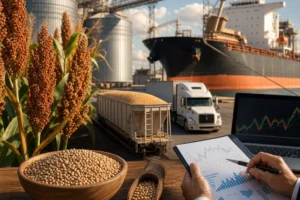





In the United States, sorghum is a nationally traded grain with a distinctly regional production base and a demand structure tied to feed users, ethanol plants, and export channels. The phrase “US sorghum supply and demand” refers to how much sorghum the country produces, stocks, consumes domestically, and ships abroad, as well as how those flows influence cash prices and futures-related hedging decisions. Although sorghum is not the dominant US feed grain, it is important in the Southern Plains and in export programs when it is competitively priced against corn and other feed grains. Understanding this market requires separating national balance-sheet fundamentals from the local cash markets where physical grain is actually bought and sold.
Geographically, US sorghum production is concentrated mainly in states such as Kansas and Texas, with additional output in parts of the Plains and surrounding regions. Trade and pricing operate in US dollars, while physical grain is commonly quoted in dollars per bushel at farm and elevator level, and sometimes in dollars per short ton or metric ton in feed and export trade. Because there is no major US sorghum futures contract comparable to corn or wheat, sorghum prices are often formed in relation to the corn market, especially through local basis-style relationships and substitution economics. That makes sorghum a physical market first, with futures used indirectly for risk management.
What US sorghum supply and demand means
In practical grain-market language, US sorghum supply and demand is the balance between available grain and competing uses across the country. Supply is built from beginning stocks, the new crop harvest, and in some years limited imports. Demand includes domestic feed use, ethanol processing, food and industrial channels, seed use, and exports.
When analysts discuss this market, they usually focus on several questions:
- How many acres are planted and harvested in key producing states?
- What kind of yields are likely after weather, heat, and moisture conditions?
- How much grain is available after accounting for carry-in stocks?
- Is sorghum competitively priced versus corn in feed rations and industrial use?
- Are export buyers active, and are Gulf or other export channels pulling grain?
In the United States, the main official framework for this discussion is the USDA balance sheet. USDA publications do not simply show production; they also indicate whether the market is becoming tighter or looser through changes in ending stocks and use categories. A smaller crop does not automatically mean higher prices if demand is weak, and a larger crop does not automatically mean lower prices if export demand strengthens at the same time.
Where the US sorghum market operates
The market is national, but its center of gravity is regional. Sorghum is especially associated with the Southern Plains, where it fits agronomically into drier production systems and can compete with other crops under heat and moisture stress. Kansas and Texas are particularly important to market participants, while neighboring states also play a role in production, feeding, and movement.
Physical trading happens through a network of country elevators, cooperatives, grain merchants, feed manufacturers, ethanol plants, and exporters. The export side often connects inland sorghum supplies to Gulf shipping channels, although the exact flow depends on seasonal freight economics, grades, and buyer demand. Some sorghum also moves by rail or truck directly to domestic processors and livestock feeders.
This creates several price layers:
- Farm-gate or local bid: what a producer can receive from a nearby buyer.
- Delivered processor or feedlot price: the value at a plant or feeding location after transport.
- Export bid: the price offered by an exporter for grain moving into an export channel.
- FOB export price: the value of grain loaded free on board at the export point.
These are not the same price. A Gulf export indication does not equal a Kansas elevator bid, because freight, handling, storage, quality terms, and local competition all intervene between inland production and vessel loading.
How sorghum prices are formed in the United States
US sorghum price formation is more decentralized than markets with a major dedicated futures contract. In practice, sorghum prices are usually influenced by:
- The value of competing feed grains, especially corn
- Local supply after harvest in producing regions
- Export demand strength
- Freight costs from interior regions to processors or export points
- Grain quality, including test weight, moisture, and damage
- Buyer competition between feed, ethanol, and export channels
- Storage availability and harvest pressure
Because sorghum often trades relative to corn, local buyers may derive bids from corn futures economics plus or minus a local adjustment. That adjustment functions similarly to a basis, even though the underlying hedge relationship is not perfect. If sorghum is cheap relative to corn, it may attract more feed demand. If export buyers become active, interior bids can strengthen even when the broader feed-grain complex is not rallying much.
| Price type | Where quoted | What it means |
|---|---|---|
| Local cash bid | Elevator, cooperative, merchant, processor | Nearby physical buying price at a specific location, usually before any farm-specific trucking or drying adjustments |
| Delivered price | Processor, feedlot, ethanol plant, end user | Value of grain delivered to the final domestic consumer location |
| Export bid | Exporter or merchant accumulating grain for shipment | Inland or terminal buying indication tied to export demand |
| FOB price | Export market | Price of grain loaded on board at the export point, excluding ocean freight |
| Benchmark futures reference | CME corn futures, when used indirectly | A financial reference for feed-grain value and hedging, not a direct sorghum farm price |
The key practical point is that futures are not the same as cash sorghum. If someone watches corn futures online, that tells them something about the broad feed-grain environment, but not the exact bid they will receive from a sorghum buyer in Texas or Kansas on that day.
Where to check US sorghum prices and market information online
Reliable sorghum market information is available, but it is spread across several official and commercial channels. Readers looking for current prices should focus first on the distinction between cash market bids and futures benchmarks.
For national supply, demand, stocks, acreage, and production estimates, the most important source is the US Department of Agriculture. USDA reports are central because they provide the official framework used by much of the grain trade. Key USDA reporting tools include:
- WASDE for national supply-and-demand tables
- NASS for acreage, yield, and production reporting
- Grain Transportation and market reporting tools for broader merchandising context
- FAS export sales and trade data for export demand monitoring
For benchmark futures relevant to feed-grain hedging, market participants typically monitor CME Group corn futures. Sorghum itself is not simply “priced on CME,” but corn futures remain an important risk-management reference because sorghum competes with corn in feed and sometimes industrial demand.
For actual physical bids, the most practical sources are:
- Local elevators and cooperatives
- Grain merchants and exporters operating in sorghum regions
- Processors and ethanol plants that post grain bids
- Regional market commentary services that cover Plains cash grain
Local bids may differ sharply from national headlines because they reflect location, freight, storage congestion, harvest timing, and nearby buyer demand. A producer should therefore treat USDA and futures screens as market context, and elevator or processor bids as the real executable physical price.
| Source type | What you can check | Best use |
|---|---|---|
| USDA WASDE and NASS | US production, stocks, use, acreage, yield | Understanding the national balance sheet and trend |
| USDA FAS export data | Export sales and shipment activity | Tracking demand from overseas buyers |
| CME Group corn futures | Feed-grain benchmark futures prices | Monitoring financial market direction and hedge reference |
| Local elevators and processors | Spot and forward cash bids | Actual physical selling opportunities |
How sorghum is actually bought and sold in the physical market
Physical sorghum trade in the United States is mostly a merchandising business rather than an exchange-traded delivery business. A farmer or originator usually sells grain to a local elevator, cooperative, merchant, processor, or feed buyer under a cash or forward contract. Those buyers then aggregate grain for domestic use or resale into larger channels.
Common transaction structures include:
- Spot cash sale: grain priced for nearby delivery.
- Forward contract: grain sold for future delivery, with price fixed now or later.
- Hedge-to-arrive or basis-style arrangements: less straightforward in sorghum than in corn, but some buyers structure pricing against related futures references.
- Storage and later sale: grain held in on-farm or commercial storage to wait for a stronger bid.
Before sale, buyers will typically specify quality and logistics terms. Moisture, damage, foreign material, and test weight matter because they affect processing yield, storage performance, and export acceptability. Payment terms and delivery windows also matter, especially in harvest periods when elevators may widen discounts or restrict intake.
A producer watching the market online still sells physically through a buyer in the real world. That is an important distinction. Online market information helps with timing and price comparison, but ownership of physical grain changes hands through contracts, scale tickets, quality grading, freight, and settlement terms.
Exports, domestic demand, and logistics
US sorghum demand can shift materially depending on export competitiveness. Sorghum is used domestically in feed rations and by some ethanol plants, but exports can become the marginal demand source that changes inland prices. When export interest is strong, terminal markets and exporters may bid more aggressively to pull grain out of producing regions.
Domestic demand tends to depend on relative value. If sorghum is attractively priced versus corn, feed users may increase inclusion where formulation and handling allow. If not, buyers may favor corn or other feed ingredients. Ethanol demand can also matter, but it competes with feed economics and plant-specific procurement programs.
Logistics are critical because sorghum is bulky and transportation cost-sensitive. Grain may move by truck from farm to elevator, then by rail or truck to processors or export channels. Export movement often depends on whether interior prices plus freight still allow US sorghum to compete internationally. This means a strong export market does not always translate one-for-one into every local cash bid; freight spreads and terminal demand can alter who benefits and by how much.
Main drivers of the US sorghum outlook
Forecasting sorghum supply and demand is best done through scenarios rather than certainty. Several variables matter repeatedly from one season to the next.
- Acreage decisions: Producers compare sorghum with corn, soybeans, cotton, and other regional alternatives.
- Weather: Heat, drought, and rainfall timing can strongly affect yields in Plains production systems.
- Harvest pace: Rapid harvest can pressure local bids if storage and logistics are tight.
- Carry-in stocks: Large beginning stocks can cushion a smaller crop; tight stocks can magnify supply risk.
- Export competitiveness: Overseas demand can tighten the balance sheet if US offers are competitive.
- Corn price relationship: Because sorghum is a feed-grain substitute, corn often shapes demand and pricing direction.
- Freight and logistics: Strong demand at destination matters less if transportation costs absorb the margin.
A bullish scenario for sorghum usually involves some combination of reduced production, firm corn values, active exports, and manageable logistics. A bearish scenario usually involves good yields, weak export pull, and domestic users seeing little reason to switch from corn.
Hedging and futures: what US sorghum users can and cannot do
Sorghum market participants often need risk management, but the tools are indirect compared with crops that have actively traded dedicated futures contracts. In the United States, hedging of sorghum exposure often references CME corn futures because corn is the nearest major feed-grain benchmark. This is useful, but imperfect.
Why imperfect? Because sorghum carries basis risk and cross-hedge risk. Basis risk exists because the local cash sorghum bid can move independently from the benchmark futures market. Cross-hedge risk exists because sorghum and corn are related but not identical commodities; their prices do not always move together by the same amount.
In practice:
- A producer, elevator, or feed user may monitor sorghum cash bids locally.
- They may use corn futures or options through a futures broker to hedge part of broad feed-grain price exposure.
- The physical grain is still bought and sold separately through cash contracts with local or regional counterparties.
Futures trading requires a brokerage account, margin funding, and acceptance of leverage and expiration risk. That is very different from owning or selling physical grain. A cash sorghum seller can lock in a physical contract without opening a futures account, while a trader can speculate in corn futures without ever handling sorghum. Those are different activities and should not be confused.
Practical FAQs about the US sorghum market
Where can I check current US sorghum prices?
Check local elevator, cooperative, processor, or merchant bids for actual cash prices. For national market context, follow USDA reports and corn futures at CME Group, but do not treat futures as the exact sorghum farm price.
What is the main benchmark for US sorghum pricing?
There is no dominant US sorghum futures benchmark equivalent to corn. In practice, the market often references corn values because sorghum competes with corn in feed and some industrial use.
Why is my local sorghum bid different from national market commentary?
Local bids reflect freight, storage pressure, quality, nearby demand, and buyer competition. A national outlook may be bullish while a local harvest glut weakens bids temporarily.
Is US sorghum mainly a domestic feed grain or an export crop?
It is both, but the balance can shift by season. Domestic feed and processing demand matter, while exports can become the marginal demand source that strengthens inland prices when overseas buying is active.
How is sorghum normally sold by farmers in the United States?
Usually through cash or forward contracts with elevators, cooperatives, merchants, processors, or feed buyers. Sales are based on local bids and contract terms for delivery, quality, and payment.
Can sorghum be hedged on a futures exchange?
Not in the same straightforward way as corn or wheat through a major dedicated US sorghum contract. Many market participants use corn futures or options as an indirect hedge, accepting cross-hedge risk.
What units are commonly used in the US sorghum market?
At farm and local cash level, sorghum is usually quoted in US dollars per bushel. In some commercial and export contexts, prices may also be discussed in dollars per short ton or metric ton.
What are the biggest short-term price drivers?
Crop conditions in producing states, harvest timing, export demand, local freight costs, and the price relationship with corn are usually the most important short-term drivers.
Sources
- US Department of Agriculture, World Agricultural Supply and Demand Estimates
- US Department of Agriculture, National Agricultural Statistics Service
- CME Group