



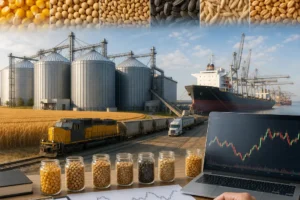
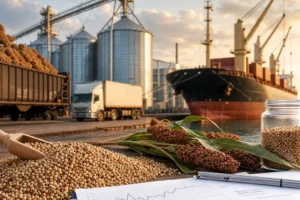

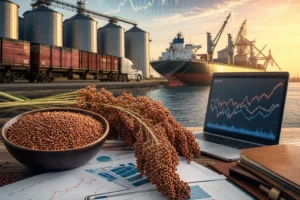



The United States sorghum market is a physical grain market anchored in the central and southern Plains, with pricing linked to broader feed grain and export demand. Sorghum is grown mainly as a feed grain, but it also moves into export channels, ethanol, and some food uses, so its value is shaped by both domestic and international buyers. In practice, US sorghum is traded in local cash markets, country elevator networks, processor channels, rail markets, and Gulf export programs, while financial risk is often managed using corn futures rather than a dedicated sorghum futures contract. For anyone trading or marketing sorghum in the US, the key is to understand geography first: local cash bids can differ sharply by state, rail access, export pull, and buyer competition.
US sorghum is usually discussed in US dollars, and cash grain is commonly quoted in cents or dollars per bushel, or in dollars per short ton or metric ton in some commercial contexts. Because there is no major standalone US sorghum futures contract comparable to corn or soybeans, the market often references Chicago corn futures as a benchmark for hedging and relative feed value. That makes basis, transportation, local supply, and export demand especially important in sorghum price formation.
Where the US sorghum market operates
The core US sorghum belt is centered in Kansas and Texas, with additional production in states such as Oklahoma, Nebraska, Colorado, and parts of the Mid-South. The crop is especially important in drier areas where sorghum’s agronomic profile can fit better than other grains. Local markets therefore develop around feedlots, ethanol plants, elevators, rail origins, and export channels connected to major terminal markets.
The United States is both a producer and exporter of sorghum. Domestic use comes mainly from feed and industrial demand, while exports can become a major price driver when international buying interest is strong. Gulf export channels matter because export bids at the coast can influence inland bids, especially in regions with efficient rail access to export terminals.
In practical trading terms, the market operates at several levels:
- Farm-gate and country elevator cash bids in producing states
- Processor and feed buyer bids for nearby delivery
- Rail markets moving grain toward domestic users or export terminals
- FOB export markets centered on the US Gulf
- Futures and options markets, mainly corn, used for risk management rather than direct sorghum delivery
What “price” means in US sorghum trading
One of the biggest mistakes in grain marketing is treating one published price as the whole market. In sorghum, that is particularly risky because local bids can vary widely by location and end use. A futures quote is not the same as a country elevator bid, and an export offer is not the same as a farm’s net price.
| Price type | Where quoted | What it means |
|---|---|---|
| Local cash bid | Elevator, cooperative, processor, feed buyer | Price offered for physical grain at a specific location and delivery period |
| Delivered bid | Feed mill, ethanol plant, end user | Price paid for grain delivered to the buyer, including logistics to that destination |
| Export bid | Merchant or export market report | Value for grain entering export channels, often at shuttle, rail, or terminal level |
| FOB price | Export market | Free on board at the export port; reflects grain loaded for shipment, not inland farm value |
| Benchmark futures price | CME corn futures | Risk-management reference used by many sorghum market participants, though it is not a sorghum cash quote |
| Basis | Cash market relationship to futures | Difference between local cash price and the relevant futures reference |
In the US, sorghum cash prices often track corn because both compete in feed channels. But sorghum can trade at a premium or discount to corn depending on export demand, local scarcity, quality, freight economics, and substitution value in feed rations. That means a trader should always ask: which location, which delivery period, which quality, and which benchmark?
How US sorghum prices are formed
US sorghum pricing is built from a combination of benchmark grain values and local commercial conditions. Since there is no widely used dedicated sorghum futures benchmark on the scale of corn, the market frequently uses corn futures as a starting point for price discovery and hedging. The rest of the price is shaped in the cash market.
Main price drivers include:
- Relative feed value: Sorghum competes with corn and other feed grains, so livestock economics matter.
- Export demand: When export buying is active, especially out of the Gulf, inland prices can strengthen.
- Local supply: Harvest pressure and regional production levels affect basis and nearby bids.
- Transportation: Truck, rail, and terminal access can widen or narrow local discounts.
- Quality: Test weight, moisture, damage, and other grading factors can change the final settlement price.
- Buyer competition: Areas with multiple elevators or end users may show stronger bids than isolated locations.
- Substitution economics: Buyers compare sorghum with corn in feed or industrial use.
Basis is crucial. If a local bid is described as “under” or “over” a corn futures month, that means the market is using corn as a hedge reference and adjusting for sorghum-specific conditions. A narrowing basis usually signals stronger local demand or tighter nearby supply, while a weakening basis can reflect harvest pressure, transport bottlenecks, or weaker export pull.
How grain is actually bought and sold in the physical market
Most US sorghum changes hands through ordinary physical grain channels rather than through an exchange delivery system. Farmers typically sell to local elevators, cooperatives, feed manufacturers, ethanol plants where applicable, or grain merchants assembling export programs. Larger commercial participants may also trade unit-train or shuttle volumes in rail markets.
Common physical transaction structures include:
- Spot or cash sales for immediate delivery
- Forward contracts for delivery after harvest or in a specified window
- Basis contracts tied to a futures reference, usually corn
- Storage arrangements with later pricing
- Delivered contracts to mills, feed yards, or processors
Every physical trade should specify core terms clearly:
- Commodity and crop year
- Quantity
- Quality and grading terms
- Delivery location
- Delivery period
- Price mechanism
- Moisture and discount schedules
- Payment terms
Counterparty risk matters. A seller should know whether the buyer is a local elevator, cooperative, merchant, processor, or exporter, and what contract terms apply if grain quality changes or delivery is delayed. In commercial markets, title transfer, weighing, grades, and settlement procedures are just as important as headline price.
How sorghum is exported and how export markets affect inland values
The United States exports sorghum primarily through major grain export channels, especially the Gulf. In export trade, prices may be discussed as FOB Gulf values or as bids at inland origins that can be assembled and shipped to the coast. Exporters, global merchants, rail carriers, and terminal operators all play a role.
For inland traders, the export market matters because an export program can lift bids well away from the port. If FOB values rise and freight remains workable, exporters may improve bids at country origin or rail loading points. If export demand weakens, inland sorghum can fall back toward domestic feed value.
Importantly, export pricing and farm pricing are not identical. FOB values include port and elevation economics and do not equal the price a producer receives in Kansas or Texas. The inland market must absorb transport, handling, margin, and timing costs.
| Market layer | Typical users | Main pricing influence |
|---|---|---|
| Farm and country market | Farmers, local elevators, cooperatives | Local supply, harvest pace, nearby buyer competition |
| Domestic destination market | Feed mills, livestock users, processors | Delivered replacement cost and feed substitution versus corn |
| Rail and origin market | Merchants, shippers, exporters | Rail freight, export pull, assembly margins |
| FOB export market | Exporters, overseas importers | Global feed grain demand, vessel economics, competing origins |
How hedging works when there is no major sorghum futures benchmark
US sorghum traders commonly hedge using corn futures and options listed by CME Group. This is not a perfect hedge because sorghum and corn do not move in lockstep all the time. The mismatch between the sorghum cash market and the corn futures hedge is a form of basis risk, and it can become large when sorghum-specific export demand surges or when local supply is unusually tight.
A physical hedger usually does not take ownership through the futures market. Instead, the futures position is used to manage price exposure while the actual grain is bought or sold in the cash market. Examples include:
- A merchandiser buying physical sorghum from farmers and selling corn futures to protect downside price risk
- A feed user buying call options on corn to cap replacement cost risk while sourcing sorghum from local suppliers
- A producer using corn futures or options as a partial hedge, while still negotiating a local sorghum cash bid
For speculative trading, access to futures and options normally comes through a regulated futures broker. Traders need to understand margin, leverage, contract months, expiration, and liquidity. But that financial position does not mean they own physical sorghum. Physical ownership requires a separate cash market transaction, storage, logistics, and quality management.
Where to check US sorghum prices and market information online
If you need a current sorghum price, the safest approach is to check both a benchmark market and a local cash source. There is no single “live US sorghum price” that accurately represents every location. A bid in western Kansas can differ materially from one in south Texas or at an export origin.
Useful places to monitor the market include:
- USDA Agricultural Marketing Service: cash market reports, grain transportation information, and some regional grain market intelligence
- USDA Foreign Agricultural Service: export sales and trade-related indicators that can influence demand
- USDA National Agricultural Statistics Service: crop progress, acreage, and production context
- CME Group: corn futures and options prices used as a benchmark hedge reference
- Local elevators and cooperatives: daily cash bids and contract offerings
- Merchants, processors, and feed buyers: delivered bids, basis offers, and destination pricing
- State extension services and market newsletters: regional commentary on basis and harvest movement
When checking prices online, note the following before comparing bids:
- Location and delivery point
- Nearby versus forward delivery period
- Whether the quote is cash, delivered, or FOB
- Unit used: bushel, short ton, or metric ton
- Any quality assumptions or discount schedules
What drives the outlook for the US sorghum market
A practical market outlook for US sorghum should be framed as scenarios rather than fixed predictions. The most important variables are planted area, weather in the Plains, yield performance, harvest timing, domestic feed economics, and export demand. Currency and freight matter indirectly through export competitiveness, while corn price direction strongly affects relative value.
Three broad scenarios are useful:
- Tighter domestic supply scenario: Weather stress or reduced acreage can strengthen basis, especially in deficit areas and nearby domestic markets.
- Strong export demand scenario: If overseas buyers become active, inland rail and origin bids may improve and sorghum can outperform corn on a relative basis.
- Heavy harvest and weak demand scenario: Large supplies combined with soft export interest can pressure cash bids, especially during harvest movement.
Because sorghum does not have a deep dedicated futures structure, local basis and destination demand often matter even more than in larger row-crop markets. Traders should watch regional crop conditions, not just national grain headlines.
Practical trading guide for farmers, merchants, and investors
For physical market participants, the most effective approach is usually to separate merchandising from price protection. First, identify the best local outlet for your grade and location. Then decide whether to fix the cash price, lock basis only, store unpriced grain, or use a hedge reference through corn futures.
For farmers and commercial sellers:
- Collect bids from multiple local buyers, not just one elevator.
- Compare spot, forward, and delivered options.
- Read quality discount schedules before delivery.
- Track corn futures separately from local sorghum basis.
- Know whether export demand is supporting your region.
For merchants and larger traders:
- Monitor origin basis and destination margins continuously.
- Use corn futures or options carefully, recognizing cross-hedge risk.
- Watch rail economics and freight bottlenecks.
- Separate speculative futures exposure from physical inventory risk.
- Be disciplined on counterparty and quality management.
For financial traders with no intention of handling grain, US sorghum is usually approached indirectly through related markets such as corn futures, export demand indicators, and grain company merchandising exposure. That is a market view, not a direct sorghum ownership strategy.
Frequently asked questions
Where is the main US sorghum market located?
The main producing and trading zones are in the central and southern Plains, especially Kansas and Texas, with additional activity in neighboring states and export-linked rail corridors.
What is the main benchmark for US sorghum prices?
In practice, many participants use CME corn futures as the main benchmark for hedging and relative valuation, then adjust through local cash basis and sorghum-specific demand.
Where can I check current US sorghum prices?
Check local elevator or processor bids for actual physical prices in your area, and use USDA market reports plus CME corn futures for benchmark context. There is no single national cash quote that fits every location.
Why is my local sorghum bid different from futures?
Because futures are only a benchmark. Your local cash bid reflects basis, freight, quality, nearby supply, buyer competition, and whether the grain is moving into domestic feed channels or export programs.
How is sorghum exported from the United States?
Merchants and exporters assemble grain inland, often through truck and rail channels, then move it to export terminals, particularly on the Gulf, where it is sold on an FOB basis to overseas buyers.
Can I trade sorghum directly on a futures exchange?
There is no major US sorghum futures market comparable to corn. Most hedging is done indirectly through corn futures and options, which introduces cross-hedge basis risk.
Is sorghum usually priced in bushels or tons in the US?
Local cash bids are commonly quoted in bushels, while some commercial export and freight discussions may use short tons or metric tons. Always confirm the unit when comparing bids.
Who typically buys physical sorghum in the US?
Buyers include country elevators, cooperatives, feed manufacturers, livestock users, processors, grain merchants, and exporters. The best outlet depends on location, timing, and quality.
Sources
- USDA Agricultural Marketing Service
- USDA Foreign Agricultural Service
- CME Group