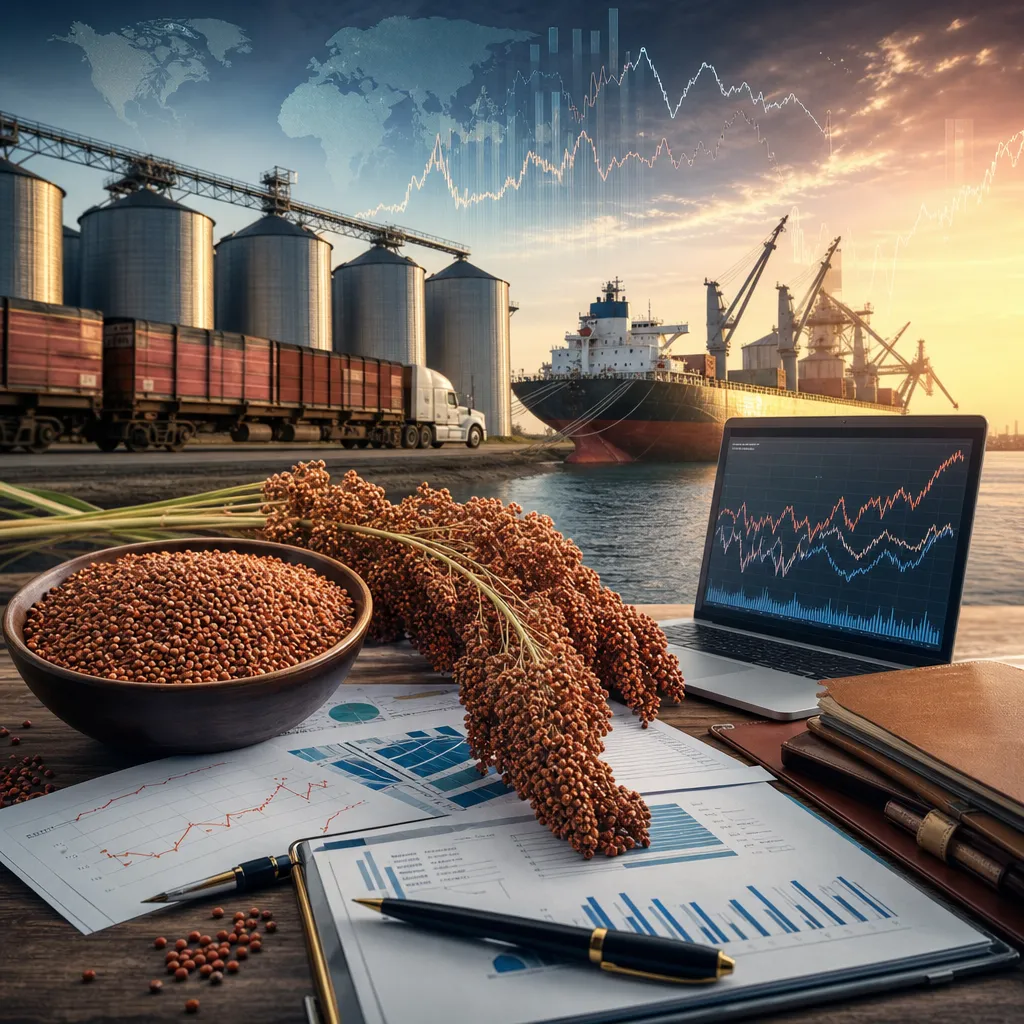



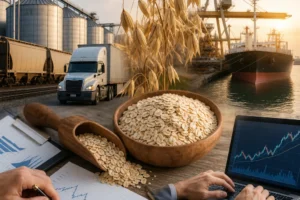

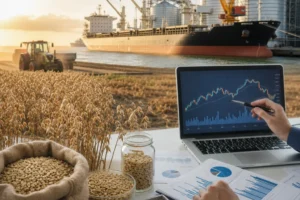

The US oat futures market is the exchange-traded market where participants manage price risk or take price exposure on oats in the United States. It is centered on a futures contract listed by CME Group, historically associated with Chicago grain trading, and it connects farm, elevator, feed, milling, and trading interests with financial participants. For practical users, the key point is that a futures price is not the same as a local cash oat bid: the cash market depends on location, quality, freight, storage, and buyer demand. Anyone following oats in the US should understand both the online futures market and the real-world physical grain trade.
Geographically, this is a US market, but it matters well beyond one state. Oats are grown in several northern US regions, and US oat users and importers also watch Canadian supply because North American oat trade is closely linked. Prices are commonly discussed in US dollars, while cash oats in the physical trade may be quoted in dollars per bushel or dollars per ton depending on the buyer and transaction type.
What the US oat futures market is
US oat futures are standardized contracts traded on a regulated exchange. Their purpose is to provide a transparent benchmark for price discovery and risk management. Farmers, grain elevators, merchants, processors, and feed users can hedge future price exposure, while speculators and spread traders can take views on price direction or relative value.
In practice, the futures market does not replace physical grain merchandising. It provides a benchmark that many commercial participants use when setting bids, offers, and hedges. A country elevator buying oats from a farmer may use the futures market to reduce price risk, even though the grain will move physically by truck or rail to a domestic user or another merchant.
The oat futures benchmark in the US is associated with CME Group. Market users should rely on CME Group contract information and data vendors or brokers for official contract details, trading hours, and settlement information.
Where the market operates
The exchange market operates electronically through CME Group’s trading infrastructure. Although oats are historically linked with the Chicago grain complex, actual trading access today is typically online through a futures broker or trading platform. Market participants do not need to be physically present in Chicago to trade the contract.
The physical oat market operates across producing and consuming regions in the US. Farmers usually sell to local elevators, cooperatives, merchants, feed manufacturers, or food processors. Oats are particularly relevant in northern production areas, while demand can come from feed channels and food manufacturing. Because the US market is integrated with Canadian oat production and trade, North American supply conditions can matter as much as local state-level conditions.
Export relevance exists, but oats are not traded globally in the same benchmark-driven way as corn, soybeans, or wheat. That makes local and regional cash conditions especially important. In many cases, the commercial market is driven more by processor and feed demand, quality needs, and transport economics than by a highly liquid export program.
How US oat prices are formed
Oat prices in the US are formed through a combination of futures values and local cash market conditions. The exchange price reflects bids and offers in the futures contract, while the physical price reflects what a real buyer is willing to pay for grain at a specific location and quality.
A local cash bid is often understood as:
- Futures price as the benchmark
- Plus or minus basis, which reflects local supply and demand and logistics
- Adjusted for quality, including test weight, moisture, and other buyer specifications where relevant
- Adjusted for timing, such as nearby delivery versus later shipment
Basis is the difference between the local cash price and the relevant futures contract. A stronger basis usually means local demand is firm relative to futures, or logistics are tight. A weaker basis may reflect larger nearby supplies, weaker demand, or higher transport costs.
It is also important to distinguish among different price types. A farmer’s nearby elevator bid is not the same as a delivered mill bid, and neither is the same as a futures settlement price. Export-style terminology such as FOB and CIF can matter in some grain markets, but oats in the US are often more strongly influenced by domestic procurement channels than by a large, continuous export market.
| Price type | Where quoted | What it means |
|---|---|---|
| Futures price | Exchange market through CME Group data and broker platforms | Standardized benchmark for a specific contract month |
| Local cash bid | Elevator, cooperative, merchant, or processor | Price for physical oats at a local point, usually reflecting futures plus or minus basis |
| Delivered price | Buyer contract or direct negotiation | Price for grain delivered to a specified destination |
| FOB export price | Export market reporting where relevant | Price at port loading point before ocean freight |
| CIF import price | Import trade negotiation where relevant | Price including cost, insurance, and freight to destination |
Where to check US oat futures and cash market information
If you need the current or live oat futures price, do not rely on a generic article because futures move constantly during market hours. The most practical places to check are CME Group market data pages, regulated broker platforms, and professional quote systems. These sources identify the exact contract month, trading session, and settlement context.
For the US physical oat market, local cash bids are typically best checked through:
- Local grain elevators and cooperatives
- Regional grain merchants and processors
- Direct buyer bid sheets where available
- USDA market reporting and grain transportation information when relevant
- USDA reports for broader supply, stocks, acreage, and feed demand context
Cash oats can differ sharply from futures because the futures contract is only a benchmark. A processor needing a specific quality at a specific time may pay well above a broad benchmark, while an oversupplied local market with expensive freight to destination may bid below it.
| Source type | What readers can check | Practical use |
|---|---|---|
| CME Group | Contract information, settlements, market structure | Official benchmark reference for oat futures |
| Futures brokers and trading platforms | Live or delayed quotes, charts, order entry | Trading and hedging access |
| USDA reports | Acreage, production, stocks, feed use, trade context | Fundamental analysis and seasonal outlook |
| Local elevators and processors | Current cash bids and delivery terms | Actual physical selling opportunities |
| CFTC | Positioning data in futures markets | Shows how commercial and non-commercial participants are positioned |
Who uses the market and why
The US oat futures market is used by both commercial and financial participants, but their goals differ. Commercial users are usually managing physical exposure. Financial users are primarily expressing a market view or pursuing spread opportunities.
- Farmers may watch futures as a reference and then sell physical oats locally.
- Elevators and cooperatives may buy cash grain and hedge with futures.
- Processors and feed users may hedge input costs if they expect future buying needs.
- Merchants may hedge inventory, freight exposure, and origination programs.
- Speculators may trade price moves without any intention of owning physical oats.
Because oats are a smaller futures market than the main row-crop contracts, users should pay attention to liquidity, spreads, and execution quality. In thinner markets, bid-ask spreads can matter more, and hedging may not perfectly match every local cash exposure.
How physical oats are actually bought and sold in the US
Physical oat trading is a merchandising business. A farmer usually sells to a local elevator, cooperative, merchant, or end-user under a cash contract, forward contract, basis contract, or sometimes a storage arrangement. The buyer sets quality requirements, delivery window, location, and payment terms.
Typical physical trade steps include:
- The seller obtains local bids from one or more buyers.
- The buyer states quality specifications and delivery terms.
- The parties agree on a price structure, which may be flat cash or based on futures plus or minus basis.
- The grain is delivered by truck or arranged transport.
- The buyer grades and accepts the grain according to contract terms.
- Payment is made under the agreed settlement terms.
For larger commercial channels, grain can also move through merchant networks, rail shipments, and processor procurement programs. Some oats may be sourced domestically; some users may also rely on cross-border North American flows depending on quality and supply conditions.
Physical ownership and futures exposure are different. A merchant can own oats in storage and hedge that inventory with futures. A speculator can own no grain at all but still hold a long or short futures position.
How futures and options are used for hedging
Futures and options are financial tools tied to the benchmark market. To use them, a participant normally opens an account with a licensed futures broker, posts margin, and trades through an approved platform. This gives price exposure, not automatic control over physical freight, quality, or local delivery relationships.
Commercial hedging examples include:
- A farmer concerned about falling prices may sell futures while still planning to sell physical oats later in the cash market.
- An elevator buying oats from farmers may hedge by selling futures against expected inventory.
- A processor worried about rising input costs may buy futures or use options to protect against higher prices.
Options can be useful when a participant wants price protection with more flexibility than a straight futures hedge. However, futures and options involve margin, premium costs, and basis risk. A futures hedge may offset broad market moves but still leave exposure to local basis changes.
Access to the exchange market is online, but physical trade remains local and contractual. That distinction is essential: a person trading oat futures is not necessarily buying truckloads of oats, and a farmer selling oats to an elevator may never place a futures order personally.
Main drivers of the US oat market
Oat prices are influenced by many of the same forces that affect other grains, but the market’s smaller size and North American integration add special features. Canadian production conditions can matter significantly because cross-border supply affects available oats for US users.
Important price drivers include:
- US and Canadian acreage and yields
- Weather during planting, growing, and harvest
- Stocks and inventory availability
- Feed demand and competition from other grains
- Food processing demand
- Rail and truck logistics
- Currency movements, especially when cross-border trade is relevant
- Relative value versus corn and other feed ingredients
Forecasting oats should be done through scenarios rather than certainty. A tighter North American crop, stronger processor demand, and transport bottlenecks could support prices. On the other hand, larger supplies, weaker feed demand, or better logistics could pressure basis and futures. Because liquidity can be thinner than in larger grain contracts, price moves can also be uneven.
Practical differences between futures, basis, and local cash decision-making
For a producer or buyer, the most useful discipline is to separate the market into two decisions: futures and basis. Futures reflect the broader benchmark. Basis reflects the local market. Sometimes it makes sense to lock one and leave the other open, depending on storage, transport, and demand conditions.
Examples:
- A farmer may like the futures level but expect local basis to improve later.
- A processor may secure physical supply at a known basis while leaving futures open until a later date.
- An elevator may hedge futures immediately after buying grain but continue managing basis exposure locally.
This is why local cash bids should always be checked directly with actual buyers. A news headline about oats rising on the exchange does not automatically mean the same change shows up in a nearby country bid.
FAQ
Where can I check the current US oat futures price?
The most reliable place is CME Group market information, or a regulated futures broker platform that shows the exact contract month. Always confirm whether the quote is live, delayed, last trade, or settlement.
Is the oat futures price the same as the price a farmer receives?
No. A farmer normally receives a local cash bid, which reflects the futures benchmark plus or minus local basis, quality adjustments, delivery terms, and freight economics.
What currency and unit are usually used in the US oat market?
US oat futures and most US market references are in US dollars. Physical trade may be quoted in dollars per bushel or dollars per ton depending on the buyer and contract type.
How do I buy or sell physical oats in the United States?
Physical oats are usually traded through local elevators, cooperatives, merchants, processors, or feed buyers. The transaction is handled through a grain contract covering price, quality, delivery point, and payment terms.
How do I trade oat futures?
You normally need a futures brokerage account, margin funding, and access to a trading platform. Trading futures gives financial exposure to oat prices; it does not automatically involve receiving or delivering physical grain.
Why does Canadian production matter for the US oat market?
The North American oat market is closely connected. US users monitor Canadian supply because cross-border trade can influence availability, basis, and procurement costs in the United States.
What is basis in the oat market?
Basis is the difference between the local cash price and the relevant futures price. It reflects location, freight, storage, local buyer competition, timing, and supply-demand conditions.
Are oats mainly an export market in the US?
Oats are less export-driven than some larger US grains. Domestic feed and food demand, regional procurement, and North American trade flows are often more important for price formation than a broad global export benchmark alone.
Sources
- CME Group
- USDA National Agricultural Statistics Service and World Agricultural Supply and Demand Estimates
- U.S. Commodity Futures Trading Commission