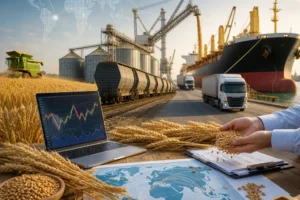
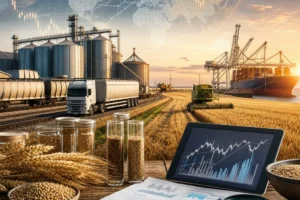


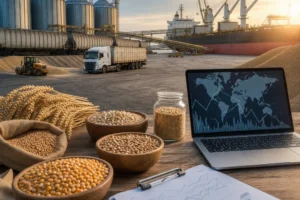

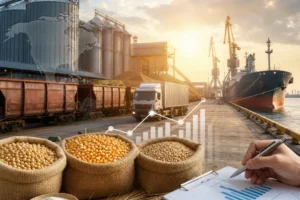
The US wheat futures market is centered in the United States but influences wheat pricing far beyond US farms, elevators, mills, and export terminals. In practice, it is not a single local cash market: it is a group of exchange-traded benchmark contracts used to discover price, manage risk, and connect US wheat values to global grain trade. The most important venues are Chicago, Kansas City, and Minneapolis-linked contracts listed through CME Group. Farmers, grain merchants, exporters, millers, feed users, hedge funds, and brokers all interact with these futures, but actual wheat is still bought and sold separately in the physical cash market.
Understanding this market requires separating futures prices from cash grain prices. A futures quote is an exchange price for a standardized contract, while a local wheat bid in Kansas, North Dakota, or at a Gulf export terminal reflects that benchmark plus or minus a local adjustment called basis. That adjustment can change with protein, grade, freight, storage, buyer demand, and regional supply conditions. For anyone following US wheat, the key is to know which contract is relevant and how it connects to the physical trade.
What the US wheat futures market means
The US wheat futures market is the organized exchange market where standardized wheat contracts are traded for future delivery months. These contracts allow market participants to lock in or manage price exposure before wheat is harvested, shipped, milled, or exported. They are used both for hedging and for speculation.
The three benchmark US wheat futures categories most commonly followed are:
- Chicago wheat, historically associated with Soft Red Winter wheat.
- Kansas City wheat, the main benchmark for Hard Red Winter wheat.
- Minneapolis wheat, the key benchmark for Hard Red Spring wheat.
These classes matter because the United States produces different wheats for different end uses. Hard Red Winter is important for bread flour and is heavily grown in the Plains. Hard Red Spring is known for higher protein and is important to millers needing stronger flour characteristics. Soft Red Winter is more relevant to some baking and feed uses and has historically had strong links to eastern US production and river export channels.
Where the market operates
The exchange-traded market operates electronically through CME Group, which lists the main US wheat futures and options contracts. Although traders around the world can access these contracts online through futures brokers, the market remains closely tied to US grain geography.
The related physical wheat trade operates across multiple US regions:
- Great Plains states such as Kansas, Oklahoma, Texas, Colorado, and Nebraska for Hard Red Winter wheat.
- Northern Plains states such as North Dakota, South Dakota, and Minnesota for Hard Red Spring wheat.
- Midwest and eastern states for Soft Red Winter wheat.
- Export channels through the US Gulf, Pacific Northwest, Great Lakes, and some Atlantic routes.
In the futures market, prices are quoted in US cents per bushel. In physical domestic trade, wheat may also be discussed in bushels, while export business is commonly evaluated in US dollars per metric ton when dealing with international tenders, FOB offers, or freight-based comparisons.
How prices are formed
US wheat pricing starts with benchmark futures, but the final physical price depends on many local and commercial adjustments. This is why a futures quote should never be treated as the exact farm-gate price.
| Price type | Where quoted | What it means |
|---|---|---|
| Futures price | CME Group market data, broker platforms, financial terminals | Exchange-traded benchmark for a standardized wheat contract and delivery month |
| Cash bid | Elevators, cooperatives, merchants, processors | Local price a buyer offers for physical wheat at a named location |
| Basis | Cash market commentary, elevator bids, merchant pricing sheets | Difference between local cash price and the relevant futures contract |
| Delivered price | Mill, feed user, or processor bid | Price including movement to the buyer’s facility |
| FOB export price | Export market reporting and merchant offers | Price loaded free on board at an export port |
| CIF import price | International tenders and trade reports | Delivered import price including cost, insurance, and freight to destination |
Local US wheat prices normally reflect:
- the relevant wheat futures contract month,
- basis at the local elevator or terminal,
- wheat class and protein,
- official grade and test weight,
- transport cost by truck, rail, or barge,
- storage conditions and nearby supply,
- competition among buyers such as mills, exporters, or feed users,
- global export demand and competing origins.
Basis is crucial. A farmer in Kansas may watch Kansas City wheat futures online, but the actual cash bid depends on what a local elevator or mill is paying relative to that contract. During harvest, basis can weaken if deliveries surge. In a tight supply situation or when exporters need coverage, basis can strengthen.
Which wheat futures benchmarks matter most
The US does not have one universal wheat benchmark that fits every physical transaction. The class of wheat and the destination use decide which futures contract is most relevant.
| Benchmark | Main wheat type relevance | Typical users | Practical role |
|---|---|---|---|
| Chicago wheat | Soft Red Winter wheat | Merchants, mills, traders, funds | Benchmark for some eastern and river market pricing and financial exposure |
| Kansas City wheat | Hard Red Winter wheat | Plains farmers, elevators, millers, exporters | Main hedge reference for US bread wheat from the Plains |
| Minneapolis wheat | Hard Red Spring wheat | Northern Plains growers, protein-sensitive millers, exporters | Benchmark for higher-protein spring wheat values |
In export trade, overseas buyers may compare US wheat with offers from Canada, the European Union, Russia, Australia, Argentina, or Black Sea origins. As a result, even highly local US wheat bids can ultimately be affected by international freight spreads, currency moves, and rival exporter availability.
How wheat is actually bought and sold in the United States
Physical wheat in the United States is usually sold through grain elevators, cooperatives, independent merchants, mills, feed manufacturers, or exporters. A farmer generally does not deliver a futures contract to sell a crop. Instead, the farmer delivers physical grain under a cash contract or spot sale, and the buyer may hedge its price risk in the futures market.
Physical grain trade
Common physical marketing channels include:
- Country elevators and cooperatives that post local bids and receive grain from farmers.
- Mill buyers seeking specific quality, especially protein and functional characteristics.
- Feed users when wheat is competitively priced against corn or other ingredients.
- Exporters and terminal operators sourcing wheat for vessel loading.
Physical contracts may be spot, forward, hedge-to-arrive, or basis contracts depending on the buyer and region. In all cases, quality terms matter. Protein, moisture, falling number, foreign material, damage, and test weight can affect discounts or premiums.
Futures and options trade
Futures and options are traded through a regulated brokerage account. The user posts margin and can gain or lose money as prices move. This is a financial market, not a normal pathway for most farmers or investors to take possession of truckloads of wheat.
Typical futures market users include:
- farmers hedging expected production,
- elevators hedging inventory or forward purchases,
- exporters covering sales commitments,
- mills hedging future raw material needs,
- speculators seeking exposure to wheat price movement without owning grain.
Leverage makes futures useful but risky. A person can trade the wheat market online through a broker without ever buying or storing physical grain. That must be kept separate from the cash grain business.
How US wheat connects to export markets
The United States is both a major wheat producer and an established exporter, though its export share changes over time depending on crop size, quality, and global competition. US wheat from inland regions moves toward export position through rail, barge, and truck networks.
The most important export relationships are usually between inland cash markets and terminal/export bids. Wheat may move:
- from the Plains toward the US Gulf, often by rail or via river-linked systems,
- from the northern and western production zones toward the Pacific Northwest, especially for Asian destinations,
- from some northern areas toward the Great Lakes and connected export channels.
Export values are often discussed as FOB offers. Those offers, in turn, are shaped by inland procurement cost, elevation and handling, rail or barge freight, vessel loading costs, and international demand. That is why a stronger export program can improve basis inland, while weak export demand can pressure terminal bids and then local cash values.
Where to check prices and market information online
If you need a current or live US wheat futures price, the safest approach is to use official exchange data or reputable brokerage platforms and always note which contract month you are looking at. A nearby futures month, a deferred contract, and a local elevator bid are not the same thing.
Useful places to check market information include:
- CME Group for official contract information and futures market data references.
- USDA Agricultural Marketing Service for cash grain and market reporting, including regional and terminal market information where available.
- USDA Foreign Agricultural Service for export sales, trade developments, and international context.
- USDA National Agricultural Statistics Service for production, acreage, stocks-related reporting links, and crop progress context.
- Local elevators, cooperatives, merchants, and mill buyers for actual cash bids and contract terms.
- Broker platforms and regulated market data services for live futures and options prices.
When checking prices, confirm these details:
- which wheat class is relevant,
- which futures contract month is being quoted,
- whether the quote is delayed or live,
- whether the price is in cents per bushel or dollars per metric ton,
- whether a cash bid includes delivery, storage, or quality adjustments.
Main drivers of US wheat futures
US wheat futures respond to domestic fundamentals, but they are also strongly affected by global wheat trade. Wheat is internationally substitutable within quality limits, so US prices rarely move in isolation.
Key price drivers include:
- US weather, especially drought, freezes, and excessive rain in winter wheat and spring wheat areas.
- Acreage and yield prospects for Hard Red Winter, Soft Red Winter, and Spring wheat.
- Crop condition and harvest progress reports.
- US carryout and world stocks expectations.
- Export competitiveness against Black Sea, EU, Canadian, Australian, and Argentine wheat.
- Protein availability and quality, which can matter as much as total tonnage in some years.
- Currency movements, especially the US dollar relative to exporter currencies.
- Freight and logistics, including rail performance, river conditions, and port capacity.
- Feed grain substitution, especially the relationship between wheat and corn in feed demand.
Forecasting should therefore be viewed in scenarios, not certainties. A weather problem in the US Plains may support Kansas City wheat, but global pressure from abundant rival export supplies can limit the upside. Conversely, tight high-protein wheat supply can lift Minneapolis-related values even if other wheat classes remain weaker.
| Scenario | Condition | Possible market implication |
|---|---|---|
| US Plains drought | Stress on Hard Red Winter crop | Kansas City wheat may gain relative importance; HRW basis can strengthen if supply tightens |
| Strong global export competition | Cheaper rival wheat origins dominate tenders | US export bids may weaken and inland cash markets can feel pressure |
| Quality-driven tightness | Limited high-protein wheat availability | Spring wheat premiums and specific basis levels can improve |
| Large US harvest with storage pressure | Heavy nearby deliveries at country level | Harvest basis can weaken even if futures are stable |
Practical guidance for hedging and trading
For a physical wheat seller or buyer, the first question is not whether futures are going up or down. It is which exposure needs to be managed: flat price risk, basis risk, or both.
For physical grain businesses:
- Match the hedge to the wheat class as closely as possible.
- Track basis separately from futures.
- Read contract quality terms carefully.
- Know delivery location, timing, storage, and discount schedules.
- Evaluate counterparty reliability and payment terms.
For futures and options traders:
- Use a regulated broker with access to CME Group contracts.
- Understand contract months, expiry, and margin calls.
- Recognize that futures profits or losses can move faster than in the physical grain trade.
- Remember that a correct futures view does not eliminate basis risk in a local cash position.
Options can also be used to manage risk with a defined premium cost, but they still require a solid understanding of volatility, time decay, and how the chosen option relates to the underlying wheat class.
FAQ
What is the main benchmark for US wheat futures?
There is no single benchmark for all US wheat. Chicago, Kansas City, and Minneapolis contracts each matter, depending on the wheat class and commercial use.
Where can I check live US wheat futures prices?
Use CME Group market references or a regulated broker platform that provides exchange data. Always check the contract month and whether the quote is delayed or live.
Is a wheat futures price the same as a farm cash price?
No. A futures price is a benchmark for a standardized exchange contract. A farm cash price reflects futures plus or minus basis, along with quality, freight, location, and buyer demand.
How do US farmers usually sell wheat?
Most farmers sell physical wheat to elevators, cooperatives, mills, or merchants under cash or forward contracts. They may use futures or options for hedging, but the physical sale is separate.
Why does basis matter so much in the US wheat market?
Basis captures local conditions that futures do not fully reflect, including transport cost, nearby supply, quality, and competition among buyers. Two areas can have the same futures benchmark but very different cash bids.
How is US wheat connected to exports?
Inland cash markets link to export terminals through rail, barge, and truck routes. Export demand at the Gulf or Pacific Northwest can raise or lower terminal bids, which then influence country bids inland.
What unit is US wheat futures quoted in?
US wheat futures are generally quoted in US cents per bushel. International export comparisons are often discussed in US dollars per metric ton.
Who uses the US wheat futures market besides farmers?
Elevators, exporters, millers, commercial merchants, institutional traders, and speculative funds all participate. Some use it to hedge physical exposure, while others trade price movement only.
Sources
- CME Group
- USDA Agricultural Marketing Service
- USDA Foreign Agricultural Service