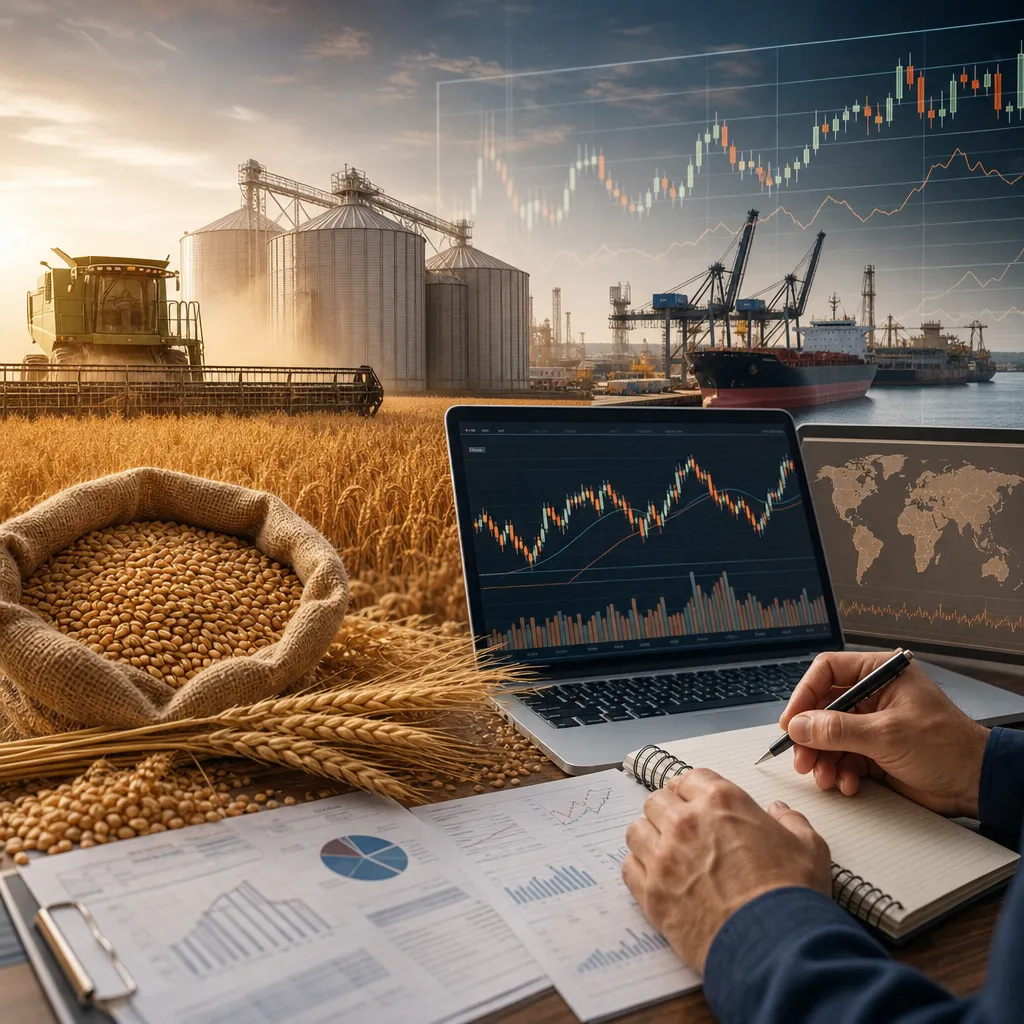








Grain prices per bushel are usually quoted in two different ways: as exchange-traded futures prices and as local cash prices offered in the physical market. The number most people see online first is often a futures quote for corn, wheat, or soybeans, but that is not automatically the price a farmer receives or a buyer pays at a local elevator, mill, or processor. To use grain prices correctly, you need to know the crop, contract month, trading venue, currency, delivery location, and whether the quote is a futures benchmark or a physical bid. In practice, grain is priced through a combination of futures, basis, quality adjustments, freight, and local supply-demand conditions.
What “grain prices per bushel” actually means
A bushel is a traditional volume unit used in grain markets, but in commercial trading it is tied to standard weights for each crop. That matters because a bushel of corn is not the same weight as a bushel of wheat or soybeans. When you read a quoted price per bushel, the crop must be clear.
In the United States, grain futures and many cash bids are commonly quoted per bushel for crops such as corn, wheat, soybeans, oats, and sometimes sorghum. Rice is often quoted differently, and in many international markets grain may be priced per metric ton rather than per bushel. Canola, rapeseed, sunflower seed, and barley markets outside the U.S. are especially likely to use metric units.
| Crop | Common pricing unit | Where often quoted | Important note |
|---|---|---|---|
| Corn | Bushel | U.S. futures and cash bids | Local basis can change the actual cash price significantly |
| Soybeans | Bushel | U.S. futures and elevator bids | Protein, moisture, and delivery terms may affect final settlement |
| Wheat | Bushel | U.S. futures and domestic cash markets | Class and quality matter: HRW, SRW, HRS are different markets |
| Oats | Bushel | Futures and selected cash markets | Liquidity may be lower than major grain contracts |
| Barley, canola, rapeseed | Often metric ton | Many non-U.S. physical markets | Do not assume prices are directly comparable to U.S. bushel quotes |
Where grain prices are quoted online
The most widely followed benchmark prices for major grains are futures prices listed on regulated commodity exchanges. For U.S. grain markets, CME Group is a key reference point for futures on corn, soybeans, soybean meal, soybean oil, wheat contracts, oats, and rough rice. Exchange data shows contract months, last trade information, settlement data, and contract specifications.
These online futures quotes are useful because they provide a transparent benchmark. However, they are not the same thing as a buy bid from a local elevator or processor. A futures price reflects a standardized contract with exchange rules on quantity, quality, delivery location, and expiry.
For local physical pricing, farmers and grain buyers typically check:
- Country elevator bid sheets
- Agricultural cooperative bid pages
- Grain merchant or processor bid portals
- Mobile apps used by local merchandisers
- Regional grain market reporting services
- Direct phone or email quotes from buyers
In many regions, elevators and processors publish cash bids online for nearby delivery, harvest delivery, or deferred delivery. Those bids may be updated during market hours or adjusted after futures moves, freight changes, or local operational needs.
Futures price versus local cash price
The most important practical distinction is the difference between a futures quote and a cash bid. The local cash price is usually calculated as:
Cash price = futures price + basis
Basis is the local adjustment that reflects transportation cost, handling, storage capacity, processor demand, export demand, and local supply. Basis can be positive or negative relative to the futures benchmark. It also varies by delivery month, crop year, and quality specifications.
A farmer selling corn to a nearby elevator does not simply receive the futures quote shown on a financial website. The elevator will post a bid for a specific delivery point, a defined moisture standard, and a basis level tied to a selected futures month. Similar logic applies for wheat sold to a mill, barley sold to a maltster, or soybeans sold to a crusher or export house.
| Market type | What the price represents | Where it is checked | Main limitation |
|---|---|---|---|
| Futures market | Exchange-traded benchmark for a standard contract | Exchange website, broker platform, market data service | Not the same as a local physical bid |
| Cash market | Price at a local delivery point with basis and quality terms | Elevator, cooperative, processor, merchant, broker | Can vary widely by location and timing |
| Forward cash contract | Agreed future delivery price or futures-plus-basis formula | Merchant, coop, processor, exporter | Counterparty and production risk must be managed |
| Basis contract | Local basis fixed now, futures set later | Physical grain buyer or merchandiser | Futures risk remains open until priced |
How physical grain is bought and sold
Physical grain trade happens through a chain of commercial participants. Sellers may include farmers, farm cooperatives, local collectors, and grain merchants. Buyers may include elevators, mills, crushers, feed manufacturers, ethanol plants, maltsters, exporters, importers, and food processors.
A typical physical grain transaction involves:
- Identifying the crop, grade, moisture, and quantity
- Checking the local bid or negotiating a price formula
- Agreeing the delivery period and delivery point
- Confirming freight responsibility
- Delivering to the agreed facility or shipping point
- Weighing, grading, and inspecting the grain
- Applying discounts or premiums for quality
- Settling payment according to contract terms
Where this takes place depends on the market. In domestic farm trade, the most common locations are grain elevators, cooperatives, feed mills, and processor receiving points. In export channels, grain may move to river terminals, rail loaders, port elevators, warehouses, or vessel loading terminals. International trade also adds shipping documents, inspection certificates, and trade terms such as FOB, CIF, or other Incoterms.
For buyers, the practical issue is not only the headline price per bushel but also landed cost. Freight, drying, shrink, cleaning loss, demurrage risk, and storage can change the economics materially.
Where futures and options trading happens
Grain futures and options are traded on regulated exchanges through approved brokers. For many global participants, the main benchmark venue is CME Group. A trader or hedger normally needs a futures brokerage account to access these contracts through a broker platform. The broker handles order routing, margin, account supervision, and exchange connectivity.
Futures are financial tools linked to a standardized physical commodity contract. They are used by farmers, elevators, processors, exporters, feed companies, and speculators. A short hedge may help protect the value of grain inventory or expected production; a long hedge may help protect a buyer against rising prices. Options can be used to define downside or upside exposure while retaining some flexibility, but they involve premiums and require understanding of time decay and volatility.
Two practical warnings matter:
- Trading a grain futures contract is not the same as buying truckloads of physical grain.
- Leverage and margin calls can create losses quickly if the market moves against the position.
Some commercial firms also use over-the-counter contracts, including customized forward agreements or swaps, but those are arranged privately and carry counterparty risk. Smaller producers often interact with futures indirectly through hedge-to-arrive contracts, basis contracts, or minimum-price structures offered by elevators or merchants rather than placing exchange trades themselves.
What moves grain prices per bushel
Grain prices are driven by both global benchmarks and local conditions. The same crop can move because of weather in one country, export restrictions in another, and freight disruptions somewhere else in the supply chain.
Major drivers include:
- Weather: drought, heat, excessive rain, frost, and harvest delays
- Acreage and yield: planting intentions, crop condition, and final production
- Stocks: ending stocks and stocks-to-use ratios
- Demand: feed use, milling demand, crushing demand, ethanol or biodiesel demand
- Trade flows: export sales, import tenders, port congestion, sanctions, and policy changes
- Currency: a stronger or weaker domestic currency changes export competitiveness
- Energy and fertilizer: production costs and biofuel margins influence the market
- Logistics: barge freight, rail capacity, truck availability, and storage constraints
Quality also matters. Wheat protein, test weight, vomitoxin, falling number, moisture, and dockage can change the real market value. Corn with high moisture or damage may receive a discount. Soybean premiums and discounts can reflect moisture, foreign material, and processor requirements.
Best official reports and data sources to check
Reliable grain price analysis starts with official and exchange data rather than rumor or isolated headlines. Several sources are especially useful.
- USDA Agricultural Marketing Service: cash grain bids, terminal market reports, transportation and basis-related market reporting in many areas
- USDA WASDE: global and U.S. balance sheets for wheat, corn, soybeans, rice, and other crops
- USDA Crop Progress: weekly updates on planting, crop condition, and harvest pace
- USDA Export Sales: export commitments and shipments that help gauge demand
- CME Group: contract specifications, settlements, expiry details, and benchmark futures information
- CFTC Commitments of Traders: positioning data for managed money and commercial participants
- FAO and national statistical agencies: broader international production and trade context
Commercial users often combine official reports with broker platforms, charting software, farm marketing tools, and internal spreadsheets. Merchandisers and analysts may also use weather services, satellite crop monitors, freight data, and customs or port shipment information.
Storage, timing, and farm economics
Storage changes the meaning of grain prices per bushel because the best bid at harvest is often not the same as the best net price later in the season. A higher deferred bid is only better if it covers carrying costs and risk.
When evaluating whether to store or sell, a farmer or grain owner usually compares:
- Current cash bid versus deferred cash bid
- Expected basis improvement
- On-farm storage cost or commercial storage charges
- Interest cost on grain held in inventory
- Shrink, spoilage, aeration, and quality risk
- Need for cash flow
- Hedging cost if price risk will be managed
Commercial storage may be provided by an elevator, warehouse, terminal, or processing facility, depending on the region. On-farm storage gives more marketing flexibility but shifts quality control and management risk to the owner. In either case, the important figure is not just gross price per bushel but net price after drying, storage, freight, and financing.
How to check, compare, and use grain prices correctly
A practical workflow helps avoid the most common mistakes.
- Identify the crop and the market unit being quoted.
- Check whether the price is a futures quote, a cash bid, or a forward contract offer.
- If it is futures, note the exchange, contract month, and currency.
- If it is a local bid, confirm the delivery location, delivery period, and quality assumptions.
- Ask whether discounts apply for moisture, damage, dockage, or low test weight.
- Compare freight and handling costs between buyers, not only the headline bid.
- Use official reports to understand whether the move is weather-driven, demand-driven, or logistics-driven.
- If hedging is involved, separate basis risk from futures price risk.
The most common mistake is comparing an online futures quote with a local cash bid as if they were the same thing. Another is looking only at flat price and ignoring grade, basis, drying, and freight. For international buyers, a further mistake is comparing U.S. bushel quotes directly with imported grain offers quoted per metric ton without adjusting for currency, freight, and quality.
Where can I check grain prices per bushel today?
For benchmark futures, check the relevant exchange market data, especially CME Group for major U.S. grain contracts. For actual local selling prices, check elevator, cooperative, processor, or merchant bid sheets, plus USDA Agricultural Marketing Service market reports where available. The most useful quote is usually the one tied to your delivery point and quality.
Why is my local grain bid different from the futures price?
Because the cash bid includes basis, local demand, freight, storage conditions, and quality adjustments. Futures are a benchmark for standardized delivery terms, while cash bids reflect real local buying conditions.
Can I buy physical grain online at the futures price?
No. A futures price is not a simple online retail or wholesale purchase price for physical grain. Physical grain purchases normally go through elevators, merchants, mills, processors, feed companies, or exporters under negotiated commercial terms.
Where do farmers usually sell grain?
Most commonly to local grain elevators, cooperatives, processors, feed mills, ethanol plants, crushers, or merchants. In some regions, farmers may also contract directly with livestock feeders, flour mills, maltsters, or export channels depending on crop type and logistics.
How are grain futures and options accessed?
Through a regulated futures broker with exchange access. The user trades on a broker platform, posts margin for futures, and pays option premiums for options. This is a financial market tool and should be distinguished from selling or buying truckloads of grain in the physical market.
What reports matter most for grain price direction?
USDA WASDE, Crop Progress, and Export Sales are central for many global grain markets. Exchange contract data and CFTC positioning reports also help, especially for understanding benchmark pricing and fund activity.
Are all grain prices quoted per bushel?
No. Bushels are common in U.S. grain markets, especially for corn, wheat, soybeans, and oats. Many international markets use metric tons, and some crops have different standard commercial units depending on the country and contract.
What should I confirm before agreeing to a grain sale?
Confirm the price type, basis or formula, delivery point, delivery window, grade standards, moisture limits, freight responsibility, inspection process, discounts or premiums, and payment terms. These details often matter more than the headline price alone.
Sources
- USDA Agricultural Marketing Service
- CME Group
- USDA World Agricultural Supply and Demand Estimates