


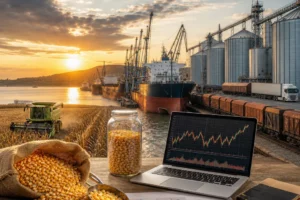
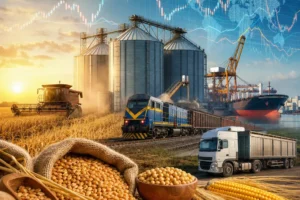






The Black Sea corn export market is the seaborne trade in maize shipped from the Black Sea region to buyers in Europe, the Mediterranean, the Middle East, North Africa, and sometimes Asia. In practice, the term usually refers most directly to export flows from Ukraine and, depending on context, also nearby origins such as Romania, Bulgaria, and Russia when traders compare regional feed grain supply. It is not a single exchange or one port market; it is a network of inland grain origination, rail and river logistics, port terminals, exporters, freight markets, and destination import tenders. Prices are normally discussed in U.S. dollars per metric ton for export quotations, while inland physical prices may be negotiated in local currency or dollars depending on the country and contract structure.
For corn, the Black Sea matters because it has been one of the world’s key feed grain export zones. When crops are large and logistics are functioning, Black Sea corn can be highly competitive against U.S., Brazilian, Argentine, and EU-origin corn. When weather, policy, war risk, freight disruption, or currency moves affect availability, importers quickly adjust and the region’s export values can move sharply relative to global benchmarks.
What the Black Sea corn export market includes
The market is best understood as a regional export arena rather than a single domestic cash market. The center of attention has often been Ukraine because corn is one of its major export grains. Romania and Bulgaria also participate through Black Sea ports and are especially relevant for European and Mediterranean buyers. Russia is more dominant in wheat than corn, but traders still watch Russian feed grain and regional freight conditions because they can affect competition and substitution.
In commercial language, “Black Sea corn” usually means corn offered for export from a Black Sea loading point, quoted on a shipment basis such as FOB or, for import markets, converted into a CIF landed value. The same cargo may begin as grain purchased inland from farmers, assemblers, elevators, or cooperatives, then moved by truck, rail, or barge to a port terminal, tested for quality, loaded onto a vessel, and sold to an importer, feed mill, trading house, or state buyer.
| Market element | What it means | Usual unit/currency |
|---|---|---|
| Inland cash market | Physical purchase of corn from farmers or local holders at silo, elevator, mill, or delivered point | Often local currency per metric ton; sometimes dollar-linked |
| Port delivered market | Corn priced for delivery into a Black Sea export terminal | Usually dollars or local currency per metric ton |
| FOB export market | Price for grain loaded on board a vessel at the export port | U.S. dollars per metric ton |
| CIF import market | Delivered cost to destination including freight and insurance | U.S. dollars per metric ton |
| Futures benchmark | Exchange-traded corn contract used for price discovery and hedging | Depends on exchange contract |
Where the market operates
Geographically, the Black Sea corn export market operates across both inland crop regions and maritime export corridors. Corn is produced inland, assembled through domestic grain networks, and then moved toward ports on the Black Sea. For Ukraine, the export chain historically relied on major port infrastructure on the Black Sea and linked inland production zones by rail, truck, and, where possible, river systems. Romania and Bulgaria connect corn surplus areas to Black Sea ports and also serve as gateways for wider regional trade.
The market therefore has several layers:
- Farm and local elevator level: where physical corn is first sold.
- Domestic wholesale level: where merchants accumulate volume and manage storage, quality, and logistics.
- Port level: where exporters bid for delivered grain and prepare cargoes.
- Seaborne export level: where FOB cargoes are sold to international buyers.
- Destination import level: where buyers compare Black Sea corn with other world origins on a landed basis.
That is why a “Black Sea corn price” can mean different things unless the quotation clearly states whether it is inland, delivered port, FOB, or CIF.
How Black Sea corn prices are formed
Price formation starts with international corn value, but the final local number depends on many adjustments. Traders compare Black Sea offers with global benchmarks such as corn futures traded on CME Group and, for European trade relationships, grain futures listed by Euronext. However, a futures price is not the same as a Black Sea export bid or a farm-gate cash bid.
The key concept is basis. Basis is the difference between a local physical price and a benchmark futures or reference market. In the Black Sea region, basis can widen or narrow because of:
- port line-ups and terminal demand,
- railcar or truck availability,
- river logistics where relevant,
- quality specifications such as moisture, test weight, or damage,
- currency movements against the U.S. dollar or euro,
- local harvest pressure or farmer holding,
- export corridor risk, insurance, and freight costs,
- competition from other exporting origins.
A simple pricing chain works like this: global flat price influence, plus or minus Black Sea export basis, minus inland transport and handling, adjusted for quality and payment terms, equals the price a local buyer may be able to pay inland. If freight or risk costs rise, the export value may not fully pass back to the farm. If export demand is urgent and logistics are smooth, inland bids can strengthen.
| Price type | Where quoted | What affects it most |
|---|---|---|
| Futures price | Exchange screen | Global supply/demand, investor activity, macro moves |
| Local cash bid | Elevator, merchant, processor | Nearby supply, transport, quality, buyer competition |
| Delivered port price | Export terminal or merchant market | Port demand, logistics costs, vessel schedule, quality |
| FOB price | Export market | International demand, origin competition, shipping conditions |
| CIF price | Import tender or destination market | FOB origin value plus ocean freight and insurance |
Who buys and sells Black Sea corn
Physical trade involves a chain of commercial participants rather than retail-style online trading. On the selling side are farmers, producer groups, local collectors, inland elevators, and trading companies. On the buying side are domestic feed users, starch users, ethanol or industrial users where relevant, exporters, and finally overseas importers such as feed mills, integrators, trading houses, or public-sector buyers.
Exporters usually buy corn through one or more of these methods:
- Spot purchase: immediate or near-term buying at current market values.
- Forward contract: buying grain for future delivery based on an agreed formula or flat price.
- Delivered port contract: seller delivers into a specified terminal under quality and timing rules.
- Warehouse or elevator transfer: title changes while grain is already in storage.
International sales are then negotiated cargo by cargo. Terms normally specify quality, shipment window, origin, loading port, payment terms, inspection, and trade rules. Because this is a professional bulk commodity market, counterparty risk, document quality, and logistics execution matter as much as price.
How exports and imports actually work
In physical export trade, a merchant first secures supply inland, then aligns storage, transport, and vessel capacity. The grain is moved to port, sampled and graded, and loaded into a ship during a shipment window agreed with the buyer. The export sale may be written as FOB, meaning the buyer takes over once the cargo is loaded on board, or the seller may arrange freight and sell the cargo on a CIF basis into the destination.
Importers do not buy “the Black Sea market” as an abstract idea. They buy a specific cargo from a specific seller under a contract. They compare Black Sea offers against other origins after adjusting for freight, timing, reliability, quality, and policy risk. A destination buyer in the Mediterranean may choose Black Sea corn when it offers the best landed value for feed use. If freight or risk premiums rise too much, the same buyer may switch to another origin.
Because corn is a feed grain, substitution matters. Importers compare corn not only with other corn origins but also, at times, with feed wheat or barley depending on local formulation economics.
How participants hedge price risk
The Black Sea corn export market itself is primarily a physical market, not a major standalone futures exchange for global hedging. Price risk is therefore often managed with international futures and over-the-counter tools. The most watched futures benchmark for global corn is the U.S. corn contract at CME Group. European participants may also watch Euronext grain contracts because of regional feed grain relationships, currency exposure, and import competition.
This creates an important distinction:
- Physical ownership: holding real corn in storage, transit, or at port.
- Financial hedge: holding a futures or options position to offset price risk.
An exporter buying corn inland may sell futures or use other derivatives to protect against a fall in flat price before the export cargo is sold. A feed importer may buy futures or options, or use supplier formulas, to reduce the risk of rising prices before physical shipment arrives. But hedging does not remove basis risk. A company can hedge global corn value and still face changes in Black Sea basis caused by local logistics, politics, or freight disruptions.
Access to futures and options normally takes place through a regulated broker or clearing intermediary, with margin requirements and daily mark-to-market. That is a financial market activity and should not be confused with the physical purchase of export corn from a merchant or terminal.
Where to check Black Sea corn prices and market information
If you need the current Black Sea corn export level, do not assume that one public number captures every deal. Prices vary by origin, port, shipment month, quality, and contract term. Reliable checking usually means combining benchmark prices with official reports and physical market intelligence.
Practical places to monitor the market include:
- CME Group: for global corn futures benchmarks used in hedging and price discovery.
- Euronext: for European grain futures relevant to regional feed grain comparisons.
- USDA Foreign Agricultural Service and WASDE-related reporting: for country crop outlook, trade balances, and world corn context.
- European Commission market information: for EU grain trade and market context affecting Romania and Bulgaria.
- National agriculture ministries or statistics agencies: for production, exports, stocks, and policy updates where available.
- Merchant and broker market reports: for daily Black Sea FOB ideas, basis discussion, and tender results.
- Import tender outcomes: these often reveal where Black Sea corn stands relative to competing origins.
Readers should be careful with headline quotes on news screens. A futures quote is not the same as a Black Sea FOB quote, and a FOB quote is not the same as what a farmer can get inland. To understand the physical tradeable value, always ask: origin, port, delivery month, basis or flat price, quality, and Incoterms.
Main drivers and forward-looking scenarios
Forecasting the Black Sea corn export market requires scenario thinking, not certainty. The most important drivers are regional crop size, logistics performance, policy and security conditions, and competition from other exporters.
Key factors to watch include:
- Weather and yields: drought, excessive rain, heat stress, and harvest conditions can shift exportable surplus.
- Planting decisions: relative economics of corn versus other crops affect acreage.
- Storage and finance: farmer liquidity and storage access influence how quickly grain comes to market.
- Export logistics: rail capacity, border flows, river movement, port access, and vessel insurance conditions can change basis sharply.
- Currency: weaker local currencies can improve export competitiveness, while stronger currencies can reduce it.
- Global competition: U.S., Brazil, Argentina, and EU crop outcomes affect whether Black Sea origin leads or follows in price.
- Feed demand: livestock economics in importing regions matter for buying interest.
- Policy and trade restrictions: any change in export procedures, sanctions environment, or phytosanitary rules can alter trade flows.
If the region has a strong crop and efficient shipping access, Black Sea corn can pressure global feed grain values and capture nearby import demand. If export channels tighten, importers may pay more for alternative origins and Black Sea basis may behave very differently from futures screens.
Practical trading guide for market participants
For physical grain sellers such as farmers or local holders, the market usually starts with nearby buyers: elevators, cooperatives, merchants, processors, or exporters’ inland programs. The practical questions are not only price but also moisture limits, damage tolerance, delivery period, payment timing, scale location, and who carries transport cost.
For physical exporters and importers, the essential steps are quality verification, contract wording, logistics execution, and counterparty management. Corn may look well priced on paper but become unattractive if loading risk, freight uncertainty, or origin restrictions create delays or extra cost.
For futures and options users, access is normally through a broker offering exchange connectivity. Traders need to understand margin, leverage, contract expiry, and basis risk. A futures position can help manage price exposure, but it does not create access to actual Black Sea export grain, and it does not guarantee delivery economics in a specific port.
In short, online tools help monitor and hedge, while physical trade happens through contracts, inspections, storage, transport, and shipping.
Frequently asked questions
What does “Black Sea corn” usually mean in trade?
It usually means corn offered from Black Sea export origins, especially Ukraine and sometimes nearby regional origins such as Romania and Bulgaria, quoted for seaborne shipment under export terms like FOB.
What unit is Black Sea corn usually priced in?
Export quotations are usually discussed in U.S. dollars per metric ton. Inland markets may use local currency per metric ton depending on the country and contract terms.
Is there one official Black Sea corn exchange price?
No. The market is decentralized. Traders use global futures benchmarks plus local physical bids, port indications, tender results, and merchant reports to judge value.
Where can I check benchmark corn prices online?
CME Group is the main reference for global corn futures, and Euronext is relevant for European grain market context. These benchmarks should then be compared with physical Black Sea export indications and local cash information.
Why is a local Black Sea cash price different from futures?
Because local prices include basis effects such as transport, port demand, quality, storage, timing, currency, and local supply-demand conditions. Futures reflect a broader benchmark market, not a specific farm, silo, or port bid.
How is Black Sea corn actually bought and sold?
Physically, it is bought through farmers, elevators, merchants, processors, and exporters under contracts that define quality, delivery, and payment. Internationally, cargoes are sold under FOB or CIF terms to overseas buyers.
Can an investor trade Black Sea corn without buying physical grain?
Yes, but that means taking financial exposure through futures or options via a broker, not owning export corn at a port. Financial trading and physical grain merchandising are related but separate activities.
What are the main price drivers for this market?
Crop size, weather, export logistics, freight, currency, security and policy conditions, and competition from other exporting countries are the main drivers.
Sources
- USDA Foreign Agricultural Service
- CME Group
- European Commission