



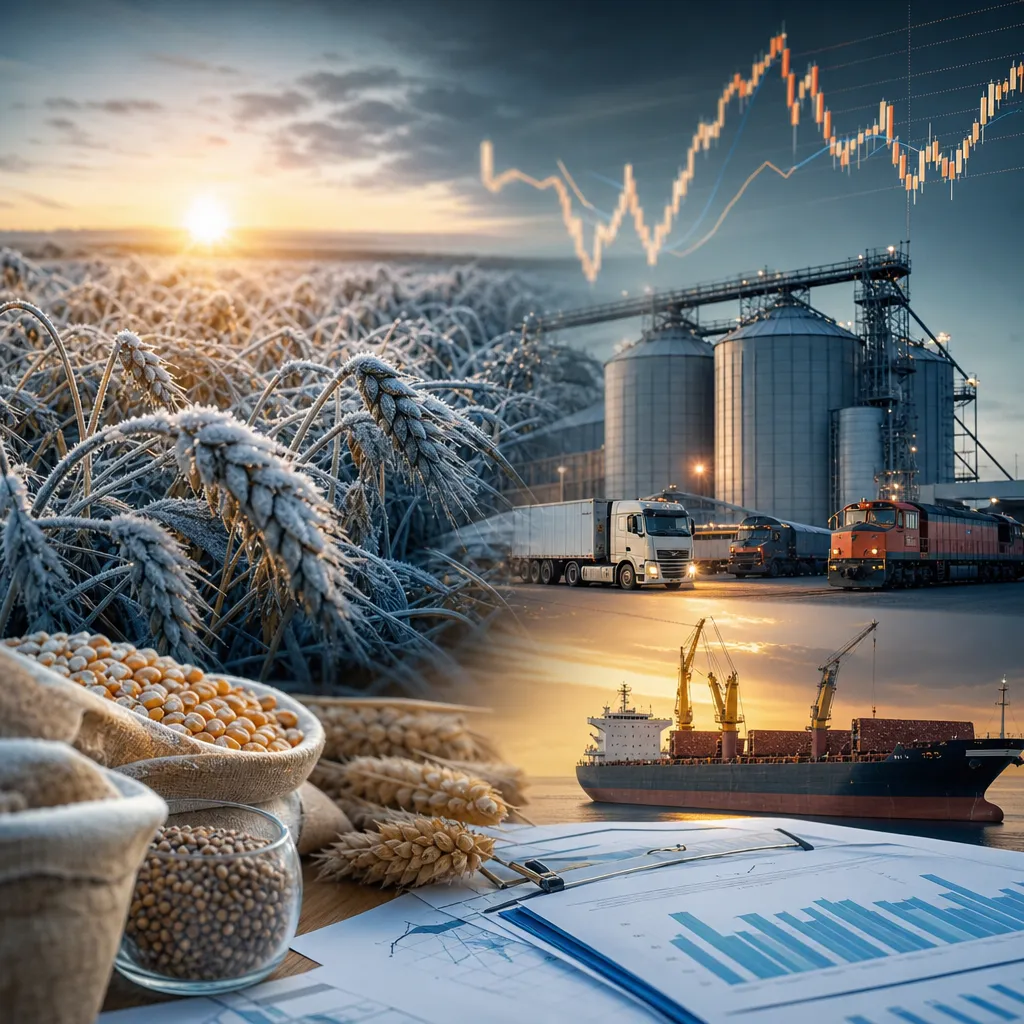
Frost risk matters to grain prices because it can cut yield, damage grain quality, delay harvest, and shift exportable supply in a very short time. Markets react before the full crop loss is measured, so a frost forecast can move futures first, then local cash bids, basis, and freight spreads as the trade reassesses supply. The practical point is that readers should watch both the weather signal and the market channel through which that signal is priced: exchange futures, local elevator bids, processor bids, and export values do not move in exactly the same way. Frost is therefore both a crop risk and a pricing risk, especially for wheat, corn, soybeans, canola, barley, oats, sorghum, and sunflower seed in late season.
In practice, frost affects grain prices through three linked mechanisms: expected production, expected quality, and timing. If the market thinks frost will reduce yield or downgrade grain, futures on regulated exchanges may rise because tradable supply looks tighter. If the damage is local rather than national, the larger effect may appear in cash basis at elevators, mills, feed plants, crushers, or export terminals. If frost disrupts harvest flow, nearby cash markets can tighten even when futures barely move.
How frost risk enters grain pricing
Frost risk is not just a weather headline. Traders translate it into market questions: Which crops are vulnerable, which growth stage are they in, how large is the affected area, and is damage reversible? A light frost on mature wheat may have limited impact, while an early freeze on immature corn or soybeans can reduce test weight, moisture profile, oil content, or final yield.
The price effect depends on where the crop is in development:
- Before maturity: frost can stop grain fill and reduce yield.
- Near maturity: volume loss may be limited, but quality risk can still matter.
- After maturity but before harvest: logistics and quality may matter more than yield.
For milling wheat, malting barley, seed crops, and food-grade grains, quality damage can be as important as tonnage loss. A crop may still exist physically but lose access to a premium market. In that case, the futures market may not fully capture the economic loss at farm level because the discount appears in the local cash market.
| Frost impact channel | How it affects price | Where it shows up first |
|---|---|---|
| Yield loss | Reduces expected production and tightens supply | Futures market, then cash bids |
| Quality downgrade | Widens discounts for damaged grain and shifts demand to higher grades | Local elevator, processor, maltster, mill, or exporter bids |
| Harvest delay | Tightens nearby physical availability and may change spreads | Nearby cash market, logistics chain, basis |
| Regional crop loss | Raises bids in affected area if buyers still need coverage | Country elevator, feed mill, crusher, ethanol plant |
| Export supply shock | Supports benchmark values if major exporting origin is hit | Futures, FOB export values, port bids |
Futures prices versus local cash prices
A common mistake is to assume a rally in wheat, corn, or soybean futures is the same as the local farmgate price. It is not. Futures are standardized contracts traded on exchanges such as CME Group for crops like corn, soybeans, soybean products, Chicago wheat, Kansas wheat, oats, and rough rice; canola futures are also used in some markets through exchange-traded benchmarks relevant to oilseed trade. These contracts reflect a broad market price for a defined grade, delivery month, and delivery mechanism.
Local cash prices are what farmers or merchants can actually sell physical grain for at a specific location. They are normally quoted by grain elevators, cooperatives, feed mills, flour mills, crushers, ethanol plants, maltsters, exporters, or merchants. The cash price is usually built from:
- the relevant futures market or another benchmark,
- basis, which is the local premium or discount to that benchmark,
- quality adjustments,
- freight and handling,
- delivery timing.
During frost events, futures may react to national or international production risk, while basis reacts to local supply conditions. If frost hits a single producing region, local basis can strengthen sharply even if board futures move only modestly. If frost damages quality, local bids for premium grades may rise while damaged lots trade at steep discounts.
Where to check frost-related grain prices and market reactions
For exchange-traded prices, the primary reference point is the exchange itself and data distributors that carry those contracts. CME Group is the main regulated marketplace for many major US grain futures and options. Readers can check contract specifications, delivery months, and official settlement information there. Brokerage platforms and commercial data terminals also distribute futures and options data, but they are not the physical grain market.
For local cash prices, practical sources are:
- local grain elevator bid sheets,
- cooperative bid pages,
- processor bid postings,
- merchant or exporter bid indications,
- government or exchange-linked cash market reporting systems where available.
These bids may be published online, by phone, through text alerts, or inside farm marketing software. In many regions, farmers compare several nearby bids because frost can create highly local demand differences. A feed mill needing immediate coverage may pay differently from an export elevator, and both may differ from a crusher or ethanol producer.
For weather and crop confirmation, practical sources include official meteorological agencies, satellite-based weather services, and agricultural reports. Weather alone is not enough; traders usually validate it with crop condition reports, harvest updates, and trade flow information.
| Source type | What it provides | Who uses it |
|---|---|---|
| Commodity exchange | Futures prices, options, settlement data, contract specs | Traders, hedgers, analysts, merchants |
| Local elevator or cooperative | Cash bids, delivery periods, discounts, storage terms | Farmers, local grain sellers |
| Processor or mill | Direct-use bids, quality requirements, delivery windows | Farmers, merchants, brokers |
| Government crop reports | Condition, acreage, yield, stocks, exports | Entire grain trade |
| Weather services | Temperature risk, frost maps, forecast models | Farmers, analysts, proprietary traders |
How physical grain trade responds to frost
Physical grain does not trade the same way as a screen-based futures contract. A physical transaction usually happens between a seller and a buyer through an elevator, cooperative, merchant, broker, processor, exporter, or direct contract. The negotiation covers location, quantity, grade, moisture, damage limits, delivery period, freight responsibility, and payment terms.
When frost risk rises, buyers often become more selective about quality. That can change the commercial flow:
- milling wheat buyers may tighten protein or falling-number requirements,
- malting barley buyers may reject germination-damaged lots,
- corn buyers may increase discounts for low test weight or high moisture,
- oilseed crushers may pay according to oil content and foreign material,
- feed buyers may absorb downgraded grain if economics are favorable.
Where this happens physically depends on the market structure. In an export-oriented region, the key pricing point may be the port terminal or inland shuttle loader. In a domestic-use region, the key bid may come from a feed mill, flour mill, or crushing plant. Grain brokers may help match off-spec grain with alternative demand, but the final value depends on actual delivery terms and end-use tolerance.
Storage also becomes important. A seller facing frost-damaged grain may need to decide whether to move it quickly before quality deteriorates further or store it and target a different buyer later. That decision should include storage losses, aeration needs, blending rules if permitted, and insurance or warehouse conditions.
How traders and farmers use futures and options around frost risk
Futures and options are risk tools, not just speculation vehicles. A farmer worried that frost could push prices higher after an early sale may use call options to re-own upside exposure in limited form, while a processor worried about rising input costs may buy futures or calls to protect coverage. A producer facing uncertain production may avoid over-hedging before frost passes, because hedging bushels that may not be harvested creates production risk.
Key mechanics:
- Futures are standardized exchange contracts that require a brokerage account and margin.
- Options give the right, but not the obligation, to buy or sell a futures contract at a strike price before expiry.
- Cash forward contracts are physical agreements with elevators, merchants, or processors and are not the same as exchange futures.
- OTC contracts may exist through commercial counterparties but involve counterparty terms outside the central exchange model.
Frost raises two practical hedging issues. First, basis risk: even if futures hedge part of the board price, local frost damage can widen or narrow basis unpredictably. Second, production risk: selling futures or forward-contracting too much grain before a freeze event can leave the seller short physical bushels if yield collapses.
Access to futures and options is normally through a regulated futures broker or introducing broker connected to an exchange clearing structure. Access to physical forward contracts is usually through an elevator, cooperative, merchant, processor, or exporter. These are different channels, with different documents, risks, and settlement methods.
What reports and data matter most during frost scares
Not every report is equally useful. In frost-sensitive periods, the market usually combines weather data with crop-stage observations and official supply-demand frameworks.
- USDA Crop Progress: widely used for crop condition and harvest pace in the United States.
- USDA WASDE: gives the broader supply-demand balance for major crops and is used to judge whether weather damage changes national stocks.
- USDA Export Sales: helps show whether demand is strong enough to amplify a supply shock.
- CFTC Commitments of Traders: useful for seeing speculative and commercial positioning in futures markets.
- Exchange contract data: open interest, volume, and settlement structure help show how the market is pricing nearby versus deferred risk.
Outside the United States, traders also rely on national agricultural ministries, crop agencies, and customs or statistical offices for crop and trade insight. For international context, FAO helps frame broader global supply conditions, though it is not a replacement for local cash market intelligence.
Practical pricing scenarios after a frost event
There is no single frost-price outcome. The result depends on crop stage, scale, and trade positioning.
- Minor frost, limited area: futures may rise briefly, then fade if crop loss appears small.
- Widespread early freeze in a major exporting region: futures may rally more strongly, especially if stocks are already tight.
- Mainly quality damage: premium-grade cash markets may strengthen while lower-grade grain is discounted.
- Harvest disruption without major yield loss: nearby basis may improve because buyers need prompt movement.
- Frost after the market was heavily short: price reaction can be amplified by short covering in futures.
This is why readers should avoid relying on one indicator alone. A futures chart can show the financial reaction, but the real marketing result often depends on who is bidding locally, what quality they require, and whether freight or storage bottlenecks are developing.
Common mistakes when evaluating frost risk and grain prices
- Assuming a futures rally automatically means a better local cash price.
- Ignoring quality discounts and focusing only on bushels or tonnes.
- Forward-selling too much grain before a frost-sensitive period is over.
- Watching national benchmark prices but not local basis and delivery terms.
- Using weather forecasts without checking crop stage and field vulnerability.
- Confusing a broker platform for a physical grain buyer.
- Forgetting that damaged grain may need different storage management.
Where can I check grain prices when frost risk is rising?
Check exchange futures through the relevant commodity exchange and market-data distributors, then compare those values with local cash bids from elevators, cooperatives, processors, or exporters. The exchange shows the benchmark market; the local bid shows what a physical buyer will actually pay at a specific place and time.
Does frost always make grain prices go up?
No. Prices rise only if the market believes frost will reduce usable supply or quality enough to matter. If the crop is already mature, if the affected area is small, or if global stocks are comfortable, the price impact may be limited or temporary.
Where does physical grain trade happen after a frost event?
Usually through country elevators, agricultural cooperatives, grain merchants, processors, feed mills, crushers, maltsters, flour mills, and exporters. Direct farm-to-buyer contracts also occur in some regions, but quality, freight, and payment terms still need to be defined clearly.
Can I hedge frost-related price risk online?
Yes, but only through the financial market side and normally through a regulated futures broker offering access to exchange-traded futures and options. That is different from selling physical grain to an elevator or processor. A hedge can protect against some price moves, but it does not remove basis risk or production risk.
Why can local bids fall even when futures rise?
Because basis can weaken. Buyers may widen discounts for moisture, low test weight, frost damage, or uncertain storability. Futures reflect the broad benchmark market, while local bids reflect actual commercial demand for the grain quality available in that area.
Which crops are most sensitive to frost risk in pricing terms?
Corn and soybeans are highly sensitive when frost arrives before maturity. Spring wheat, canola, barley, oats, sorghum, and sunflower seed can also see important yield or quality effects depending on stage and temperature. The price response is strongest when the affected crop is a major component of domestic feed, processing, or export supply.
What should a farmer check before selling frost-affected grain?
Check grade standards, moisture, test weight, visible damage, local discounts, delivery point requirements, storage condition, and whether an alternative buyer values the grain differently. It is often worth comparing elevator, feed, processor, and merchant bids before committing.
Sources
- USDA World Agricultural Supply and Demand Estimates
- CME Group contract specifications and market data for grain and oilseed futures and options
- CFTC Commitments of Traders