


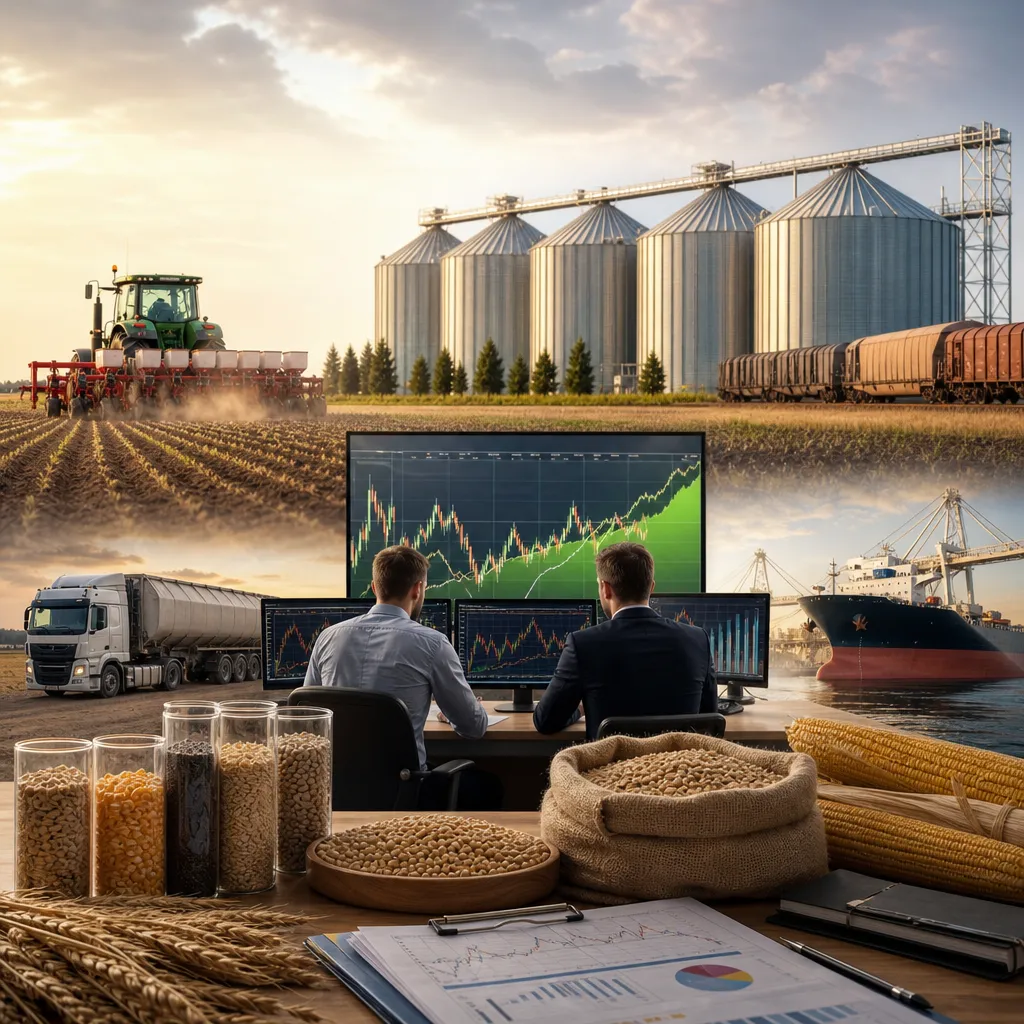
Planting season is one of the most important periods for grain prices because it sets the market’s first realistic estimate of acreage, production risk, and timing of new supply. Prices often react before a seed goes into the ground, then move again as weather, field progress, and early crop condition data either confirm or challenge expectations. In practice, planting season affects both exchange-traded futures prices and local physical cash bids, but those are not the same thing. Anyone following grain markets should know where to check each price, how planting risk is reflected in them, and why local basis, freight, and quality can matter as much as the futures board.
For crops such as corn, soybeans, wheat, canola, rice, sorghum, barley, oats, rye, and sunflower seed, planting season creates uncertainty around acreage and yield potential. That uncertainty is what the market prices. Farmers, elevators, processors, exporters, feed mills, and traders all use this period to adjust buying, selling, hedging, and storage decisions.
Why planting season moves grain prices
Planting season matters because grain markets trade expected supply, not just current inventories. If wet weather delays corn planting, the market may price in lower yield potential, more prevented plant acres, or a switch into another crop. If weather is favorable and planting progresses quickly, the market may reduce the weather premium that had been built into prices.
The mechanism is straightforward. Grain prices respond to changes in expected production, and production depends on acreage and yield. Planting season is the point when both become less theoretical and more measurable. Markets watch:
- Acreage intentions: how many acres farmers plan to seed.
- Planting progress: how much has actually been planted.
- Weather during the planting window: rain, soil moisture, temperature, and field access.
- Input economics: fertilizer, fuel, seed, and financing costs.
- Relative crop returns: whether corn, soybeans, wheat, canola, or another crop offers a better risk-adjusted margin.
When planting is delayed or acreage shifts unexpectedly, futures markets often move first because they aggregate expectations quickly. Local cash markets may react more slowly or in a more region-specific way depending on nearby demand, storage space, and logistics.
Futures prices versus local cash grain prices
A common mistake is to assume that the exchange price is the same as the price a farmer receives at the elevator. It is not. Futures are standardized contracts traded on regulated exchanges. Cash prices are the actual local bids offered by elevators, cooperatives, merchants, ethanol plants, mills, crushers, feed manufacturers, or exporters for physical grain delivered at a specific location and quality standard.
For example, corn and soybean futures are widely referenced through CME Group contracts. Wheat can be priced against different futures benchmarks depending on class and region. Canola has an exchange market in Canada, and rapeseed benchmarks are also used in Europe. But the price paid in the country elevator, inland processor, or export terminal still depends on local basis and logistics.
| Market type | What it shows | Where it is used | Main limitation |
|---|---|---|---|
| Futures market | Exchange-traded benchmark price for a standardized contract month | Hedging, speculation, price discovery, risk management | Does not equal a local delivered cash bid |
| Cash market | Actual local bid for physical grain at a delivery point | Farm sales, processor buying, elevator procurement, export execution | Highly local and affected by freight, quality, storage, and buyer demand |
| Basis | Difference between local cash price and futures price | Cash contracts, hedging decisions, merchandising | Can strengthen or weaken independently of futures |
During planting season, futures often react to national or international weather risk, while basis can reflect very local issues such as rail service, barge freight, road restrictions, elevator space, or a processor needing nearby grain.
Where to check planting-season grain prices and market signals
If you want to follow planting-season price action, start by separating benchmark futures data from local physical bids.
Where futures prices are quoted
Exchange benchmark prices are normally available from the relevant exchange and from broker or market-data platforms. For many globally watched grain contracts, CME Group is a primary source for contract specifications and delayed market data. Brokerage platforms and commercial data terminals may provide more detailed intraday pricing, charting, spreads, and options information.
What futures quotes tell you:
- Which crop the market is pricing.
- Which delivery month is active.
- The unit and currency of the contract.
- How the market is reacting to planting delays, acreage expectations, or weather forecasts.
What they do not tell you:
- Your local elevator bid.
- Your freight-adjusted net farm price.
- Whether your grain meets the buyer’s quality specs.
Where local cash bids are checked
Farmers and physical grain buyers usually check local bids through grain elevators, agricultural cooperatives, grain merchants, processors, mills, crushers, ethanol plants, feed companies, or export buyers operating in their region. These bids may be posted on company websites, mobile apps, text services, or farm account portals, or may be available directly by phone from the buyer.
In some countries, official or semi-official agricultural market reporting services publish representative cash prices, terminal prices, or regional market summaries. These are useful for benchmarking, but actual tradable bids still depend on delivery point, timing, moisture, test weight, grading, and freight.
Where planting progress and crop reports are found
For U.S. markets, USDA reports are central. USDA provides acreage estimates, planting progress, crop condition, stocks, export sales, and broader balance sheets. Traders, merchants, and analysts use those releases to compare market expectations with official data. In other countries, ministries of agriculture, statistics agencies, or grain boards may publish planting, acreage, or crop condition information, though reporting frequency varies.
How planting season affects specific crops
Not all grains react the same way. Timing, crop rotation, weather sensitivity, and substitute demand differ by crop.
| Crop | Planting-season sensitivity | Common market focus |
|---|---|---|
| Corn | High sensitivity to planting window and early weather | Progress pace, acreage, yield risk, ethanol and feed demand |
| Soybeans | Sensitive to acreage competition and later-season weather | Crop switching, export demand, crush margins |
| Spring wheat | Sensitive to delayed fieldwork in northern regions | Seeded area, protein outlook, export competitiveness |
| Rice | Sensitive to water access and regional logistics | Planting pace, irrigation conditions, milling quality |
| Canola or rapeseed | Affected by seeding conditions and vegetable oil demand | Acreage, crush demand, biofuel policy, export flow |
Cross-crop competition matters as well. If soybean economics improve relative to corn before final planting, acreage can shift. That is why planting season price moves are often relative, not isolated. One crop gains acres at another crop’s expense.
How physical grain buyers and sellers respond during planting season
In the physical market, planting season is not just a chart-driven event. It changes procurement behavior.
Farmers may delay cash sales if they believe weather risk could lift prices, or they may lock in a portion of expected production if profitable margins are available. Elevators and merchants may adjust basis levels to encourage deliveries or defend storage space. Processors such as mills, crushers, or ethanol plants may extend coverage if they are concerned about future supply risk. Exporters watch whether inland supply and port margins remain workable given futures moves and freight costs.
A physical grain transaction during planting season usually involves:
- A seller such as a farmer, cooperative, or merchant.
- A buyer such as an elevator, processor, feed mill, exporter, or another merchant.
- A contract structure, which may be spot, forward cash, basis-only, or hedge-to-arrive depending on the market.
- Defined delivery terms, including location, timing, grade, moisture, and sometimes protein or oil content.
- Freight responsibility, which may sit with the seller or buyer.
- Settlement and payment terms after delivery and any required inspection.
Where does this happen in practice? Most farm-origin transactions are arranged directly with local elevators, cooperatives, or processors, often by phone, through a grain merchandiser, on a buyer’s website, or through a farm marketing app. Larger commercial origination and destination trade can involve merchants, brokers, warehouse operators, and export houses using negotiated contracts rather than exchange execution.
How futures and options are used during planting season
Planting season is one of the main periods when hedging activity increases. A farmer may use futures or options to manage the risk that prices fall by harvest. A processor or feed buyer may hedge the risk that prices rise before physical coverage is secured.
Futures trading normally takes place through a regulated exchange and requires a futures brokerage account. The account is financial, not a warehouse account for physical grain. Traders post margin, which is a performance bond rather than a down payment on grain. Because futures are leveraged, price moves can produce gains or losses larger than expected, and margin calls can occur quickly.
Options are commonly used when a market participant wants price protection with asymmetric risk. A put option can help a producer establish a price floor while preserving some upside if the market rallies on planting weather risk. A call option can help a buyer protect against upside risk while remaining open to lower prices if conditions improve. Options involve premiums, time decay, and strike selection decisions, so they are not cost-free insurance.
Important limitations remain:
- Basis risk: local cash prices may not move exactly with futures.
- Contract mismatch: crop quality, delivery month, or location may differ from the exchange benchmark.
- Liquidity differences: nearby contracts may trade more actively than deferred months.
- Operational risk: a hedge works only if it matches the underlying exposure reasonably well.
Which reports and data matter most in planting season
Good planting-season analysis starts with reliable public data before moving to private analytics. The most practical sources are official reports, exchange data, and weather services.
- USDA Acreage and Prospective Plantings: used to compare intended or planted area with trade expectations.
- USDA Crop Progress: watched weekly for planting pace and early condition changes.
- USDA WASDE: used for broader supply and demand balance, including stocks and exports.
- USDA Export Sales: shows whether demand is strengthening or weakening while the crop is being established.
- CFTC Commitments of Traders: useful for seeing how large speculative and commercial positions are developing in futures and options.
- CME Group contract information: essential for checking contract size, delivery months, and benchmark pricing structure.
- National meteorological and agricultural agencies: important for rainfall, temperature, and drought conditions in major producing areas.
Commercial data services, charting platforms, and farm management software can add value by combining bids, basis history, weather maps, and hedge positions. But users should distinguish between a data platform and a market venue. A charting service shows information; it does not buy your grain. A futures broker executes financial trades; it does not replace a local elevator or exporter in the physical chain.
Practical risks, costs, and limitations
Planting-season markets can be fast and emotional because traders are pricing weather probabilities rather than confirmed production. That creates opportunity, but also large forecasting error.
Main practical risks include:
- Weather reversals: a delayed start can be offset by rapid later progress.
- Policy surprises: import rules, biofuel mandates, or export restrictions can change demand or trade flows.
- Currency moves: export competitiveness can change even when local crop conditions do not.
- Logistics constraints: freight, rail, barge, port, or storage problems can disconnect local cash markets from futures.
- Quality variation: even if prices rally, grain with poor quality or high moisture may face discounts.
Costs also matter. Hedging has brokerage and margin implications. Storage has physical cost, shrink, interest, and quality risk. Forward contracts reduce some price uncertainty but create performance obligations if production falls short. Buying or selling too much too early in planting season can create exposure if acreage or yield expectations change sharply.
How to use planting-season information well
The best approach is to combine public data, local market intelligence, and a clear distinction between price benchmarks and tradable local values.
- Check benchmark futures for the relevant crop and contract month.
- Check local bids from elevators, cooperatives, processors, or merchants in your delivery area.
- Track basis separately from futures.
- Follow official planting and acreage reports rather than relying only on headlines.
- Compare weather forecasts with actual field progress and soil conditions.
- When hedging, match contract month and expected sale window as closely as possible.
- Before making a physical sale, confirm grade, moisture, delivery point, freight terms, and payment timing.
Planting season does not determine the whole crop year, but it often sets the first major price range of the marketing season. Understanding how futures, basis, weather, acreage, and local buying programs interact is the practical key to using that period well.
Where can I check grain prices during planting season?
Check futures prices on the relevant exchange or through a broker or market-data platform, and check local cash bids through elevators, cooperatives, processors, merchants, or official market reporting services where available. Futures show benchmark market sentiment; local bids show what a physical buyer may actually pay in your area.
Why do grain prices rise before the crop is even planted?
Because the market prices expected supply. If acreage may fall, planting may be delayed, or weather may reduce yield potential, buyers and traders may bid prices higher before production is known.
Does a rally in futures guarantee a better local cash price?
No. A higher futures market can be offset by weaker basis, wider freight, poor local demand, or grain quality discounts. The final cash price depends on both the board and the local market.
Where does physical grain selling actually take place?
Usually through local elevators, agricultural cooperatives, processors, feed mills, merchants, or exporters. Sales may be arranged by phone, through a buyer’s website or app, via a grain merchandiser, or through negotiated contracts in the commercial trade.
How do farmers hedge planting-season price risk?
They may use futures, options, forward cash contracts, basis contracts, or combinations of these tools. Futures and options are accessed through a regulated futures broker, while cash contracts are arranged with a physical grain buyer.
Which reports matter most during planting season?
USDA Crop Progress, acreage-related USDA reports, WASDE, Export Sales, and CFTC positioning data are among the most followed in U.S.-linked grain markets. In other countries, official agriculture ministries and statistics agencies may play a similar role.
Can I trade planting-season grain volatility online without buying physical grain?
Yes, through regulated futures and options markets if you have an appropriate brokerage account. That is financial trading, not physical grain ownership. It involves leverage, margin, and significant risk.
What is the biggest mistake when interpreting planting-season prices?
The biggest mistake is treating an exchange quote as a farmgate price. Always separate futures, basis, freight, and quality adjustments before making a production, storage, or marketing decision.
Sources
- USDA National Agricultural Statistics Service
- USDA World Agricultural Supply and Demand Estimates
- CME Group