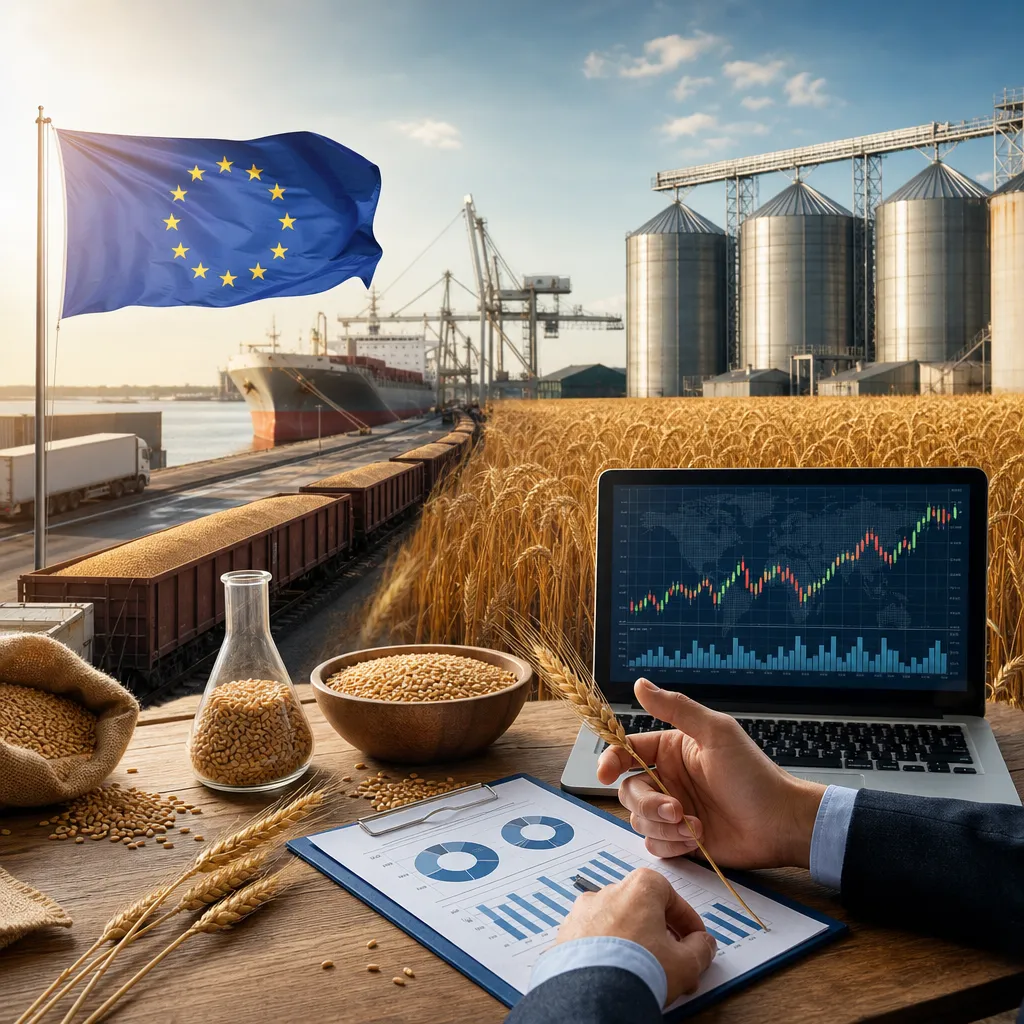
The European Union wheat market is not a single local cash market but a large, integrated regional system covering many producing and consuming countries, with France, Germany, Poland, Romania, and several other member states playing important roles. In practice, “EU wheat supply and demand” refers to how much wheat the bloc grows, carries in stock, feeds to livestock, mills into flour, uses industrially, imports, exports, and retains at the end of the season. Prices in this market are influenced by both local physical trade and international benchmarks, especially Euronext milling wheat futures. For anyone following the market, it is essential to separate exchange prices, export values, and inland cash bids, because they are related but not the same thing.
The EU is one of the world’s major wheat-producing and wheat-exporting regions, but its balance changes from year to year with weather, quality, Black Sea competition, currency moves, and internal logistics. Wheat is usually discussed in metric tonnes, and market values are commonly referenced in euros per tonne in EU trade and futures, although some export business is negotiated in US dollars per tonne. Because the bloc contains many different domestic markets, supply-and-demand analysis matters not only at EU level but also by country, port, and end-user sector.
What “EU wheat supply and demand” means
At a practical level, supply and demand is the balance sheet behind the market. On the supply side, analysts look at beginning stocks, production from the new harvest, and imports from outside the EU. On the demand side, they look at feed use, food milling, industrial use, seed, exports, and ending stocks.
For wheat in the EU, the most important distinction is often between quantity and quality. A nominally large crop does not automatically mean abundant milling wheat for export. Rain at harvest, protein levels, test weight, Hagberg falling number, and other quality factors can shift grain from higher-value milling channels into feed channels. That is why supply-and-demand discussion in the EU often focuses on both total wheat and usable export-quality wheat.
The market usually follows all-wheat supply broadly, but price formation often depends on smaller and more specific balances: milling wheat versus feed wheat, western EU surplus versus inland deficit areas, old crop versus new crop, and near-port availability versus interior stocks.
| Balance sheet item | What it means | Why it matters for price |
|---|---|---|
| Beginning stocks | Wheat carried over from the previous marketing year | Buffers a poor crop or amplifies a tight one |
| Production | Current harvest volume and quality | Main driver of EU availability |
| Imports | Wheat entering the EU from third countries | Can ease shortages in specific qualities or regions |
| Feed use | Wheat consumed by livestock sector | Competes with corn and barley, affecting domestic demand |
| Food and industrial use | Milling, starch, ethanol and other uses | Supports higher-quality demand and processing margins |
| Exports | Shipments from the EU to non-EU destinations | Major outlet for surplus wheat, especially in export-oriented countries |
| Ending stocks | Remaining wheat at season end | Key indicator of tightness or comfort going into the next crop year |
Where the EU wheat market operates
The EU wheat market operates across many national and regional cash markets, but several locations matter more because they concentrate export flows, milling demand, or surplus production. France is central because it is often one of the bloc’s largest producers and exporters of common wheat. Germany, Romania, Poland, and the Baltic member states are also important, while Spain and Italy are significant consumers and can be import-dependent in some years.
Physically, the market functions through country elevators, cooperatives, merchant networks, inland silos, feed mills, flour mills, rail and river routes, and export terminals. A farmer in France or Germany typically does not “sell to the EU”; the farmer sells to a cooperative, merchant, collector, or processor in a domestic cash market. That grain may later move to a mill, a feed plant, another member state, or an export terminal serving destinations outside the bloc.
On the financial and risk-management side, the best-known benchmark for EU wheat is Euronext milling wheat futures, historically associated with the MATIF market. It is a futures market, not a universal farm-gate cash market. Traders, exporters, importers, mills, and some producers watch it because it helps form price expectations and hedge risk.
How EU wheat prices are formed
EU wheat prices are formed through an interaction between futures, export competition, local supply-demand conditions, and quality. The benchmark futures price reflects tradable expectations for a standardized milling wheat contract. A local cash bid reflects what a physical buyer is willing to pay at a specific location for wheat with stated quality and delivery terms.
Readers should separate the following price types:
| Price type | Where it appears | What it means |
|---|---|---|
| Futures price | Euronext exchange screens and broker platforms | Benchmark value for standardised future delivery, used for hedging and price discovery |
| Cash bid | Local elevator, cooperative, merchant or processor | Actual physical buying price at a specific location and quality |
| Delivered price | Mill, feed compounder, inland processor, or terminal | Price including transport to the buyer’s destination |
| FOB price | Export market quotations | Free on board price at the export port before ocean freight |
| CIF price | Import tenders and destination markets | Cost including freight and insurance to the destination port |
| Basis | Cash market relationship to futures | Difference between local cash price and the benchmark futures price |
Basis is especially important. A French inland cash wheat price, for example, may be above or below the Euronext futures level depending on freight, local supply, quality, storage, and export demand. A strong export program can tighten nearby basis near ports. A burdensome harvest or quality discount can weaken basis inland. Currency also matters because export business often competes in dollar-denominated world trade while much of the EU cash market is discussed in euros.
The euro exchange rate can affect competitiveness. A weaker euro can make EU wheat more attractive to overseas buyers, while a stronger euro can make EU offers less competitive against Black Sea, US, or other origins. However, currency alone does not determine trade; freight, quality, geopolitics, and importer demand also matter.
Main drivers of EU wheat supply and demand
The biggest supply driver is weather. Autumn planting conditions, winter survival, spring moisture, heat during grain fill, and rain during harvest can all materially alter production and quality. Because the EU spans many climates, outcomes differ by region. A poor western EU crop may be partly offset by stronger results in eastern member states, but the quality mix and freight implications still matter.
Demand is shaped by several sectors:
- Feed demand: Wheat competes with corn and barley in animal rations.
- Milling demand: Relatively stable, but quality-sensitive.
- Industrial demand: Includes starch and, in some places, ethanol-related demand.
- Export demand: Highly sensitive to world prices, tenders, freight, and rival exporters.
Competing suppliers heavily influence the EU export balance. Black Sea origins are often a major reference point in world wheat pricing. If those origins are aggressively priced, EU exporters may need lower FOB values or stronger internal efficiencies to win business. If global supply tightens elsewhere, EU export demand can improve quickly.
Policy and regulation also matter. Trade measures, phytosanitary rules, sustainability standards, transport disruptions, and sanctions-related market dislocations can all affect the effective movement of wheat even when headline production appears comfortable.
How wheat is actually bought and sold in the EU
In the physical market, wheat is typically bought and sold through bilateral commercial transactions rather than on an exchange. Farmers deliver to collection points, cooperatives, merchants, or processors under cash contracts, forward contracts, storage arrangements, or delayed-pricing agreements, depending on local practice and buyer policy.
Key practical points in physical trade include:
- Quality specification: protein, moisture, test weight, impurities, falling number, and sometimes other milling criteria.
- Delivery terms: ex-farm, delivered silo, delivered mill, or delivered port.
- Timing: spot sale at harvest, post-harvest stored sale, or forward sale for future delivery.
- Payment and counterparty: seller should understand payment timing, dispute procedures, and contract terms.
Export trade is a further step in the chain. Merchants or exporters assemble wheat to meet vessel size and quality requirements, move it to port terminals, and sell it on FOB terms or into tender business. The export bid at port may be stronger than inland demand if overseas demand is active. But inland sellers do not receive the full export price automatically; transport, elevation, handling, finance, and margin all intervene.
Imports into the EU matter in specific years or regions, especially where local deficits exist or where import quality or freight economics are favorable. Southern consuming countries may sometimes be more import-sensitive than surplus northern or western zones.
How futures and hedging fit into the market
Futures are a risk-management tool, not the same as physical ownership of grain. In the EU wheat market, Euronext milling wheat futures are widely watched by commercial participants and analysts. A mill may buy futures to help manage rising price risk before it purchases physical wheat. A merchant or producer may sell futures to hedge against falling prices on unsold grain or forward purchases.
Using futures normally requires access through a broker or trading platform that supports exchange-traded derivatives. This involves margin, mark-to-market exposure, and contract expiry. It is essential to understand that a futures hedge reduces price risk but does not eliminate basis risk. The local cash price may move differently from the futures contract because location, quality, and logistics conditions can change.
Options can also be used where available and appropriate, allowing participants to manage risk with different payoff structures. But physical participants still need separate arrangements for storage, transport, quality certification, and customer contracts. A futures position does not arrange a truck, book port capacity, or guarantee the local buyer’s cash bid.
Where to check EU wheat prices and market information online
Readers looking for current prices should avoid assuming that one number represents the whole EU. The most practical approach is to monitor both benchmark futures and local physical indications.
Useful places to check include:
- Euronext: for milling wheat futures reference prices and contract information.
- European Commission: for EU market dashboards, trade context, and agricultural reporting.
- USDA: especially the Foreign Agricultural Service and World Agricultural Supply and Demand Estimates for international context.
- Eurostat: for official statistical context on production, trade, and related indicators.
- Local cooperatives, merchants, processors, and grain buyers: for actual cash bids in a specific region.
- Broker platforms and market reporting services: for futures access and professional market coverage.
When checking prices, confirm four things: the wheat type, the location, the unit, and the date. A futures quote in euros per tonne for a nearby Euronext contract is not the same as a farm bid in inland Romania or a FOB offer from a French port. Local cash values may differ because of basis, quality premiums or discounts, transport, storage charges, and buyer competition.
Trade flows, logistics, and the EU’s role in world wheat trade
The EU is important in world wheat trade because it can generate a sizable exportable surplus in good crop years. Export capacity is linked to surplus-producing regions and coastal loading zones, while internal trade redistributes wheat from surplus countries to deficit consuming areas. River, rail, truck, and port logistics all affect how much of the theoretical surplus is actually available to customers at a competitive price.
Ports matter because that is where inland grain becomes an exportable cargo. A port market is often stronger when exporters have vessel lineups, active tender demand, or tight nearby supply. It is weaker when world buyers step back, freight economics deteriorate, or competing origins undercut EU offers.
Inside the EU, trade flows also reflect quality segmentation. One member state may have feed wheat to move, while another needs milling-grade wheat. This means that “EU supply” is not interchangeable across all uses without cost or discount.
What to watch in forecasts and market outlook
Any forecast for EU wheat supply and demand should be treated as a scenario, not a certainty. The main watchpoints are planted area, crop condition, spring and summer weather, harvest pace, quality results, carry-in stocks, export momentum, feed substitution, and the euro’s competitiveness in world trade.
A practical framework is to think in three broad scenarios:
| Scenario | Conditions | Possible market implication |
|---|---|---|
| Large crop, good quality | Favorable weather and efficient harvest/logistics | Heavier exportable surplus, but prices still depend on world competition |
| Large crop, mixed quality | High tonnage but weather damage or lower milling specs | Feed wheat may be burdensome while milling wheat remains relatively supported |
| Smaller crop or tighter stocks | Weather losses, lower area, or stronger demand | Domestic basis and export pricing may strengthen, especially for reliable quality |
For traders and commercial users, the outlook is rarely just “bullish” or “bearish.” The better question is where the tightness or surplus sits: by country, by quality, by delivery period, and by export corridor.
Frequently asked questions
What is the main benchmark for EU wheat prices?
The most widely followed benchmark is Euronext milling wheat futures. It is a standardized exchange price used for reference and hedging, not a universal physical cash price across all EU regions.
In what currency and unit is EU wheat usually priced?
EU wheat is commonly discussed in euros per metric tonne in domestic and futures contexts. Export business can also be referenced in US dollars per tonne, especially when competing in international tenders.
Why is my local wheat price different from the futures price?
Your local cash price reflects basis, quality, location, transport costs, storage, and buyer demand. Futures provide a benchmark, but the actual bid depends on what a nearby merchant, cooperative, mill, or exporter needs.
Where can I check current EU wheat market information online?
For benchmark futures, check Euronext. For broader balance-sheet and trade context, follow the European Commission and USDA. For actual physical selling opportunities, check local buyers such as cooperatives, merchants, mills, and processors.
How is wheat physically sold in the EU?
It is usually sold through cooperatives, merchants, grain collectors, processors, and exporters under contracts that specify quality, delivery point, timing, and payment terms. The exchange itself is not the normal route for most farm physical sales.
Can someone outside the physical grain trade participate in EU wheat futures?
Yes, but normally only through an authorized broker or trading platform that offers exchange access. That is financial trading with margin and leverage, not the same as owning and moving physical wheat.
Is the EU mainly an exporter or importer of wheat?
At bloc level, the EU is often a significant wheat producer and exporter, but this varies by season. Some member states are structural buyers or occasional importers, while others produce exportable surpluses.
What are the biggest factors to watch in an EU wheat outlook?
Weather, harvest quality, carry-in stocks, Black Sea and other global competition, export demand, euro exchange-rate moves, and internal logistics are usually the main market drivers.
Sources
- European Commission
- Euronext
- USDA Foreign Agricultural Service