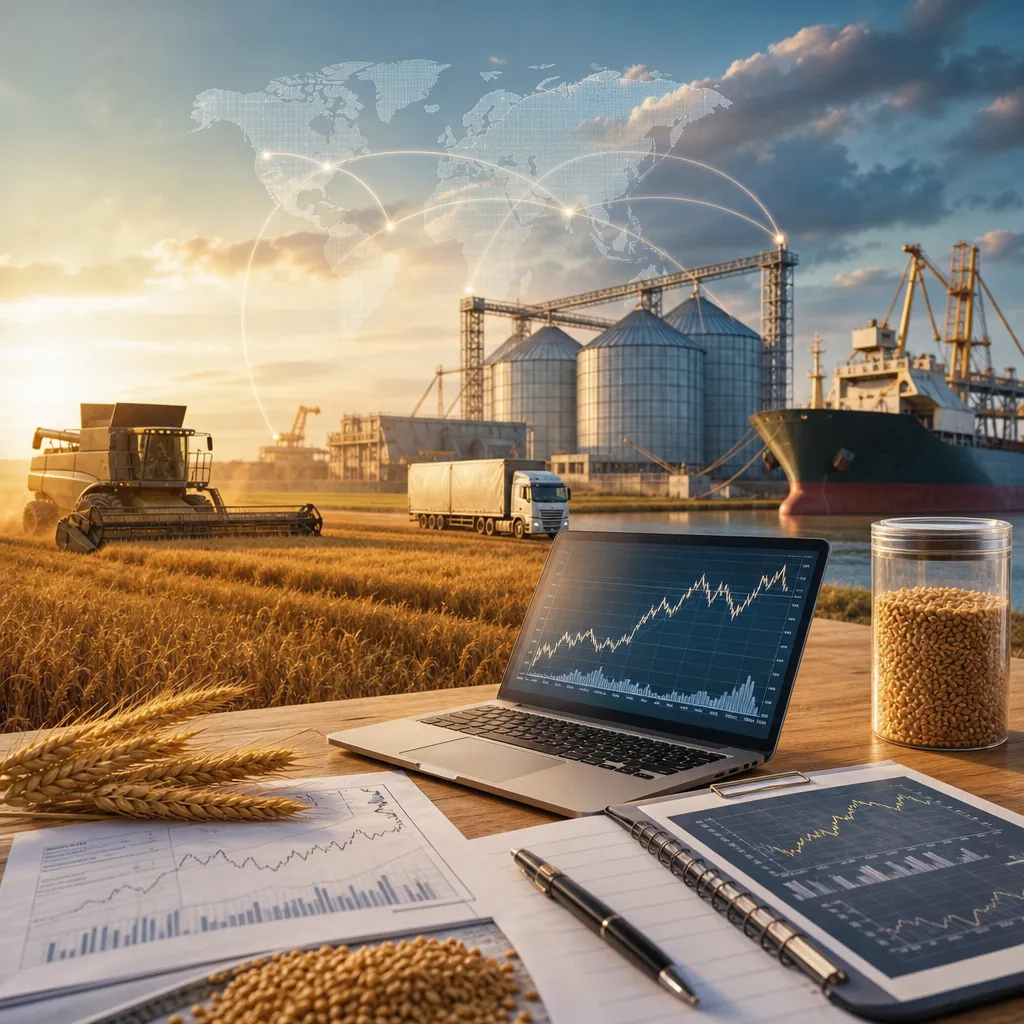
The EU wheat market is not a single farm-gate price but a network of national, regional, port, milling, feed, and export markets linked by a common policy framework and by Euronext wheat futures. In practice, when people discuss an “EU wheat price forecast,” they usually mean the outlook for milling wheat values across the European Union, especially the relationship between inland cash markets and the benchmark futures market in Paris. France is central because Euronext milling wheat futures are the main European benchmark, but Germany, Poland, Romania, Bulgaria, the Baltic states, Spain, and Italy also matter because local supply, demand, and logistics can push prices above or below the benchmark. A useful forecast therefore combines futures, basis, crop conditions, exports, imports, currency moves, and transport costs rather than relying on a single number.
Within the EU, wheat is priced mainly in euro per metric tonne. The key benchmark is Euronext milling wheat futures, often still referred to by many market participants as MATIF wheat. Physical trade, however, occurs through merchants, cooperatives, mills, feed compounders, exporters, and importers, with quality and delivery terms playing a major role. That is why a futures move in Paris does not always match the exact price offered to a farmer in northern France, eastern Germany, the Danube region, or a feed buyer in Spain.
For readers looking for a practical forecast, the essential question is not only whether wheat is “up” or “down,” but which wheat, where, for what quality, for what delivery period, and against which benchmark. The EU market is highly integrated, but it is still fragmented by protein, logistics, port access, and local demand. Understanding those differences is the key to reading the market correctly.
What the EU wheat market covers
The European Union is one of the world’s largest wheat-producing and wheat-trading regions. The most important wheat type for pricing and trade discussion is usually common wheat, especially milling wheat for flour production and feed wheat for livestock use. Durum wheat is also important in some areas, particularly for pasta demand, but it is a separate market and should not be confused with the main Euronext milling wheat benchmark.
Geographically, the EU wheat market includes major producing and exporting countries such as France, Germany, Romania, Bulgaria, and the Baltic states, as well as large consuming and at times importing countries such as Spain and Italy. Some regions are structurally export-oriented, while others depend more heavily on imports from within the EU or from third countries, depending on crop size and quality.
This matters for forecasting because the EU does not trade as a single physical pool. A poor harvest in one member state may tighten local supply while another member state still has exportable surplus. Prices therefore reflect both EU-wide balance sheets and regional dislocations.
| Market element | What it means in the EU wheat market | Typical unit/currency |
|---|---|---|
| Euronext wheat futures | Financial benchmark for European milling wheat expectations and hedging | Euro per metric tonne |
| Local cash bid | Price offered by a cooperative, merchant, mill, or feed buyer in a specific region | Usually euro per metric tonne |
| Export bid | Price linked to wheat assembled for shipment from an export hub or port | Usually euro per tonne, often by trade term |
| Delivered mill/feed price | Price including transport to the end user, often with quality specifications | Usually euro per tonne |
Where EU wheat prices are formed
The financial benchmark for EU wheat is Euronext milling wheat futures, traded in Paris. This futures market gives millers, exporters, traders, cooperatives, and funds a transparent reference for nearby and forward values. It is not the same as a physical cash bid, but it strongly influences physical pricing across the EU.
Physical prices are then formed in local markets. A cooperative in France, a grain merchant in Germany, a port trader in Romania, or a feed mill in Spain may all look at the same futures contract, but each will apply a different basis. Basis is the difference between the local cash price and the futures benchmark. It reflects quality, local supply and demand, transport cost, storage, competition among buyers, and export or import access.
For example, wheat near an active export port may trade at a stronger basis when international demand is firm. Inland areas with heavy harvest pressure or weaker logistics may trade at a lower basis. Feed wheat can also discount to milling wheat if quality falls short on protein, test weight, Hagberg falling number, or other contract terms.
Futures, cash, FOB, CIF, and delivered prices
- Futures price: Exchange-traded benchmark reflecting forward market expectations.
- Cash bid: Physical price offered locally for wheat collected from farm or delivered to a buyer.
- Basis: The premium or discount of local cash relative to futures.
- FOB price: Free on board price at the export point, before ocean freight.
- CIF price: Cost, insurance, and freight to the destination buyer.
- Delivered price: Price including inland transport to a mill, feed plant, or other user.
A forecast for “EU wheat prices” should therefore be read as a forecast for the benchmark and for the likely direction of basis, not as a guaranteed farm-gate number.
Main drivers of an EU wheat price forecast
The first driver is production risk. Wheat prices react to planted area, winter survival, spring moisture, heat stress, disease pressure, and harvest weather. In the EU, the condition of crops in France, Germany, Romania, Poland, and other major producers can quickly shift sentiment. Excess rain can damage quality even if tonnage is large, which may weaken feed wheat but support higher-protein milling grades.
The second driver is global competition. EU wheat must compete with other major exporters, especially the Black Sea region, North America, and at times Australia or Argentina depending on freight and crop timing. If competing exporters offer cheaper wheat into key destination markets, EU export demand can slow and local prices may weaken even if the domestic crop is only average.
The third driver is currency. Because international grain trade is heavily influenced by the US dollar, the euro/dollar exchange rate matters. A weaker euro can improve the competitiveness of EU wheat exports, while a stronger euro can make EU origin less attractive to importers abroad.
The fourth driver is intra-EU demand. Feed demand, flour milling demand, livestock margins, and substitution with maize or barley can change the internal balance. In deficit regions such as Spain in a dry year, stronger buying can support values even if the benchmark futures market is soft.
The fifth driver is logistics and freight. River levels, rail availability, port congestion, storage shortages, and trucking costs all influence basis. For eastern EU origins and Danube-linked trade, movement conditions can be especially important.
| Forecast factor | Likely market effect | Why it matters |
|---|---|---|
| EU crop size and quality | Large impact on benchmark and basis | More supply usually pressures prices, but poor milling quality can support premiums |
| Black Sea export competitiveness | Can limit EU export upside | Importers compare landed values across origins |
| Euro exchange rate | Affects export competitiveness | A weaker euro can support EU wheat in world tenders |
| Feed and milling demand | Changes regional basis | Local users can bid strongly even in a soft futures market |
| Freight and logistics | Mostly basis-driven impact | Transport cost alters the gap between inland and port values |
Practical forecast scenarios for EU wheat
An expert forecast should be scenario-based rather than a fixed price call. In a bearish scenario, the EU harvest is large, quality is broadly acceptable, export competition is aggressive, and feed users can substitute maize or barley. In that case, futures may weaken and basis may also soften in surplus inland regions during harvest.
In a supportive scenario, crop stress reduces yield, harvest rain lowers milling quality, and export demand remains active because competing origins are less competitive or have supply problems. Then futures can rise, milling premiums can strengthen, and port basis may improve relative to inland areas.
A mixed scenario is common in the EU. Total production may be comfortable, but quality may disappoint in some countries. That can produce softer feed wheat values but firmer premiums for specific milling grades. It can also create regional divergence, with exportable areas under pressure while importing regions remain relatively firm.
For most readers, the practical lesson is that the best EU wheat forecast is not one price estimate. It is a view on benchmark direction, quality structure, and regional basis risk.
Where to check EU wheat prices and market information online
Because live and current prices change continuously, it is safer to check official and market-recognized sources rather than relying on static articles. For the benchmark futures market, readers should monitor Euronext for milling wheat futures. This is the main reference point for European price direction and forward hedging.
For EU-wide supply, demand, trade, and policy context, the European Commission is highly relevant, especially for cereals market information. For international balance sheets and comparative exporter analysis, the USDA is widely followed, particularly its global grain reports.
For local physical prices, the most useful sources are usually:
- Farmer cooperatives and grain merchants in the relevant country or region
- Mills and feed compounders for delivered demand indications
- Port market commentary from physical traders and brokers
- National agriculture ministries or statistical agencies where market reporting exists
Readers should remember that a quoted futures price is not the same as a payable local wheat bid. Local bids may differ because of moisture, protein, falling number, test weight, mycotoxin risk, transport distance, delivery timing, and buyer competition.
How wheat is actually bought and sold in the EU physical market
Most physical grain in the EU is traded outside the exchange. Farmers usually sell to cooperatives, local merchants, processors, mills, feed manufacturers, or exporters. Contracts may be spot, forward, minimum-price, storage-based, or formula-linked to futures plus or minus a basis.
Quality matters. A wheat parcel may be sold as milling wheat only if it meets the buyer’s specification. If it falls short, it may be repriced as feed wheat. Contract terms often specify protein, moisture, test weight, Hagberg falling number, impurities, and delivery window. Payment terms, title transfer, and dispute rules are also important.
In export-oriented regions, merchants often assemble inland grain and move it by truck, rail, barge, or a combination of modes to port terminals. Export prices then reflect the port bid and the cost of getting wheat there. In importing regions, mills and feed users may price wheat on a delivered basis because logistics from other member states or overseas origins are central to the final cost.
Counterparty quality matters as much as price. In practical terms, sellers and buyers should pay attention to contract wording, quality tolerances, delivery obligations, and payment security.
How hedging and futures trading work in the EU wheat market
Futures and options are mainly used for price risk management, not for routine physical ownership. A cooperative, exporter, mill, or trader with exposure to wheat prices may hedge using Euronext wheat futures. The aim is to reduce market risk while continuing to buy or sell physical grain in the cash market.
An individual trader or firm normally accesses Euronext through a broker or trading intermediary. This requires a suitable account and the ability to meet margin requirements. Futures are leveraged instruments, so gains and losses can move quickly. Options can also be used to manage upside or downside risk, but they involve premiums and strategy complexity.
It is important not to confuse a futures position with physical wheat ownership. A farmer may watch futures online but still sell actual grain to a local cooperative. A merchant may hedge export commitments on Euronext without intending to take exchange delivery. There is also basis risk: even a well-hedged futures position may not perfectly protect the local cash price if basis changes unexpectedly.
EU export and import trade: why ports and logistics matter
The EU is both an exporter and an internal balancing market. France is a key export origin, while the Black Sea-facing member states and Baltic countries can also play major roles depending on crop size and competitiveness. At the same time, southern Europe can import significant volumes in seasons when domestic production is reduced by drought or when quality is insufficient.
Port values matter because export demand often sets the ceiling or floor for inland pricing in surplus areas. If FOB values are attractive and vessels are being covered, inland merchants may raise bids to secure supply. If export demand fades, inland basis can soften even if futures remain relatively stable.
For import-dependent users, the relevant comparison may be CIF import alternatives or delivered inland values from another EU origin rather than local harvest pressure alone. That is why the EU wheat market can show strong regional divergence at the same time.
FAQ
What is the main benchmark for EU wheat prices?
The main benchmark is Euronext milling wheat futures in Paris, usually quoted in euro per metric tonne. It is the leading European reference for pricing and hedging, but it is not identical to a local cash bid.
Where can I check EU wheat prices online?
For futures, check Euronext. For broader market context, the European Commission and USDA are widely used. For actual local physical bids, check cooperatives, merchants, mills, feed buyers, and regional market reports in the relevant EU country.
Why is my local wheat price different from the Paris futures price?
Because local prices include basis. Basis reflects quality, transport cost, location, storage, timing, local supply and demand, and buyer competition. A futures quote is only the benchmark part of the price.
Is EU wheat priced in euros or dollars?
Within the EU, wheat is commonly priced in euros per metric tonne. In global trade, dollar-based competition still matters because importers compare origins on an international basis.
How do farmers and grain companies in the EU sell wheat?
Most physical wheat is sold through cooperatives, merchants, processors, mills, feed manufacturers, and exporters. Sales can be spot, forward, or linked to futures plus or minus a basis, depending on the contract.
Can I buy EU wheat futures directly?
Access to Euronext futures normally requires a broker or intermediary and a trading account. Futures involve margin and leverage, so they are different from buying physical grain and require risk management discipline.
What matters more for a forecast: futures or local basis?
Both matter. Futures drive the benchmark direction, while basis determines how that move translates into the local cash market. In some periods, basis changes can be as important as the futures trend.
What are the biggest risks to an EU wheat price forecast?
The main risks are weather, harvest quality, export competition, currency moves, logistics disruptions, and changes in feed or milling demand. These can change both the benchmark and regional basis levels.
Sources
- Euronext
- European Commission
- USDA Foreign Agricultural Service