






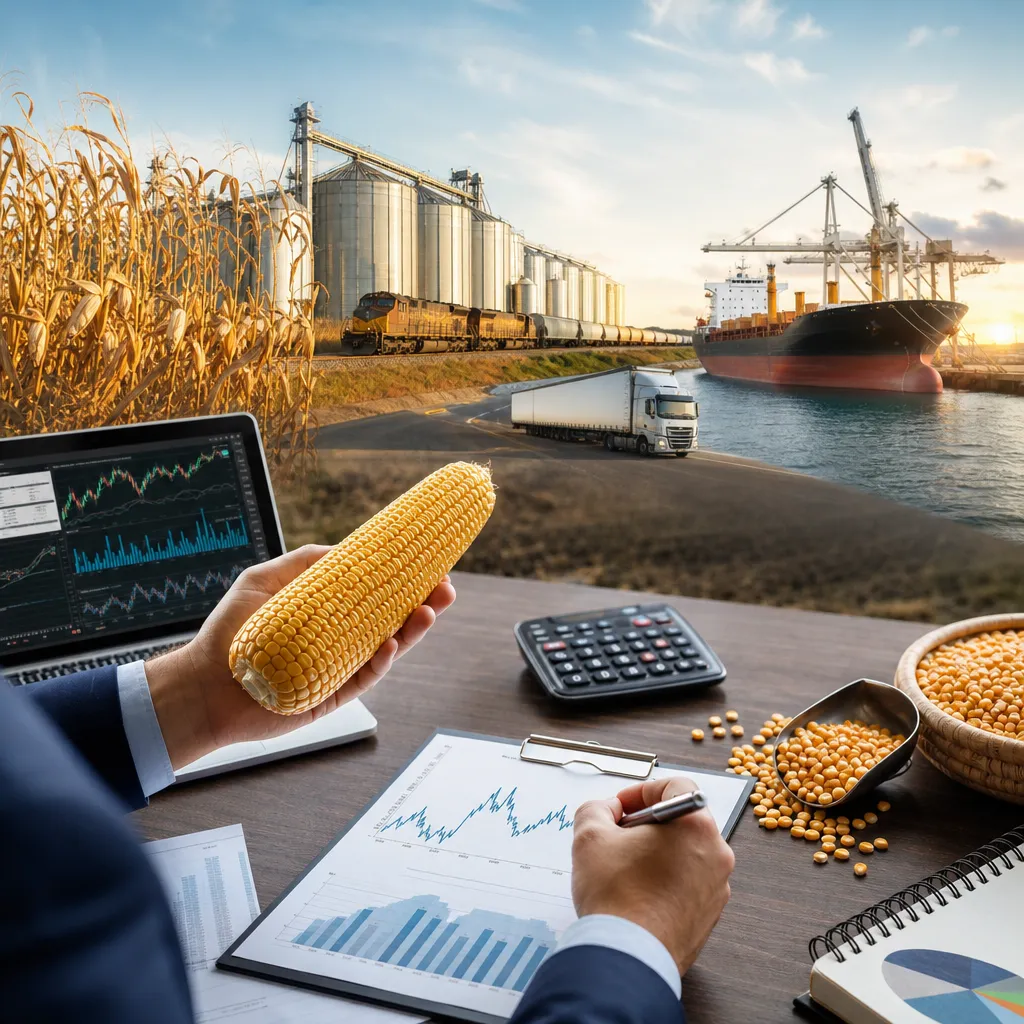
Corn prices in 2026 will most likely be shaped by a familiar set of forces: U.S. acreage and yield, South American production, feed and ethanol demand, exports, stocks, currency moves, and weather. No serious forecast should present a single “correct” number this far ahead; the practical way to think about 2026 is through scenarios. For farmers, buyers, and traders, the key is to understand where benchmark prices are formed, how those benchmarks translate into local cash bids, and which reports and market tools are worth watching. In practice, the 2026 corn outlook will matter differently depending on whether you are hedging production, buying physical grain, trading futures, or managing storage and logistics.
What “corn price forecast 2026” really means
When people discuss a corn price forecast, they may be referring to two different markets.
- Futures market: the benchmark price discovered on a regulated exchange, mainly Chicago Board of Trade corn futures, now part of CME Group. This is a financial and commercial risk-management market.
- Physical cash market: the price actually paid at a local elevator, processor, feed mill, ethanol plant, export terminal, or by a grain merchant. This is the real-world grain trade.
These prices are linked, but they are not the same. A farmer does not automatically receive the futures price. Local cash prices reflect the futures market plus or minus basis, which is the local premium or discount caused by freight, storage availability, local demand, quality, and regional supply.
So a useful 2026 forecast should answer two questions: where the benchmark market may go, and how local cash markets may behave around that benchmark.
Main scenarios for corn prices in 2026
The most accurate approach is to frame 2026 through bullish, neutral, and bearish setups rather than fixed targets.
| Scenario | Likely drivers | How it typically affects price |
|---|---|---|
| Bullish | Weather problems, lower yields, tighter stocks, stronger exports, firm ethanol or feed demand | Futures usually strengthen and basis can also firm in deficit areas |
| Neutral | Trend yields, balanced acreage, steady demand, manageable stocks | Prices tend to stay range-bound, with local basis doing more of the work |
| Bearish | Large U.S. and South American crops, weak exports, rising stocks, soft energy demand | Futures usually weaken and basis may also soften where storage is full |
At a high level, 2026 prices will likely depend on whether global corn supply remains comfortable or tightens unexpectedly. Corn is especially sensitive to weather during planting and pollination in the U.S., and to crop conditions in Brazil and Argentina because those countries strongly influence export competition.
The biggest drivers to watch in 2026
1. U.S. planted acreage
Corn competes with soybeans and, in some regions, other crops for acreage. Relative profitability matters. If corn input costs stay high and soybean margins look better, some acres may shift. If corn economics improve, acreage can expand. This matters because the United States remains the key benchmark market for global corn pricing.
2. Yield and weather
Yield risk is often the single most important variable. A small change in national average yield can have a major effect on ending stocks. Traders watch spring planting conditions, summer heat and moisture, and early frost risk. Weather markets can produce sharp futures volatility long before final production is known.
3. Ending stocks and stocks-to-use
Prices are not determined by production alone. What matters is production relative to demand and carryout. If ending stocks are large, the market has a buffer. If stocks tighten, prices become more sensitive to any new threat. Analysts often focus on stocks-to-use because it provides a clearer picture of how comfortable supply really is.
4. Export competitiveness
U.S. corn must compete with Brazil, Argentina, and other origins. Currency shifts matter here. A stronger U.S. dollar can make U.S. exports less competitive. A weaker dollar can support export demand. Export pace is tracked closely because it quickly reveals whether published projections are realistic.
5. Ethanol and energy economics
In the U.S., ethanol is a major demand channel for corn. Oil prices, fuel blending economics, policy settings, and plant margins can all influence usage. Stronger ethanol demand can tighten nearby supply, especially in regions with concentrated processing capacity.
6. Feed demand
Livestock, poultry, and dairy sectors drive feed demand. Feed usage can change with herd size, profitability, disease issues, and substitution with wheat, sorghum, or other feed grains when relative prices change.
7. Freight, storage, and logistics
Even when futures are stable, local cash prices can move sharply because of logistics. River conditions, rail service, trucking availability, port congestion, and local storage pressure can widen or narrow basis. This is where many physical-market decisions are made.
Where corn prices are quoted and how to check them
For benchmark futures prices, the main reference is CME Group, where CBOT corn futures trade. Those quotes are standardized contracts, not farmgate prices. Market data vendors, brokers, and charting platforms also distribute these prices, sometimes in delayed form and sometimes live depending on the subscription.
For physical cash prices, farmers and commercial users usually check:
- local elevator bid sheets, often posted online or on mobile apps,
- cooperative bid boards,
- ethanol plant bids, feed mill bids, and processor bids,
- grain merchant or exporter bids at specific delivery points,
- regional agricultural market reporting services where available.
A local bid normally shows:
- delivery location,
- delivery period,
- cash price or futures month plus basis,
- sometimes storage or delayed-pricing terms.
Anyone checking a 2026 outlook should monitor both benchmarks and local bids. A weak futures market can still leave some interior cash bids relatively firm if basis improves because of local demand or freight tightness.
| Market type | Where it is found | What it tells you | Main limitation |
|---|---|---|---|
| Futures | CME Group, broker platforms, market-data services | Benchmark price for standardized corn contracts | Not the same as local cash value |
| Local cash bids | Elevators, cooperatives, processors, merchants | Actual price available at a specific point and period | Highly location- and quality-specific |
| Export values | Merchants, port bids, trade reporting, customs and official export data | Competitiveness in world trade | Can differ greatly from inland farm bids after freight |
How farmers, buyers, and traders use a 2026 forecast
A forecast is only useful if it affects action. Different participants use it differently.
Farmers and grain sellers
Producers use 2026 outlooks to guide acreage plans, pre-harvest marketing, and storage strategy. In practice this may involve forward cash contracts with an elevator, hedge-to-arrive contracts where available, futures hedges through a broker, or simply setting target prices for incremental sales.
Physical selling usually takes place through elevators, cooperatives, processors, grain merchants, or direct commercial buyers. Key details include delivery window, moisture and grade standards, discount schedules, freight responsibility, and payment timing.
Feed mills, livestock operators, and processors
These buyers monitor forecasts to decide whether to buy spot grain, extend coverage, or hedge input costs. Their risk is often the opposite of the farmer’s: rising prices and tightening nearby availability.
Merchants and exporters
Commercial traders combine futures, basis, storage, freight, and export demand to manage margin. They are usually less focused on “price prediction” alone and more focused on spreads, pipeline coverage, and execution risk.
Speculators and financial traders
These participants trade CBOT corn futures or options through regulated futures brokers. They do not need to handle physical grain, but they do take on leverage and margin risk. A forecast for 2026 in this context is a trading thesis, not a purchase order for grain.
How corn futures and options work in practice
CBOT corn futures are standardized exchange contracts. They trade electronically through CME Group and are accessed through futures brokers. A broker account is normally required, along with margin capital and risk disclosures.
Important practical points:
- Futures are not the same as buying grain. You are trading a financial contract tied to a standardized delivery mechanism.
- Leverage cuts both ways. Small market moves can create large gains or losses relative to margin posted.
- Expiry matters. A trader who does not want delivery exposure normally offsets or rolls the position before the contract enters its delivery process.
- Basis risk remains. A producer who hedges futures still faces local basis changes when the physical grain is sold.
Options on corn futures are used to manage price risk with defined premium cost. Farmers may use puts to protect downside while retaining upside, and buyers may use calls to protect against rising prices. However, option value depends on volatility, time to expiration, and strike selection, so they are not simple substitutes for good cash marketing.
Where physical corn is bought, sold, and stored
The physical corn market functions through a network of commercial participants rather than a single central exchange. Common channels include:
- Country elevators and cooperatives: common first points of sale for farmers.
- Ethanol plants, feed mills, and starch or food processors: direct demand centers that may post bids.
- Grain merchants and exporters: buy inland and move grain to domestic or export destinations.
- River terminals, rail loaders, and port facilities: aggregate grain for long-distance movement and export.
- Warehouses and on-farm storage: allow timing flexibility but add quality and carrying-cost risk.
Storage decisions matter to any 2026 price view. Carrying grain into a later period only makes sense if expected price improvement covers storage cost, shrink, interest, handling, and quality risk. Commercial storage and warehouse arrangements vary by region and provider, so users should confirm grading rules, insurance responsibility, and settlement terms before committing grain.
Best reports and data sources for a 2026 corn outlook
Reliable forecasting depends on official and exchange data rather than rumor. The most relevant sources are:
- USDA WASDE: balance sheets for production, use, exports, and ending stocks. This is the core reference for supply-and-demand analysis.
- USDA Crop Progress: weekly updates on planting, emergence, condition, and harvest pace in the U.S.
- USDA Acreage and Grain Stocks reports: crucial for planted area and inventories.
- USDA Export Sales: weekly insight into demand and shipment pace.
- CFTC Commitments of Traders: shows positioning by different futures market participant categories.
- CME Group contract information and futures data: contract months, specifications, settlement structure, and market benchmarks.
- FAO and national agriculture agencies: useful for international context, especially outside the U.S.
These reports are mainly used online through official portals, broker research, agricultural market newsletters, and professional data terminals. Public data is often enough for many producers and smaller commercial users, while larger traders may combine it with private weather, satellite, freight, and cash-market intelligence.
Practical risks and limitations of any 2026 forecast
The biggest mistake is to treat any long-range corn forecast as certainty. Grain markets reprice quickly when weather changes, policies shift, or logistics break down.
Main limitations include:
- weather uncertainty remains high until the crop is grown,
- government policy can affect biofuels, trade flows, and tariffs,
- currency moves can change export competitiveness,
- local basis can move opposite to futures,
- storage and freight constraints can distort physical values,
- input costs can change acreage response before planting.
For that reason, the best use of a 2026 forecast is to create decision ranges, not perfect predictions. Farmers may scale sales in increments. Buyers may stagger coverage. Traders may define risk before entering positions. Forecasting is most effective when combined with disciplined execution.
FAQ
Where can I check corn prices for 2026?
For benchmark futures, check CBOT corn contracts through CME Group data or a futures broker platform. For actual physical selling or buying prices, check local elevator, cooperative, processor, or merchant bids. The local bid is what matters for real delivery.
Is the CBOT corn price the same as the cash price I receive?
No. The CBOT price is a futures benchmark. Your cash price depends on that benchmark plus or minus local basis, which reflects freight, demand, storage pressure, and delivery location.
Where does physical corn trading usually take place?
Physical corn is commonly traded through elevators, cooperatives, grain merchants, feed mills, ethanol plants, processors, river terminals, and exporters. Transactions may be arranged by posted bid, direct negotiation, or brokerage depending on the market structure.
How can a farmer hedge corn for 2026?
A farmer may hedge using CBOT corn futures or options through a regulated futures broker, or use commercial contracts offered by elevators or grain buyers. Futures reduce price exposure but leave basis risk, while cash contracts reduce price uncertainty but may limit flexibility.
What reports matter most for a corn forecast?
USDA WASDE, Acreage, Grain Stocks, Crop Progress, and Export Sales reports are central. CFTC Commitments of Traders can help explain speculative positioning, and CME contract data helps users understand the futures market structure.
Can I trade corn online without buying physical grain?
Yes. Corn futures and options can be traded online through a futures broker on a regulated exchange. That is different from purchasing truckloads, railcars, or warehouse grain in the physical market.
What is basis and why does it matter in 2026?
Basis is the difference between local cash price and the relevant futures price. It matters because a correct futures view can still produce a disappointing physical sale if basis weakens, or a better-than-expected sale if basis strengthens.
Should storage be part of a 2026 marketing plan?
Often yes, but only if expected improvement in cash price or basis is enough to cover interest, storage charges, handling, spoilage risk, and quality loss. Storage is a commercial decision, not automatically a bullish strategy.
Sources
- USDA World Agricultural Supply and Demand Estimates
- CME Group Corn Futures and Options Contract Information
- CFTC Commitments of Traders