

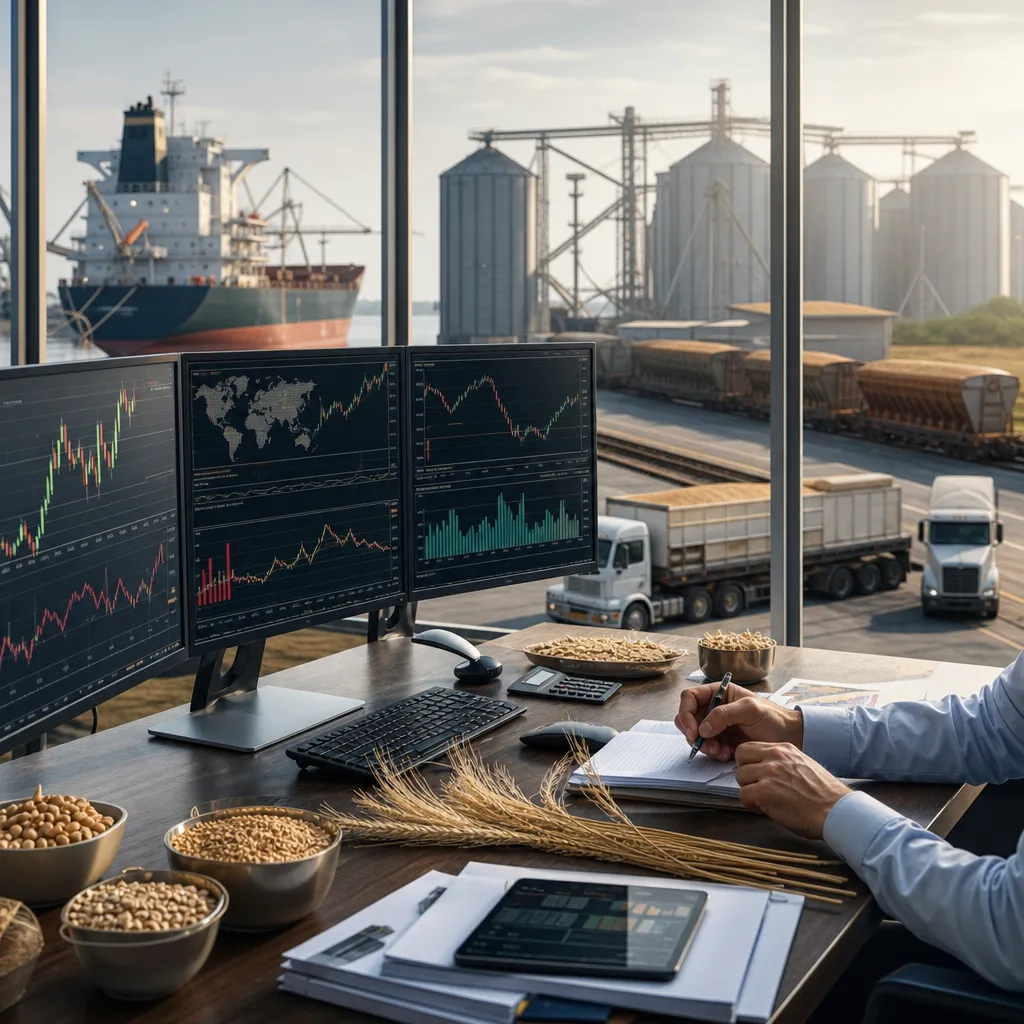
Grain day trading means trying to profit from short-term price moves in grain-related markets, usually futures contracts on corn, wheat, soybeans, soybean meal, soybean oil, oats, canola, or rapeseed-linked products where available. In practice, most day trading in grains happens on regulated futures exchanges through a futures broker and trading platform, not by buying trucks of physical grain. The job is to read fast-moving information such as weather forecasts, USDA reports, export news, spreads, and intraday order flow, then manage risk tightly because grain futures are leveraged and can move sharply within minutes. A practical grain day trader must know where prices are quoted, how futures differ from local cash bids, which reports move the market, and how execution, margin, and contract specifications work.
For most readers, the first step is to separate financial grain trading from physical grain merchandising. Day trading normally uses exchange-listed futures and, less often, options. Physical grain is sold through elevators, cooperatives, merchants, processors, mills, feed companies, or exporters, with pricing affected by basis, freight, quality, and delivery terms. A futures quote is a benchmark; it is not automatically the price a farmer or buyer receives locally.
What grain day trading is and where it happens
Grain day trading usually takes place on regulated commodity exchanges via a licensed futures broker. In the United States, the main venue is the CME Group, which lists major agricultural futures including corn, soybeans, soybean meal, soybean oil, wheat contracts, and oats. Market participants access these contracts through brokerage platforms that provide quotes, charting, order entry, and risk controls.
The trader does not need to handle physical grain to day trade futures. Instead, the trader opens and closes positions during the same session or within a very short time frame. This avoids carrying overnight exposure, although many traders do hold positions longer. Day trading can be based on chart patterns, report reactions, spread relationships, or macro drivers such as the U.S. dollar, energy markets, and river or port logistics.
Outside exchange trading, physical grain transactions happen in a different market structure. Farmers and grain owners usually sell to:
- grain elevators,
- agricultural cooperatives,
- local merchants,
- ethanol plants, crushers, mills, and feed manufacturers,
- exporters at river, rail, or port locations.
Those cash transactions may be negotiated directly, offered as posted bids, or arranged through contracts. They are affected by local supply, storage pressure, freight, and quality. A day trader in futures may watch the cash market for context, but is not normally taking part in physical delivery.
Futures versus physical grain: the difference that matters most
New traders often make a basic mistake: they see a futures quote and assume that is the tradable local grain price. It is not. A futures contract is a standardized exchange instrument with a delivery month, exchange rules, and a reference location or specification. A local cash bid is a physical buying price at a real location and reflects basis, which is the difference between the local cash price and the relevant futures market.
| Market | Where it exists | What price means | Who uses it |
|---|---|---|---|
| Futures market | Regulated exchange accessed through a broker platform | Benchmark price for a standardized contract month and specification | Traders, hedgers, funds, merchandisers, processors |
| Cash market | Elevators, cooperatives, processors, merchants, exporters | Actual bid or offer for physical grain at a delivery point with basis and quality terms | Farmers, grain owners, feed buyers, mills, exporters |
| Forward cash contract | Directly negotiated with a buyer or elevator | Future physical delivery price using cash terms, futures linkage, or basis agreement | Producers, merchants, processors |
For day trading, futures are preferred because they are centralized, highly standardized, and electronically tradable. For actual buying and selling of grain, the cash market matters more. Farmers and commercial users generally check both: futures for benchmark direction, local posted bids for executable cash values.
How grain day trading works in practice
A practical setup starts with a futures brokerage account that permits agricultural futures trading. The broker provides market access, margining, statements, and order routing. The platform may include charting, depth of market, and news feeds. Before trading, the trader should review contract specifications, minimum tick sizes, trading hours, and first notice or expiry rules on the exchange website.
The basic workflow looks like this:
- Choose a market, such as corn, soybeans, or wheat.
- Identify the most active contract month, since intraday liquidity often concentrates there.
- Check the session calendar, scheduled reports, and known event risks.
- Mark key levels from prior highs, lows, settlement, overnight range, and report reactions.
- Enter with a defined thesis and a predefined exit if wrong.
- Flatten or reduce exposure before major reports if the strategy is not designed for event risk.
- Keep records of entry, exit, slippage, and reason for trade.
Because grain futures are leveraged, traders post margin rather than paying the full notional value. That magnifies both gains and losses. A one-tick or one-cent move can have a meaningful monetary impact depending on the contract. This is why intraday risk controls matter more than prediction.
Day traders usually use one of four broad approaches:
- Momentum trading: following a sharp move after a breakout, weather shift, or export headline.
- Mean reversion: fading overstretched moves when liquidity returns and no fresh catalyst appears.
- Report reaction trading: responding to USDA, crop progress, or export sales surprises.
- Spread trading: trading relationships between months or related products rather than outright direction.
Which information moves grain markets intraday
Grain markets often react to a mix of agriculture-specific and macro inputs. Weather is especially important during planting and growing seasons, while logistics and export demand can dominate at other times. Intraday traders need a calendar of recurring market-moving events.
| Driver | Why it matters | Where to check it |
|---|---|---|
| USDA WASDE | Updates supply, demand, exports, ending stocks, and global balance sheets | USDA reports and market calendars |
| USDA Crop Progress | Tracks planting, condition, and harvest pace, especially for U.S. crops | USDA weekly crop reporting pages |
| USDA Export Sales | Signals international demand for U.S. grain and oilseeds | USDA export sales publications |
| Weather models | Rain, heat, and drought expectations can reprice yield risk quickly | Government weather agencies and specialized ag-weather services |
| CFTC Commitments of Traders | Shows how major trader categories are positioned | CFTC weekly reports |
| Energy and currency markets | Affect biofuels, export competitiveness, and broad risk appetite | Exchange data and macro market data services |
Traders should not rely on headlines alone. The important question is whether new information changes expected production, demand, stocks, or trade flows enough to justify repricing. For example, rain in a dry corn belt may be bearish if it improves yield expectations, while harvest delays can be bullish or bearish depending on storage pressure and export timing.
Where to find grain prices, bids, charts, and reports
For exchange-traded prices, the starting point is the relevant exchange website and the trader’s broker platform. CME Group provides contract specifications, delayed market information, expiration details, and educational material. Real-time pricing usually depends on broker or data-vendor arrangements.
For local cash prices, farmers and physical grain buyers typically check:
- posted bids from grain elevators and cooperatives,
- processor bids such as mills, crushers, feed manufacturers, or ethanol plants,
- merchant or exporter indications,
- official or semi-official market reporting systems where available.
In the United States, the USDA Agricultural Marketing Service publishes extensive cash grain market reporting, transportation information, and regional movement data. This helps distinguish benchmark futures from actual interior and terminal market conditions. In other countries, comparable information may come from agriculture ministries, commodity boards, statistical offices, or port-market reporting agencies.
For global context, analysts often combine:
- USDA balance sheet and crop reports,
- FAO market monitoring for broad food and commodity context,
- customs or trade databases for exports and imports,
- exchange data for price discovery, volume, and open interest,
- weather agencies for rainfall and temperature anomalies.
For software, it helps to separate four categories:
- Broker platforms: execution and account management for futures trading.
- Market-data terminals and charting tools: deeper analytics, spreads, news, and historical charts.
- Farm and grain management software: inventory, contracts, storage, and merchandising records.
- Physical marketplaces or broker networks: used for cash grain negotiation, not the same as exchange futures.
Core grain day trading strategies
1. Report reaction strategy
This strategy focuses on scheduled releases such as WASDE, Crop Progress, or Export Sales. The trader prepares by identifying consensus expectations from market commentary, mapping likely support and resistance, and deciding in advance whether to trade the first reaction or wait for a pullback. The risk is that the initial move may reverse quickly if the market had already priced in the news.
2. Weather volatility strategy
Weather matters most when crop development is sensitive to heat or moisture. Traders monitor forecasts, drought maps, and changes in model runs. The key is not whether weather is merely interesting, but whether it changes production risk. This strategy can work well in summer grain markets, but model-to-model noise can produce whipsaws.
3. Opening range breakout
Some traders use the early session range as a reference. A move above or below that range with volume can signal directional continuation. This is a pure market-structure method and can be combined with fundamentals, such as a stronger-than-expected export figure or overnight weather change.
4. Intermarket and crush or feed relationship trading
Professional traders often monitor relationships between grain and related products. Soybean traders may watch soybean meal and soybean oil. Corn traders may watch ethanol economics and feed substitution. Wheat traders may compare classes and exporting-origin competitiveness. These are advanced approaches and require understanding of product linkages, not just charts.
5. Calendar spread trading
Instead of trading direction outright, the trader buys one delivery month and sells another. This focuses on carry, nearby tightness, storage economics, and logistics. Spread trading may reduce some outright market risk, but it introduces its own complexity and can still move sharply around delivery periods and report changes.
Risk management, costs, and common mistakes
In grain day trading, survival depends more on risk control than on being right often. A good process includes position sizing, stop discipline, event awareness, and post-trade review. Many losses come not from bad analysis, but from oversized exposure during report releases or from holding a day trade after the original thesis has failed.
Main risks include:
- Leverage risk: futures magnify losses as well as gains.
- Gap risk: prices can jump on reports or weather changes.
- Liquidity risk: some contracts or times of day trade thinner than others.
- Execution risk: slippage can be material during fast markets.
- Basis misunderstanding: confusing futures direction with local cash reality.
- Delivery and expiry risk: holding the wrong contract too close to notice or expiration dates.
Practical costs to check with any broker or provider include brokerage commissions, exchange and clearing fees, market-data charges where applicable, and financing or margin requirements. These vary by provider and jurisdiction, so traders should confirm them directly rather than assume a standard schedule.
Common mistakes include trading USDA reports without a plan, using contracts without understanding tick value, relying on delayed data for fast execution, and treating weather headlines as confirmed yield outcomes. Another frequent error is ignoring volume and open interest when choosing a contract month.
How commercial grain users apply similar tools differently
Farmers, elevators, feed mills, crushers, and exporters may use the same futures markets, but their objective is usually hedging, not day trading. A farmer may sell futures or use options to protect a crop price while still producing and storing physical grain. A feed mill may buy futures to manage rising input costs. An elevator may hedge inventory and basis exposure.
Physical grain transactions usually involve more steps than a futures trade:
- Seller contacts an elevator, cooperative, merchant, or processor.
- Buyer quotes a bid based on futures, basis, delivery location, and quality.
- Parties agree on quantity, delivery window, moisture or grade terms, and payment terms.
- Grain is delivered by truck, rail, or barge depending on the market.
- Weight, inspection, and settlement occur according to contract terms and local practice.
This is where logistics, storage, grade discounts, and freight become essential. Day traders should understand these commercial flows because they help explain why basis firms or weakens, why nearby futures invert or carry, and why a futures rally may not fully translate into higher local bids.
FAQ
Where can I check grain futures prices?
You can check benchmark grain futures on exchange sources such as CME Group and on futures broker platforms. Exchange sites typically provide contract specifications and market information, while brokers and data vendors provide trading access and, depending on service level, real-time quotes.
Where do farmers check the price they can actually receive for grain?
Farmers usually check local elevator bids, cooperative bids, processor bids, ethanol plant bids, crusher bids, or exporter bids. These are cash prices for a delivery location and are not the same as futures quotes because basis, freight, and quality affect the final number.
Can I day trade grain by buying physical corn or wheat?
Not usually in the practical retail sense. Day trading is normally done through futures contracts on a regulated exchange. Buying and selling physical grain involves storage, transport, quality, delivery points, and commercial relationships with grain handlers or end users.
Which reports matter most for grain day traders?
The most watched U.S. reports usually include USDA WASDE, Crop Progress, Acreage, Grain Stocks, and Export Sales. Traders also monitor CFTC Commitments of Traders for positioning and official weather sources for developing crop risk.
What is the biggest difference between futures and cash grain prices?
Futures are exchange-traded benchmark contracts. Cash prices are local physical bids or offers. The difference is basis, which reflects location, logistics, local supply and demand, storage pressure, and quality or grade considerations.
Do grain day traders need a special type of broker?
They generally need a broker that offers regulated futures trading access to agricultural contracts. The account must support futures margining and order execution on the relevant exchange. Requirements vary by broker and jurisdiction, so the trader should confirm access, risk disclosures, and data arrangements directly.
Are options used for grain day trading too?
Yes, but less commonly than outright futures for pure day trading. Options add time value, implied volatility, and strike selection considerations. They are also widely used by commercial hedgers who want price protection with different risk characteristics than futures.
How do I avoid delivery problems when trading grain futures?
Know the contract’s first notice date, last trade date, and delivery rules on the exchange specification page. Most short-term traders close or roll positions well before delivery-related deadlines, especially in physically deliverable agricultural contracts.
Sources
- CME Group
- United States Department of Agriculture
- U.S. Commodity Futures Trading Commission