

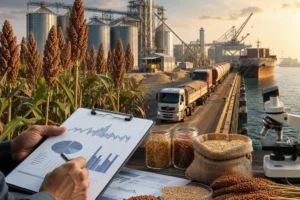



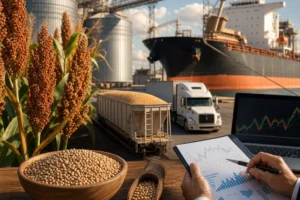

In the United States, sorghum does not have a major dedicated futures contract of the same importance as corn, soybeans, or wheat. When people refer to the US sorghum futures market, they usually mean the way US sorghum prices are managed and interpreted through related grain futures, especially CBOT corn futures, while the physical sorghum trade happens through local cash markets, feed channels, processors, and export programs. Sorghum is grown mainly in the Great Plains and parts of the Southern Plains, with Kansas and Texas central to production, and its cash price is commonly quoted in US dollars per bushel or US dollars per short ton/metric ton depending on the buyer and market channel. Understanding this market requires separating the financial benchmark used for hedging from the actual physical grain trade.
That distinction matters because a sorghum producer may watch futures prices online every day but still sell physical grain to a local elevator, feed mill, ethanol plant if accepted, or exporter at a cash bid that reflects location, quality, logistics, and buyer demand. In export trade, sorghum may also be valued against other feed grains in delivered and FOB terms rather than through a standalone futures market. So the practical US sorghum market is a combination of local basis-style pricing, substitution with corn in feed demand, and export competitiveness.
What the US sorghum futures market actually means
Unlike corn or wheat, US sorghum is not centered on a highly liquid flagship US futures contract used by the whole industry every day as the direct pricing reference. In practice, sorghum market participants often use corn futures traded at the Chicago Board of Trade, part of CME Group, as the nearest hedge benchmark because sorghum competes with corn in animal feed and sometimes in industrial demand.
That does not mean sorghum and corn are the same commodity. Sorghum prices can detach from corn because of local supply shortages, export demand, freight, grading factors, bird resistance premiums, moisture, test weight, tannin traits where relevant, and destination-specific quality needs. But from a risk-management perspective, corn futures often serve as the most practical listed price reference for many US sorghum users.
| Market element | What it is | Why it matters for sorghum |
|---|---|---|
| CBOT corn futures | Exchange-traded grain futures benchmark in the US | Often used as the hedge reference or pricing guide for sorghum |
| Local sorghum cash bid | Bid from an elevator, feed buyer, processor, or exporter | This is the actual price many farmers and merchants trade |
| Export bid | Price for sorghum moved into an export channel | Reflects vessel demand, destination buying interest, and logistics |
| Delivered feed price | Price to a feedlot, dairy, poultry integrator, or other end user | May differ from elevator bids because freight and urgency are included |
Where the market operates in the United States
The core physical sorghum market is in the central and southern US grain belt, especially the Plains. Kansas and Texas are typically among the most important states, with additional production in states such as Oklahoma and others depending on season and acreage decisions. Sorghum grows well in drier environments and is valued for its relative drought tolerance compared with some competing crops.
The financial side of price discovery is national. Traders, merchandisers, and producers monitor futures through CME Group markets and broker platforms, while the physical market is local and regional. Grain moves by truck, rail, and sometimes through export terminal systems connected to Gulf export channels. A local farm price in western Kansas will not be identical to a delivered export value on the Gulf, even if both are reacting to the same broad grain market trend.
In the US, pricing is usually expressed in US dollars. Farm and elevator bids are often quoted in dollars per bushel, while some feed, freight, or export discussions may use dollars per short ton or metric ton. Readers should always check the unit before comparing prices.
How sorghum prices are formed
US sorghum price formation starts with broad grain market fundamentals but ends with a very location-specific cash price. The biggest influences usually include corn futures direction, local sorghum supply, nearby harvest pressure, transportation capacity, feed demand, and export interest.
A practical way to think about sorghum pricing is:
- Futures benchmark: usually CBOT corn futures as the nearby market signal.
- Basis or cash adjustment: the local premium or discount applied by the buyer.
- Quality adjustment: moisture, damage, test weight, and other grade factors.
- Freight and destination: whether grain is picked up locally, delivered to a mill, or moved toward export.
- Buyer competition: a strong nearby feed or export buyer can tighten the market.
Basis is especially important. In grain merchandising, basis is the difference between the local cash price and the benchmark futures price. Even though sorghum does not map perfectly onto corn futures, many market participants still think in basis-like terms when comparing sorghum bids against corn values or a related flat-price benchmark.
FOB pricing means free on board at the export point, where the seller delivers the grain onto the vessel or into the export position under agreed terms. CIF pricing includes cost, insurance, and freight to the destination. A local country elevator bid is neither of those: it is an inland cash bid that already reflects the cost and margin required to move grain from farm to a downstream market.
| Price type | Where quoted | What it means |
|---|---|---|
| Futures price | Exchange or broker platform | A tradable financial benchmark, not a farm-gate sorghum cash quote |
| Cash bid | Elevator, cooperative, merchant, processor | Price offered for physical grain at a specific location and time |
| Delivered price | Feed buyer or processor | Price including transport into the buyer’s facility |
| FOB export price | Export market | Value of grain at the export point before ocean freight to destination |
Where to check sorghum prices and market information online
There is no reliable way to state a single live US sorghum price without specifying location, buyer, quality, unit, and date. A local Texas elevator bid and a Kansas feed mill bid may differ sharply, and neither should be confused with a CBOT corn futures quote.
For practical market checking, readers usually combine several sources:
- CME Group for corn futures prices, contract months, and futures market structure.
- USDA Agricultural Marketing Service for cash grain and feed market reporting where available, including regional grain reports and terminal market information.
- USDA Foreign Agricultural Service for US export sales, trade context, and international demand signals.
- USDA National Agricultural Statistics Service for acreage, production, stocks-related context, and crop progress or summary data when available.
- Local elevators, cooperatives, and grain merchants for actual sorghum cash bids.
- Broker and trading platforms for futures charts and options pricing if the user is hedging or trading risk.
The key point is that a producer selling physical sorghum needs the local bid, not just the futures screen. A trader managing price risk may need both the futures market and a view of local basis. An exporter may focus more on delivered shuttle, terminal, or FOB economics.
How physical sorghum is bought, sold, and exported
Physical sorghum trade in the US normally starts with a cash transaction between the producer and a first buyer. That buyer may be a country elevator, cooperative, feedlot-related buyer, grain merchant, or exporter. Contracts can be spot, forward, basis-related, or delivery-window agreements depending on the counterparties.
Before delivery, the parties usually agree on:
- Quantity and delivery period.
- Location of delivery or pickup.
- Quality and grading terms.
- Pricing method, whether fixed cash, later pricing, or benchmark-related.
- Payment timing and contract terms.
Once purchased, sorghum may move into domestic feed use, stored inventory, or export channels. Export trade depends on international feed grain demand and the relative value of US sorghum versus corn and other coarse grains. The Gulf export system is important for many US grain flows, but inland freight economics heavily influence whether sorghum can compete into export positions.
Import activity in sorghum is far less central to the US market than domestic production and exports. The US is mainly a producer and periodic exporter rather than a structurally import-dependent sorghum market.
How futures and options are used for hedging
For risk management, the sorghum market often relies on cross-hedging. This means using a related futures contract, usually corn, to manage part of the price risk of physical sorghum. It is useful, but imperfect. The main risk is that sorghum cash values may move differently from corn futures, especially when export demand or local shortages drive sorghum-specific premiums.
A practical hedge structure may involve selling corn futures or buying put options while holding or planning to purchase physical sorghum. The purpose is not to copy the sorghum cash price exactly, but to reduce exposure to a broad decline in feed grain values.
Users of futures and options include:
- Farmers protecting expected sales value.
- Elevators and merchants managing inventory risk.
- Feed users protecting replacement cost.
- Speculators trading grain price direction without owning physical sorghum.
Futures and options access normally happens through a registered broker or futures commission merchant. That requires a trading account and margin capability. This is different from owning physical grain. A screen trade changes financial exposure; it does not move sorghum in a truck, railcar, bin, or vessel.
Main drivers of the US sorghum market
The US sorghum market responds to a mix of crop-specific and broader grain factors. Weather in the Plains matters because sorghum is concentrated in dryland areas where rainfall timing can be critical. Acreage decisions also matter, since farmers may shift among sorghum, corn, soybeans, wheat, or other alternatives depending on expected returns and agronomic conditions.
Other major price drivers include:
- Corn market direction: because sorghum competes in feed rations.
- Export demand: strong overseas buying can lift US sorghum above normal feed relationships.
- Rail and truck logistics: freight can widen or narrow inland basis.
- Harvest pace and storage capacity: heavy movement can pressure nearby bids.
- Quality: weather damage or grading issues can affect merchant demand.
- Currency and competing exporters: these matter most in export-oriented price discovery.
Forecasting the market should be done by scenario, not certainty. A large Plains crop with soft exports may weaken cash bids even if futures are steady. A smaller crop or a sudden export program can tighten local markets quickly. Because sorghum lacks a dominant dedicated futures benchmark, local cash relationships can become especially important during these periods.
Practical differences between online trading and the real grain market
Many newcomers assume that if there is a futures chart, that chart is the commodity market. In US sorghum, that view is too simple. The online side of the market is mainly about price discovery and risk transfer. The real grain market is about ownership, movement, storage, quality, and delivery.
A producer may watch corn futures on a phone app, then call three local buyers for sorghum bids and sell to the best net return after trucking. A merchant may buy cash sorghum in Kansas and hedge part of the position in corn futures. A speculator may trade corn futures because they expect feed grain prices to fall, but they may never own a bushel of sorghum.
Understanding that separation helps avoid a common error: treating a futures quote as the exact value of local grain. In reality, the final price is shaped by basis, transport, storage, quality, and immediate buyer competition.
FAQ
Is there a major US exchange-traded sorghum futures contract?
Not in the same practical sense as corn, soybeans, or wheat. Most commercial sorghum price risk management in the US uses related grain benchmarks, especially CBOT corn futures, alongside local cash market pricing.
Where can I check current US sorghum prices?
Check local elevator or cooperative bids for actual cash prices, USDA Agricultural Marketing Service reports for regional market information, and CME Group for the corn futures benchmark often used in sorghum analysis. Always confirm the location, unit, and date.
Why is my local sorghum bid different from corn futures?
Because futures are only a benchmark. Your sorghum bid reflects local supply and demand, freight, quality, buyer competition, storage conditions, and whether the grain is going into feed use or export channels.
Is sorghum priced in bushels or tons in the United States?
Both are used. Farm-level and elevator cash bids are often quoted in US dollars per bushel, while some feed, export, or logistics discussions may use dollars per short ton or metric ton. Check the unit before comparing offers.
How do farmers usually sell physical sorghum?
Usually to local elevators, cooperatives, merchants, feed users, or exporters under spot or forward contracts. The transaction is a physical grain sale with agreed quality, delivery location, and payment terms.
How do traders hedge sorghum if there is no dominant standalone futures contract?
They often cross-hedge with corn futures or use options on corn futures. This reduces general feed grain price risk, but it does not eliminate sorghum-specific basis risk.
Does the US sorghum market depend on exports?
Exports can be very important in some seasons and can strongly affect inland bids, especially when international buyers are active. However, domestic feed demand and substitution with corn also remain central drivers.
What is the best benchmark for following US sorghum market direction?
For financial market direction, many participants watch CBOT corn futures. For actual tradeable physical value, the best benchmark is the local sorghum cash bid from the buyer relevant to your region and delivery point.
Sources
- CME Group
- USDA Agricultural Marketing Service
- USDA National Agricultural Statistics Service