
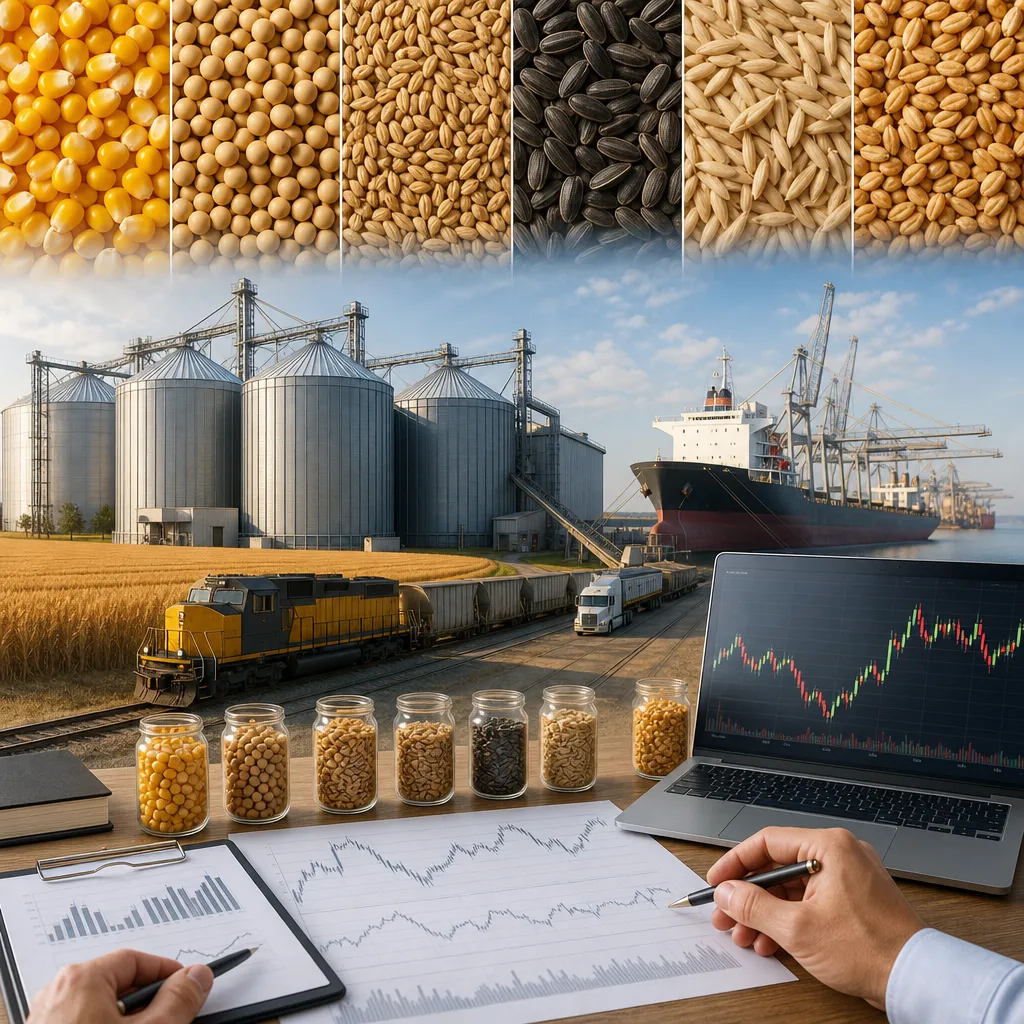
Grain options are exchange-traded contracts that give the buyer the right, but not the obligation, to buy or sell a grain futures contract at a set price before expiration. They are used by farmers, elevators, feed mills, exporters, processors, and traders to manage price risk or take a market view with defined option premium risk. In practice, grain options are usually accessed through a futures broker on regulated exchanges such as CME Group, while physical grain is still bought and sold separately through elevators, cooperatives, merchants, processors, and exporters. The most important practical point is that an option usually hedges or references a futures market price, not the exact local cash bid a farmer receives.
Understanding grain options starts with three linked prices: the futures price, the option premium, and the local cash price. The futures contract is the underlying financial benchmark; the option premium is what the buyer pays for the right embedded in the option; and the cash price is what is negotiated in the physical market after basis, freight, quality, and delivery terms are considered. That difference explains both the usefulness and the limitation of options in grain marketing.
What grain options are and how they work
A grain option is a contract on a grain futures contract. The two basic types are calls and puts.
- Call option: gives the buyer the right to buy the underlying futures contract at the strike price.
- Put option: gives the buyer the right to sell the underlying futures contract at the strike price.
If the market moves favorably, the option may gain value. If it does not, the buyer can let the option expire, losing the premium paid plus transaction costs. An option seller, by contrast, receives premium but takes on potentially substantial risk and may face margin calls.
For grain markets, options commonly exist on futures for crops such as corn, soybeans, wheat, soybean oil, soybean meal, rough rice, oats, canola, and in some regions rapeseed or milling wheat contracts listed on local exchanges. The exact available contracts depend on the exchange.
Most grain options are financially used as hedging tools, even though the underlying futures market may be physically deliverable. A farmer buying a put is usually not trying to make exchange delivery. Instead, the farmer is trying to create a floor under futures-related price risk while still selling physical grain in the local cash market when and where it makes commercial sense.
Where grain options trade and who uses them
In the United States, grain options are most commonly traded on CME Group markets tied to CBOT grain futures, including corn, soybeans, Chicago wheat, soybean meal, soybean oil, oats, and rough rice. In Canada, participants may also follow canola futures and options where listed on the relevant exchange. In Europe, grain users may look to exchange-listed milling wheat, corn, or rapeseed contracts where available on regional exchanges.
Access is normally through a regulated futures broker, also called a futures commission merchant or introducing broker depending on the structure. The exchange lists the contract, but the customer typically does not open an account directly with the exchange. Instead, the broker provides the account, trading platform, risk disclosures, and clearing access.
Typical users include:
- Farmers seeking downside price protection without locking in all upside.
- Elevators and cooperatives managing inventory or merchandising exposure.
- Feed manufacturers controlling input cost risk.
- Processors such as mills, crushers, or ethanol plants hedging raw material needs.
- Commodity trading firms and speculators taking directional or volatility views.
- Exporters and importers managing price exposure between purchase and shipment.
| Market type | What it does | Where it is accessed | Typical users |
|---|---|---|---|
| Exchange-listed grain options | Hedges or speculates on futures price movement | Through a futures broker and exchange-connected platform | Farmers, elevators, processors, traders |
| Grain futures | Locks or offsets benchmark price exposure | Through a futures broker on a regulated exchange | Commercial hedgers and traders |
| Physical cash grain market | Buys or sells actual grain | Elevators, cooperatives, merchants, processors, exporters | Farmers, buyers, end users |
| OTC grain contracts | Customized pricing or risk transfer outside exchange | Negotiated with a bank, merchant, or commercial counterparty | Larger commercial participants |
Calls, puts, strike prices, expiry, and premium
Every option has key terms that determine how it behaves.
- Strike price: the price at which the futures contract can be bought or sold if the option is exercised.
- Expiration: the last date or period in which the option remains valid under exchange rules.
- Premium: the upfront price paid by the option buyer.
- Underlying contract: the specific grain futures contract month tied to the option.
- Time value: part of the premium that reflects time remaining and volatility.
- Intrinsic value: the amount by which the option is in-the-money.
For example, a corn producer concerned about falling prices may buy a put option on a relevant corn futures month. If futures fall, the put can gain value, partly offsetting weaker cash sale prices. If futures rise, the put may expire worthless, but the producer can usually still benefit from selling physical grain at improved cash levels, subject to basis.
A feed buyer worried about rising corn prices may buy a call option. That creates upside price protection while leaving room to benefit if the market instead falls and physical grain can be purchased later at lower cash prices.
How grain options are used for hedging in real farm and commercial situations
Options are often chosen when a business wants protection but does not want the full commitment of a futures hedge. A short futures hedge removes much of the upside as well as the downside. A put option, by contrast, can act more like price insurance on the futures component.
Common practical uses include:
- Farmer buying puts: creates a futures-related floor before harvest while waiting to see crop size, local basis, or storage opportunities.
- Elevator buying calls after forward purchases: helps manage risk after buying grain from farmers that will later be sold onward.
- Processor buying calls: helps cap raw material price exposure on future grain needs.
- Exporter using options around tenders: manages price risk while waiting for shipment or customer confirmation.
However, the hedge is not perfect because the local cash market includes basis. Basis is the difference between the local cash price and the relevant futures price. It changes with freight, storage demand, river or rail conditions, port congestion, local supply, processor demand, and grain quality. An option can help with futures risk, but not necessarily with local basis deterioration.
| Option strategy | Typical grain user | Main purpose | Main limitation |
|---|---|---|---|
| Buy put | Farmer, elevator with inventory | Protect against falling futures prices | Premium cost and basis risk remain |
| Buy call | Feed mill, processor, importer | Protect against rising futures prices | Premium may expire worthless |
| Sell call | Advanced commercial or speculative user | Collect premium | Potentially large risk and margin exposure |
| Sell put | Advanced commercial or speculative user | Collect premium or express bullish view | Downside risk and margin exposure |
Where to check prices and how options relate to cash grain bids
Readers should separate exchange prices from local cash bids.
Exchange futures and listed option information are normally checked through:
- CME Group contract pages and market data tools
- Broker trading platforms
- Licensed market-data vendors
- Farm marketing software that integrates futures data where available
Local cash grain bids are usually checked through:
- Country elevators and local cooperatives
- Grain merchant bid sheets
- Processor bid pages
- Regional market reporting services
- Direct calls or messages with merchandisers
A farmer does not usually sell grain by clicking an option quote. The grain is more commonly sold through a separate cash contract with an elevator, cooperative, ethanol plant, feed mill, flour mill, crusher, exporter, or merchant. That physical contract may be spot, forward, basis-only, futures-fixed, hedge-to-arrive, minimum-price, or another commercial format depending on the market and buyer.
When checking prices, confirm:
- the crop and contract month,
- the unit of measure,
- the currency,
- whether the price is futures or cash,
- whether basis is included,
- delivery location and timing,
- quality specifications such as moisture, test weight, protein, damage, or foreign material.
How to trade grain options step by step
For exchange-traded grain options, the normal process is straightforward but regulated.
- Choose the market need. Decide whether you need downside protection, upside protection, or a more complex strategy.
- Select the relevant crop and futures month. The underlying option should match the period of exposure as closely as possible.
- Open a futures trading account. This is normally done with a regulated futures broker, not with a physical grain elevator.
- Complete identity, suitability, and risk documentation. Requirements vary by jurisdiction and provider.
- Fund the account. Option buyers pay premium and commissions; option sellers may also need substantial margin.
- Enter the order on the broker platform or through a broker. Confirm strike price, expiration, quantity, and order type.
- Monitor position, time decay, and connection to your physical exposure. A hedge should be reviewed as crop size, sales plans, and basis conditions change.
- Exit, exercise, or allow expiration. Many commercial users offset the option position before expiration rather than going through exercise.
For physical grain, the process is different: negotiate a cash contract, confirm grades and discounts, arrange delivery or pickup, verify scale and inspection procedures, and understand payment timing. Options may support that decision, but they do not replace it.
Costs, risks, and limitations
The main attraction of buying options is limited premium risk. The main drawback is that protection is not free.
Important costs and risks include:
- Premium cost: paid upfront by the option buyer.
- Time decay: options lose value as expiration approaches if the market does not move enough.
- Volatility changes: option values are affected not just by price, but also by expected market volatility.
- Basis risk: local cash price may move differently from futures.
- Liquidity differences: some crop contracts and strike prices trade more actively than others.
- Margin risk for sellers: uncovered option writing can create large losses and margin calls.
- Mismatch risk: using the wrong contract month or wrong crop benchmark can weaken the hedge.
Storage and logistics also matter. If a farmer buys puts but then stores grain, the final result still depends on storage cost, shrink, quality preservation, and whether local basis improves enough to justify holding inventory. In export chains, vessel timing, rail performance, barge freight, and port capacity can all affect basis and commercial outcomes independently of the futures hedge.
Where to find reports, data, and analysis for grain option decisions
Good option use depends on good market information. The most widely used public and official sources include the following:
- USDA WASDE: global and U.S. balance sheets, useful for understanding supply, demand, stocks, and broad price direction.
- USDA Crop Progress: planting, emergence, condition, and harvest pace, especially relevant during the growing season.
- USDA Grain Transportation Report: useful for basis and logistics context in the U.S. market.
- USDA Export Sales: helps track overseas demand for U.S. grains and oilseeds.
- CFTC Commitments of Traders: shows positioning by participant category in futures and options markets.
- CME Group contract specifications: contract size, trading months, settlement structure, and option details.
- FAO and national agriculture ministries or statistics agencies: broader international crop and trade context.
Commercial participants may also use paid market-data terminals, broker research, weather analytics, satellite crop tools, and internal merchandising systems. Those tools can improve timing, but they do not remove basis risk, execution risk, or local quality issues.
Common mistakes when using grain options
- Confusing a futures option with a cash grain contract.
- Assuming the option guarantees the exact local sale price.
- Choosing an expiration that ends before the actual pricing risk period.
- Ignoring local basis, freight, storage cost, and grade discounts.
- Buying options without a clear marketing plan for the physical grain.
- Selling options for premium income without understanding margin exposure.
- Relying on delayed or incomplete price data.
Where can I check grain option prices?
Exchange-related option prices are normally checked through CME Group market information, a licensed market-data service, or a futures broker platform. Local grain elevators generally show cash bids, not full listed option chains.
Can I buy grain options from a grain elevator?
Usually no in the direct exchange-trading sense. Exchange-traded options are normally accessed through a futures broker. Some elevators or cooperatives may offer grain marketing products that use options internally, but the commercial grain contract and the exchange option are not the same thing.
What is the difference between a grain put option and forward-selling grain?
A put option can provide downside futures-related protection while leaving upside potential open, apart from the premium paid. Forward-selling grain usually commits physical bushels at agreed pricing terms and reduces or removes upside on that portion.
Do grain options involve physical delivery of grain?
Not usually for most end users. The option is on a futures contract, and many positions are offset before exercise or expiration. Physical grain delivery happens through separate cash market channels such as elevators, processors, exporters, and merchants.
Why does my local cash bid not match the futures price?
Because cash bids reflect basis, freight, location, local supply and demand, storage pressure, processor demand, and grain quality. Futures are a benchmark, not a guaranteed local bid.
Are grain options safer than futures?
Buying options limits the buyer’s loss to premium and transaction costs, which is often less open-ended than a leveraged futures position. But they still carry risk, especially if the wrong strike, timing, or underlying contract is chosen. Selling options can involve substantial risk.
Which reports matter most before using grain options?
For many users, the most important regular references are USDA WASDE, USDA Crop Progress, USDA Export Sales, CFTC Commitments of Traders, and exchange contract specifications. The key set depends on whether the concern is production, exports, positioning, or logistics.
Sources
- CME Group
- United States Department of Agriculture
- Commodity Futures Trading Commission