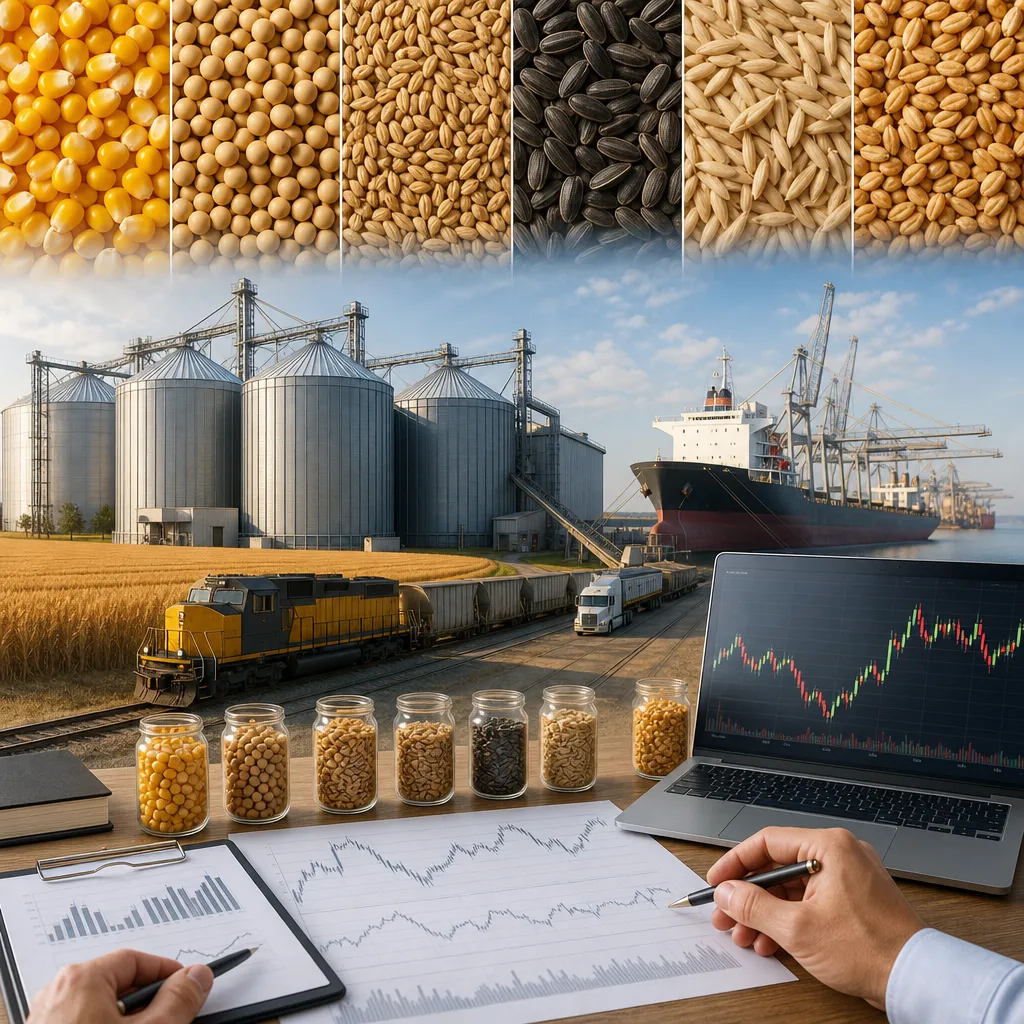








The U.S. sorghum market is a physical grain market tied closely to domestic feed demand, ethanol use in some areas, and export demand, especially when U.S. sorghum is competitive against corn and other feed grains. Geographically, it is centered in the Great Plains and southern Plains, with production concentrated in states such as Kansas and Texas, but pricing is influenced by national grain benchmarks, freight, and export programs. Sorghum is usually priced in U.S. dollars, and in farm and elevator trade it is commonly quoted in dollars per bushel or dollars per hundredweight depending on the buyer and region. For market participants, the key point is that there is no single nationwide “sorghum price”: local cash bids, delivered feed prices, and export values can all differ materially on the same day.
Unlike corn, sorghum does not have a major dedicated U.S. futures contract that serves as the main public benchmark for hedging physical grain. In practice, many commercial participants watch corn futures as a reference, then adjust with a sorghum-specific cash relationship based on local supply, nearby demand, transportation, and export interest. That makes basis and substitution economics especially important. Anyone following the U.S. sorghum outlook should therefore monitor both sorghum cash channels and the wider feed grain complex.
What the U.S. sorghum market is and where it operates
In the United States, sorghum is primarily a feed grain, though it also moves into ethanol, food, and specialty channels. The market operates across farm-gate, country elevator, feed mill, processor, rail, truck, and export terminal networks. Production is concentrated in semi-arid regions where sorghum’s drought tolerance offers agronomic advantages relative to some competing crops.
The most important producing and merchandising regions are in the central and southern Plains. Kansas and Texas are especially prominent, and other states can also contribute meaningful output depending on acreage and weather. Sorghum then moves into domestic users or toward export channels, often through Gulf export infrastructure when overseas demand is active.
Because it is a smaller crop than corn in the U.S., sorghum prices can react sharply to regional shifts in weather, harvest pressure, rail availability, and export buying. A local market with only a handful of active buyers may show wider price swings than a deep, highly liquid futures-linked market.
| Market element | How it works in U.S. sorghum | Why it matters |
|---|---|---|
| Farm and local elevator market | Farmers sell physical grain to local elevators, cooperatives, merchants, feed users, or processors | This is where most physical pricing begins |
| Delivered domestic market | Buyers quote delivered prices to feed mills, livestock operations, or industrial users | Freight and proximity to users can strongly change values |
| Export market | Merchants assemble grain inland and move it to export position, commonly connected to Gulf logistics | Export demand can tighten inland supplies and lift bids |
| Benchmark market | Corn futures often serve as the nearest practical benchmark for value comparison and hedging approximation | Sorghum has no equally dominant dedicated public benchmark in U.S. trade |
How U.S. sorghum prices are formed
U.S. sorghum price formation starts with substitution value. Buyers often compare sorghum with corn on a feed or processing basis. If sorghum is discounted enough to corn, demand may improve from feeders or exporters; if it becomes too expensive relative to corn, demand can slow.
The next layer is location. Sorghum grown near a strong feed market, processor, or shuttle loading point may command a better bid than grain in an area with fewer outlets. Transportation costs are critical because grain is bulky and freight can materially alter net value.
Quality also matters. Test weight, moisture, foreign material, damage, and other grading factors can affect a bid. Some export channels may have additional specifications or tolerances. Harvest-time grain with high moisture may be discounted or face drying charges, while off-condition grain may be harder to place.
Finally, timing matters. Harvest pressure can widen discounts when many bushels hit the market at once. Later in the season, prices may strengthen if farmer selling slows, stocks tighten, or export business accelerates.
Futures, cash, basis, delivered, and export prices
Readers should distinguish several price concepts:
- Futures price: For sorghum, market participants often watch corn futures on CME Group as a broader feed grain benchmark. This is not the same as a local sorghum cash bid.
- Cash bid: The price offered by a local elevator, cooperative, merchant, or processor for physical sorghum at a named location.
- Basis: The difference between the local cash value and the benchmark futures reference used by the trade. Since sorghum often keys off corn economics rather than a direct sorghum futures contract, this relationship can be less standardized.
- Delivered price: A price including transport to the buyer’s site, such as a feed mill or processor.
- FOB export price: A price for grain loaded free on board at an export point, reflecting export demand and logistics.
- CIF import price: More relevant to an importing buyer overseas; it includes cost, insurance, and freight to destination and is not the same as inland U.S. cash value.
| Price type | Where quoted | What it means |
|---|---|---|
| Local cash bid | Elevator, cooperative, merchant, processor | Physical price at a named local delivery point |
| Delivered domestic price | Feedlot, feed mill, ethanol plant, processor | Price including transport to end user |
| FOB export value | Export trading and port market | Value at export loading position before ocean freight |
| Corn futures benchmark | CME Group | A financial reference for wider feed grain price direction, not a farm-gate sorghum price |
Where to check U.S. sorghum prices and market information online
There is no single official live national sorghum price screen that captures every local market. Practical price discovery usually comes from several sources used together.
USDA Agricultural Marketing Service is one of the most useful starting points. AMS publishes grain and feed market reporting, including cash market information in some channels, transportation context, and regional market commentary. Reports may not cover every local sorghum bid every day, but they are highly relevant for grounding the market in observed trade.
USDA National Agricultural Statistics Service provides production, acreage, yield, and farmer stock context. That is not a live cash bid source, but it matters for understanding supply pressure and seasonal outlook.
USDA World Agricultural Outlook Board and associated balance sheet reporting are important for broader U.S. and global feed grain outlooks. Sorghum outlook interpretation often requires comparing it with corn, barley, and global coarse grain conditions.
CME Group is relevant for following corn futures, which many commercial participants use as a reference for feed grain direction and hedging logic. Again, this is not the same as a sorghum cash bid.
Elevators, cooperatives, processors, and merchants remain essential for actionable local pricing. Many post daily bids online or through customer apps and text systems. These are often the best source for actual nearby selling opportunities because they reflect the exact location, delivery window, and grade terms being offered.
U.S. Grains Council can also be useful for export-oriented readers because it publishes market perspectives and trade-related material connected to coarse grains, including sorghum’s position in international demand.
Physical buying and selling: how the real grain trade works
Most physical U.S. sorghum is not bought and sold on an exchange. It moves through cash contracts between a seller and a commercial buyer. A farmer typically contacts a local elevator, cooperative, grain merchant, feed manufacturer, livestock feeder, or processor. The buyer offers a bid for immediate delivery, later delivery, or a deferred pricing structure.
Common practical issues in physical trade include:
- Delivery location and whether the price is at the elevator, on farm, or delivered to the buyer
- Delivery period, such as harvest delivery versus post-harvest movement
- Moisture limits, grading terms, and discount schedules
- Storage arrangements if grain is held before pricing or shipment
- Payment timing and title transfer
- Counterparty risk, especially in private contracts
Merchants and exporters typically accumulate grain inland by truck or rail, then move it to interior loading points or port position. Export demand can pull prices higher in origin areas that are well connected to rail and terminal systems. Where logistics are weak or freight is expensive, farm-level prices may lag broader market strength.
Futures and options: how sorghum is hedged in practice
Because U.S. sorghum lacks the same dedicated benchmark structure that corn has, hedging is often indirect. Commercial firms may use corn futures and sometimes options to manage broad feed grain price risk while accepting that sorghum basis and substitution spreads can still move independently. This is called basis risk or cross-hedging risk.
Futures and options trading takes place through regulated brokerage accounts, not through local elevators unless the elevator offers marketing services alongside physical purchasing. A trader or hedger needs a futures broker, margin funds, and an understanding of contract expiry, mark-to-market, and leverage. Buying a futures contract does not mean owning physical sorghum in a bin. Selling grain to an elevator does not automatically hedge price risk unless a separate hedge is placed.
For farmers and grain firms, the practical lesson is simple: the physical sale and the financial hedge are two different transactions. They may be related in strategy, but they occur in different markets and carry different risks.
Supply, demand, and trade drivers in the U.S. sorghum outlook
The U.S. sorghum outlook depends on a relatively small set of high-impact variables.
Acreage and weather are fundamental. Sorghum is often planted in regions vulnerable to heat and moisture stress. Because of this, seasonal rainfall and late-summer conditions can rapidly change production expectations.
Competition with corn is central. Farmers compare relative margins when deciding acreage, and end users compare feed value when sourcing grain. If corn is abundant and cheap, sorghum may need to trade at a discount to attract demand. If sorghum supplies tighten or local logistics favor it, that discount can narrow.
Export demand can be decisive. U.S. sorghum exports have historically been capable of swinging meaningfully from year to year depending on overseas demand, trade policy, and competitiveness against other origins or substitute feed grains.
Domestic feed and industrial demand also matter. Feedlots, poultry and livestock sectors, and some processors can provide important regional support. Ethanol demand may be relevant in some locations if sorghum is priced attractively for plant buyers.
Freight and logistics often have an outsized effect. Rail costs, barge conditions where relevant, truck availability, and terminal capacity influence whether inland values fully reflect export demand.
Scenario-based market outlook
It is more accurate to frame sorghum outlook in scenarios than in certainty.
| Scenario | Conditions | Likely market implication |
|---|---|---|
| Supportive price scenario | Weather-reduced crop, firm export demand, or strong domestic feed buying | Local bids may strengthen, especially in deficit areas or export-connected origins |
| Pressure scenario | Large crop, weak exports, cheap corn, or harvest-time logistics congestion | Cash discounts may widen and storage economics become more important |
| Mixed scenario | Average crop but highly regional demand differences | Expect local price divergence rather than one clear national trend |
For many readers, the most realistic outlook framework is to monitor crop prospects, export sales pace, and the corn market together. Sorghum can move with corn, but it can also decouple when local supply or export programs dominate.
Why local cash markets matter more than a headline benchmark
In sorghum, local cash market structure matters more than in some larger exchange-centered grains. Two buyers in different counties can bid very different prices because one may be full, one may need nearby coverage, one may have rail freight secured, and one may not. Basis can also change quickly when an exporter enters or exits the market.
That is why a producer or merchant should not rely on a national feed grain headline alone. The practical market is the bid available at a specific place, for a specific delivery window, with specific quality terms. Online futures and USDA reports provide context, but the tradeable number usually comes from the local buyer.
FAQ
Where can I check U.S. sorghum prices today?
The most practical places are local elevator and cooperative bid sheets, processor and merchant bids, and USDA Agricultural Marketing Service reports. For broader market direction, many traders also watch corn futures on CME Group, but that is not the same as a sorghum cash bid.
What is the main benchmark for U.S. sorghum?
There is no equally dominant dedicated U.S. sorghum futures benchmark comparable to corn futures. In practice, the market often references corn futures and then adjusts for local sorghum supply-demand conditions.
Why is my local sorghum cash bid different from futures?
Because futures reflect a financial benchmark, while your local cash bid reflects basis, freight, local buyer demand, quality, storage pressure, and competition among nearby buyers. Sorghum also carries cross-commodity substitution effects versus corn.
How is sorghum physically sold in the United States?
Usually through cash contracts with elevators, cooperatives, merchants, processors, or feed users. The contract specifies delivery point, timing, quality terms, and payment conditions.
Can I trade U.S. sorghum on an exchange?
Most direct price exposure is managed indirectly through related futures and options, especially corn, via a regulated broker. That is separate from owning or delivering physical grain.
Is the U.S. a major exporter of sorghum?
Yes, the United States is an important sorghum exporter when supplies are available and its grain is competitively priced in global feed markets. Export demand can materially affect inland prices.
What unit is sorghum usually priced in?
In U.S. farm and cash trade, sorghum is commonly quoted in U.S. dollars per bushel or in some cases dollars per hundredweight, depending on region and buyer practice. Export and international comparisons may also use dollars per metric ton.
What are the biggest drivers of the U.S. sorghum outlook?
Weather, acreage, yield, corn price relationships, export demand, freight costs, and the intensity of local buyer competition are usually the most important factors.
Sources
- USDA Agricultural Marketing Service
- USDA National Agricultural Statistics Service
- CME Group