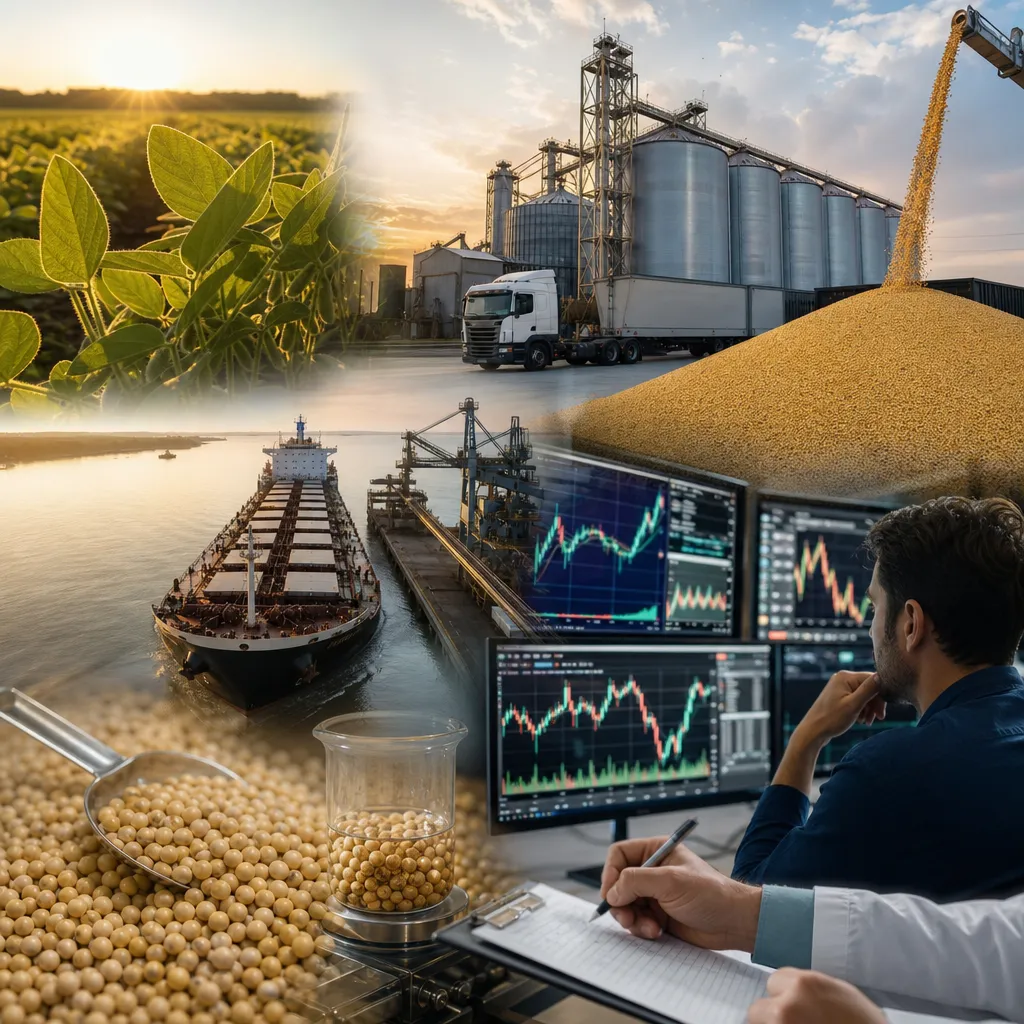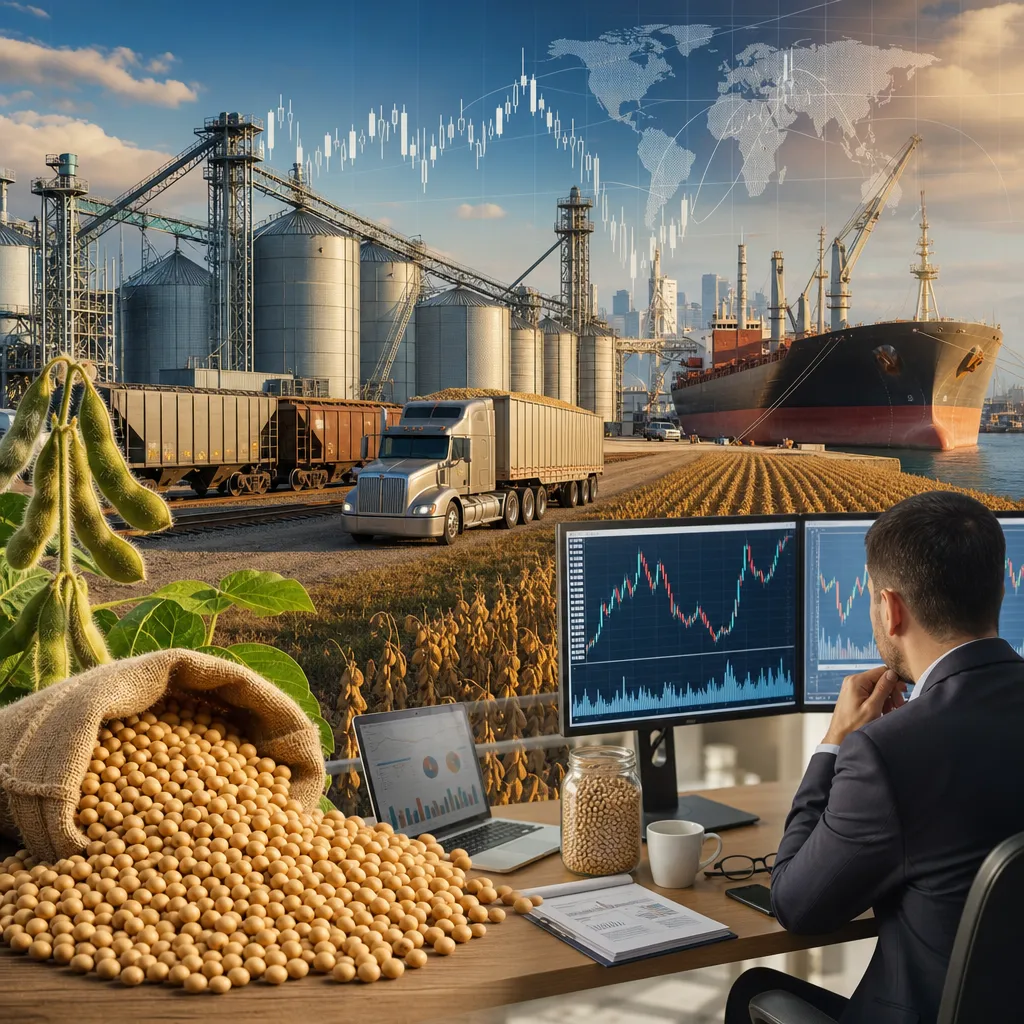






The US soybean futures market is the main global benchmark for pricing soybeans and, by extension, an important reference for soybean meal and soybean oil. It operates in the United States through exchange-traded futures and options, while the physical soybean trade happens separately through elevators, processors, exporters, feed manufacturers, and river or port channels. For farmers, merchants, crushers, and importers around the world, this market is not just a screen price in Chicago; it is a risk-management tool that helps set real cash prices across the US interior and in export business. To understand it properly, readers need to separate futures from cash grain, and benchmark prices from the basis that converts futures into local bids.
Geographically, the market is centered in the United States, with the benchmark futures contract traded on CME Group’s Chicago Board of Trade division. The physical soybean market spans major producing states in the Midwest and Plains, processing centers across the country, and export corridors such as the Mississippi River system and Pacific Northwest routes. Prices are quoted in US dollars, and futures are commonly discussed in cents per bushel. Physical export trade may also be discussed in US dollars per metric ton, especially in international business.
What the US soybean futures market means
The US soybean futures market is a standardized exchange market where participants buy and sell contracts tied to soybeans for specific delivery months. Its main role is price discovery and hedging. It allows market participants to transfer price risk without requiring every trade to result in physical delivery.
This benchmark matters far beyond the United States. US soybean futures influence farm marketing decisions in Iowa and Illinois, crusher margins in Indiana, export offers at the Gulf, feed procurement abroad, and global competition with Brazil and Argentina. Even when a physical cargo is sold using an export premium rather than a flat futures price, the underlying benchmark often comes from US futures.
In practice, the market serves several groups:
- Farmers who hedge expected production or monitor benchmark values before selling cash soybeans.
- Country elevators and cooperatives that buy from farmers and manage their own price exposure.
- Processors/crushers that buy soybeans and sell soybean meal and oil.
- Exporters that originate soybeans inland and sell to overseas buyers.
- Speculators and managed funds that provide liquidity but do not necessarily handle physical grain.
- Importers and global merchants that use the market as a reference for international pricing.
Where the market operates
The central exchange venue is CME Group, through the Chicago Board of Trade, usually referred to as CBOT in grain trade language. Although trading is associated with Chicago, the futures market is national and global in reach because participants access it electronically through brokers and trading platforms.
The physical soybean market operates throughout the United States. The largest producing and merchandising activity is concentrated in states such as Illinois, Iowa, Minnesota, Indiana, Nebraska, Ohio, and surrounding regions. Soybeans move from farms to local elevators, river terminals, rail loading facilities, crushers, feed users, and export terminals.
Two physical regions are especially important for price formation:
- Interior cash markets, where farmers sell to local elevators, cooperatives, or processors.
- Export markets, especially Gulf export channels and other major shipping routes, where international demand becomes visible in premiums and bids.
Because the US is both a major producer and a major exporter and processor of soybeans, domestic cash prices are strongly linked to futures, but they are never identical to the futures quote on the screen.
How soybean prices are formed
The most important concept is that the futures price is a benchmark, not the final local cash price. A farmer or commercial buyer in the US physical market normally deals with cash price = futures price + basis. The basis can be positive or negative depending on location and market conditions.
Several price layers matter in soybeans:
| Price type | Where quoted | What it means |
|---|---|---|
| CBOT soybean futures | Exchange screens and broker platforms | The benchmark price for a standardized futures contract in US cents per bushel. |
| Local cash bid | Elevators, cooperatives, crushers, merchants | The price offered for physical soybeans at a specific location and time. |
| Delivered price | End-user or processor contracts | The price for soybeans delivered to a specified destination, often reflecting freight and timing. |
| Export bid / premium | Merchant and export market channels | The value attached to export demand, often expressed relative to futures. |
| FOB export price | International trading market | Price of soybeans loaded free on board at an export point, excluding ocean freight. |
| CIF import price | Import market | Delivered cost into the importing country including freight and insurance. |
Basis reflects the local relationship to futures. It is shaped by transport costs, river conditions, rail availability, local supply, processor demand, storage economics, quality, protein or moisture concerns, and export competition. A crush plant with strong nearby demand may post a stronger bid than a nearby elevator serving a weaker freight market. During harvest, basis may weaken if supplies are temporarily abundant; later, it may strengthen if logistics improve or farmer selling slows.
For export business, additional layers matter. A merchant might buy soybeans inland at a cash bid linked to futures, assemble them through the logistics chain, then sell them FOB at the Gulf or another loading point. The export value must cover elevation, transport, handling, storage, finance, and risk.
How futures relate to the real physical soybean trade
Futures trading and physical soybean ownership are not the same thing. Most futures market participants close or roll their positions before delivery. They use contracts to manage price exposure rather than to take truckloads or vessel cargoes of beans.
Physical grain trading in the United States usually happens through direct commercial relationships:
- Farmers deliver or contract soybeans with a local elevator, cooperative, processor, or merchant.
- The buyer sets a cash bid, often based on a futures month plus or minus basis.
- Contracts may be spot, forward, basis-only, hedge-to-arrive, or other commercial structures depending on the buyer.
- The buyer then stores, processes, resells, or ships the grain onward.
A crusher may buy soybeans physically while hedging input risk through futures. An exporter may purchase soybeans from country origins and hedge the flat price exposure on the exchange while managing basis separately. A farmer may watch futures online every day but still sell the crop through a local physical buyer, not on the exchange itself.
This distinction is essential. Buying one futures contract does not mean a person has arranged trucking, grading, quality certification, and storage for physical grain. Likewise, selling physical soybeans to an elevator does not necessarily mean the seller has personally traded a futures contract.
Who uses the market and how hedging works
Commercial hedgers use soybean futures to reduce price risk. A soybean grower worried about falling prices before harvest may sell futures or use options as protection. A crusher that needs soybean supplies may buy futures to protect against rising prices while sourcing physical beans in the cash market. Exporters and elevators use similar tools to manage inventory and merchandising risk.
Futures hedging does not remove all risk. It mainly addresses benchmark price risk. The remaining exposure is often basis risk, meaning the local cash market may move differently from the futures market. That is why strong merchandising depends not only on getting the futures direction right, but also on understanding local demand, transport, and timing.
Speculators also play an important role because they provide liquidity. Their activity can increase volatility in the short term, but active participation also helps hedgers enter and exit positions more efficiently.
| Market activity | Where it happens | Typical users |
|---|---|---|
| Physical soybean sale | Elevators, cooperatives, processors, merchants, exporters | Farmers, grain companies, end users |
| Futures trading | CME Group through brokerage access | Hedgers, traders, funds, commercial firms |
| Options trading | CME Group through brokerage access | Participants seeking price insurance or flexible risk structures |
| Export merchandising | Merchant networks, terminals, international trade desks | Exporters, global trading houses, importers |
Where to check soybean futures and market information online
For current or live prices, readers should check official or well-established market information sources rather than rely on delayed or unattributed numbers. The primary reference for US soybean futures is CME Group, which lists soybean futures and options information, contract months, and market data availability. Depending on access level, quotes may be delayed or real-time.
For broader market fundamentals and physical context, USDA is essential. The most widely used USDA sources include supply-and-demand reports, export sales data, crop progress updates during the growing season, grain transportation information, and market commentary from official reporting services. These reports help explain why futures move and why basis may strengthen or weaken.
For local cash prices, the most practical sources are often:
- Local elevators and cooperatives, which publish current bids for nearby and forward delivery.
- Soybean processors/crushers, where relevant, especially in areas with strong domestic demand.
- Merchants and regional grain buyers, particularly for delivered bids or specialty quality terms.
- USDA market reporting services for regional cash market information and basis indicators where available.
Readers should remember that a futures quote from CME Group is not the same as a farm-gate price. A local bid can differ materially because of freight, basis, storage, local demand, moisture, quality discounts, and the buyer’s position in the supply chain.
Main price drivers and market trends to watch
The US soybean futures market responds to a mix of domestic and global drivers. Because soybeans are deeply integrated into world feed, vegetable oil, and biofuel-linked value chains, the benchmark often reflects more than just US farm conditions.
Key drivers include:
- US acreage and yield expectations, especially planting progress, summer weather, and harvest pace.
- USDA balance sheets, including production, ending stocks, crush demand, and export assumptions.
- Export demand, especially competition with South American suppliers.
- Crush economics, driven by soybean meal and soybean oil demand.
- River, rail, and port logistics, which affect basis and export execution.
- Currency movements, particularly because soybeans are internationally traded in US dollars.
- Energy and biofuel policy, especially through the soybean oil side of the complex.
- Fund positioning and macro sentiment, which can amplify price swings beyond immediate physical news.
Forecasting should be viewed as scenario-based rather than certain. If US weather is favorable and export competition is intense, futures may face pressure. If weather threatens yields, logistics tighten, or global demand improves unexpectedly, prices can strengthen. Basis can move differently from futures under either scenario, especially when local processors or export programs need coverage.
How soybeans are bought, sold, exported, imported, or hedged in practice
Physical market
In the physical US soybean market, trade usually starts with a commercial contract between a seller and a buyer. The seller may be a farmer, elevator, processor, or merchant. The buyer may be a crusher, exporter, feed manufacturer, or another grain handler. Contracts specify quantity, delivery period, location, quality terms, discount schedules, and payment terms.
Common practical channels include:
- Farmer to country elevator or cooperative.
- Farmer or elevator to processor/crusher.
- Elevator or merchant to export terminal.
- Merchant to overseas buyer on an FOB or similar trade basis.
Export business typically requires assembling soybeans from inland origins, moving them by truck, rail, or barge, and loading at an export terminal. Importers outside the US generally do not buy CBOT futures as a substitute for cargo procurement. They buy physical soybeans from merchants or exporters, often using futures-linked pricing formulas.
Futures and options market
To trade soybean futures or options, a participant normally opens an account with a licensed futures broker or futures commission merchant that provides access to CME markets. Futures involve margin and daily mark-to-market. This creates leverage, which can be useful for hedging but risky for speculation.
Commercial firms often combine exchange hedges with cash contracts. For example, they may fix basis first and futures later, or vice versa, depending on market conditions. Options can be used to cap risk while preserving some upside, but they involve premiums and strategy complexity.
Anyone using futures should understand expiry, rollover, contract month selection, margin calls, and basis risk. These are financial risk-management tools, not simple substitutes for physical grain buying or selling.
Practical interpretation of US soybean futures for international readers
For readers outside the United States, the US soybean futures market is best understood as the world’s dominant soy complex benchmark rather than a statement of what soybeans cost everywhere. An importer in Asia, Europe, North Africa, or the Middle East may negotiate a cargo in dollars per metric ton, yet the seller may hedge or reference CBOT soybean futures in the background.
Likewise, a US farmer may think in bushels and local basis, while an overseas buyer thinks in tonnes and CIF destination costs. Both are connected through trade margins, freight, quality specifications, and exchange-based risk management.
The market therefore has two layers that must always be separated:
- Screen price: the exchange benchmark visible worldwide.
- Physical transaction price: the actual commercial value after basis, logistics, quality, and delivery terms are applied.
Understanding that distinction is the key to reading soybean market news correctly.
Frequently asked questions
Where can I check the current US soybean futures price?
The main official reference is CME Group, where soybean futures are listed by contract month. Many broker platforms and market terminals also display prices, sometimes in real time and sometimes with delay.
Is the CBOT soybean price the same as the cash price paid to a farmer?
No. The CBOT futures price is a benchmark. The farmer’s cash price depends on futures plus or minus basis, along with quality, location, timing, and freight conditions.
In what unit are US soybean futures usually quoted?
They are typically discussed in US cents per bushel. Physical export trade may also be evaluated in US dollars per metric ton, especially in international transactions.
How do I find local soybean bids in the United States?
The most practical sources are local elevators, cooperatives, processors, and merchants. Many publish daily bids for spot and forward delivery, while USDA reporting can provide regional market context.
Can I buy physical soybeans by trading futures?
In normal practice, no. Futures are mainly used for hedging or speculation. Physical soybean buying requires commercial contracts, logistics, quality handling, and delivery arrangements separate from exchange trading.
Why does US export demand affect futures so much?
The United States is a major soybean exporter, so overseas buying influences domestic prices, basis at export channels, and overall stock expectations. Export competition with other major origins also matters.
What is basis in the soybean market?
Basis is the difference between the local cash price and the relevant futures price. It reflects local supply and demand, transport costs, storage, quality, and buyer competition.
Who typically uses soybean futures to hedge?
Farmers, cooperatives, elevators, processors, exporters, and commercial traders are common hedgers. They use futures or options to manage price risk while conducting physical business separately.
Sources
- CME Group
- USDA Agricultural Marketing Service
- USDA World Agricultural Outlook Board