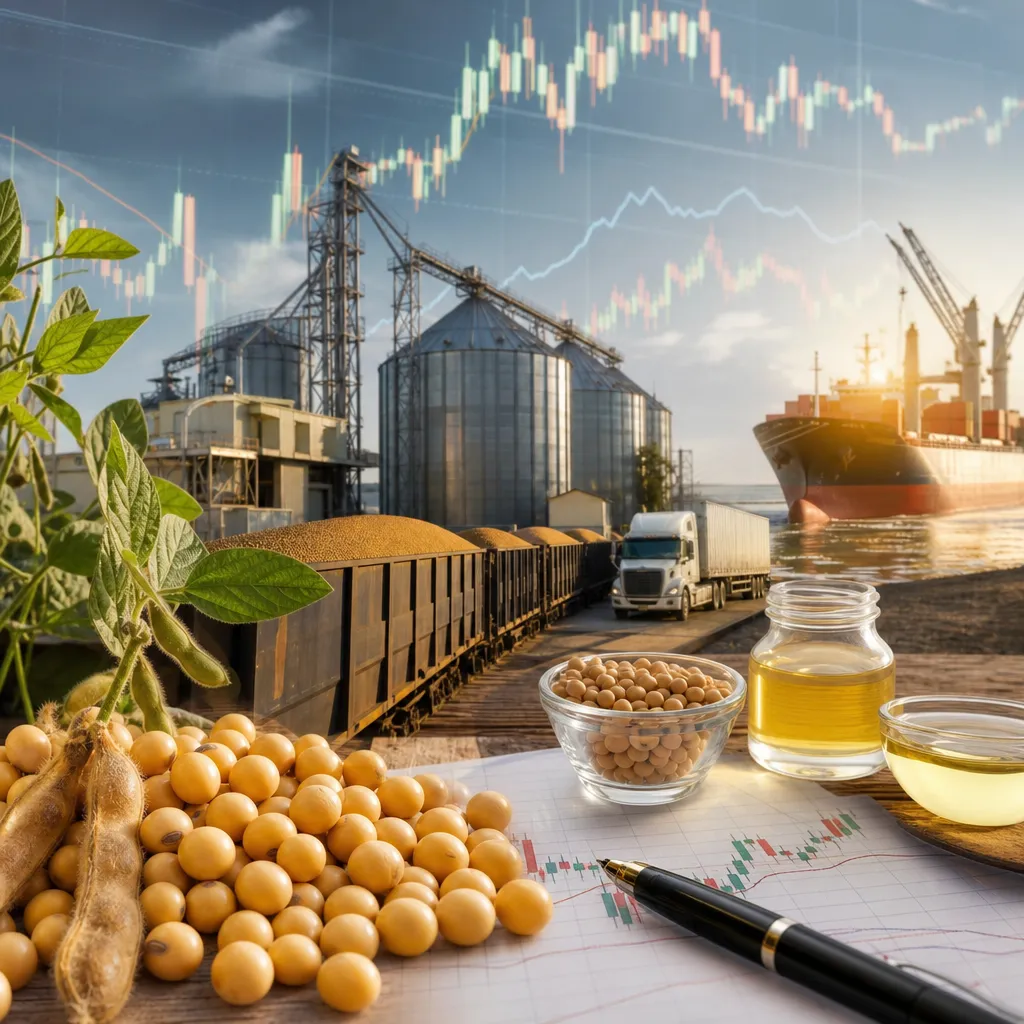










The US soybean export market is the network through which soybeans grown in the United States are sold to overseas buyers, priced against international benchmarks, moved through inland elevators and export terminals, and shipped mainly from the Gulf, Pacific Northwest, and Atlantic export channels. It is one of the most important agricultural export markets in the world because US soybeans are a major source of oilseed supply for global feed, food, and crushing demand. In practice, this market is not a single screen price or one exchange location: it is a chain linking farm-level cash bids, interior processor and elevator demand, barge and rail freight, export basis at ports, and futures traded in Chicago. Anyone following this market needs to understand both the online benchmark prices and the real physical trade terms used by merchants, exporters, crushers, and importers.
Geographically, the market begins in the US soybean belt across states such as Illinois, Iowa, Minnesota, Indiana, Nebraska, Ohio, Missouri, and the Dakotas, then flows toward export positions at the US Gulf, Pacific Northwest, and some Atlantic or Great Lakes outlets when seasonally relevant. Soybeans are commonly quoted in US dollars per bushel in the domestic market, while export trade is often discussed in US dollars per metric ton or in relation to a futures market plus or minus basis. The main benchmark futures contract is Chicago soybean futures traded on CME Group’s Chicago Board of Trade platform, but export business itself is negotiated physically between commercial counterparties.
What the US soybean export market includes
The US soybean export market covers the sale of whole soybeans from US origin to foreign buyers. The main end users are importers, crushers, feed manufacturers, food processors, and state or private buying agencies in soybean-importing countries. While soybean meal and soybean oil are also major export products, the soybean export market usually refers specifically to unprocessed beans.
This market matters because the United States is a major soybean producer and exporter, and US export competitiveness affects farm prices, elevator bids, crush margins, interior basis, and futures spreads. Export demand can tighten local supplies in some periods, while large South American crops or weaker overseas buying can pressure US values.
In commercial terms, the market usually involves:
- Farmers selling to local elevators, cooperatives, crushers, or merchants.
- Merchants assembling soybeans inland by truck, rail, or barge.
- Exporters positioning soybeans at port terminals.
- Foreign buyers purchasing on FOB, CIF, or similar shipment terms.
- Risk management through futures and options rather than relying only on spot pricing.
Where the market operates in the United States
The production base is inland, but the export market is shaped by logistics. The most important export channels are the US Gulf and the Pacific Northwest. The Gulf is closely tied to the Mississippi River system, where soybeans move by truck or rail to river elevators and then by barge to export terminals. The Pacific Northwest is especially important for rail-served soybeans moving to Asian destinations.
These locations matter because export bids at port are not the same as farm-gate prices. A soybean cargo value at a Gulf or Pacific Northwest terminal includes location value, elevation and handling costs, freight, timing, and export demand. Interior cash bids reflect what remains after transport and commercial margins are accounted for.
Seasonality also matters. Harvest pressure in the autumn often weighs on inland basis, while river conditions, rail performance, vessel lineups, and export demand can shift the premium between one export corridor and another. Weather in the US crop belt and conditions in competing exporters such as Brazil and Argentina also affect where business is done and which origin is cheapest to buyers.
How soybean export prices are formed
US soybean export pricing is built from several layers rather than a single number. The global reference point is usually CBOT soybean futures. Commercial participants then add or subtract a basis, which reflects location, quality, timing, logistics, and local supply-demand conditions.
The most important pricing distinctions are:
| Price type | Where quoted | What it means |
|---|---|---|
| CBOT soybean futures | CME Group market data and broker platforms | Benchmark futures price for US soybeans; financial reference, not a local farm bid. |
| Local cash bid | Elevators, cooperatives, processors, merchandisers | What a local buyer will pay at a specific location for physical soybeans. |
| Export bid | Port market or merchant bid sheets | Price for soybeans delivered into export position, often quoted as futures plus or minus basis. |
| FOB price | Export trade negotiation | Free on Board vessel loading point; seller covers costs to load at export port. |
| CIF or delivered import price | Destination market | Price including ocean freight and possibly insurance to destination, depending on contract terms. |
Basis is central. If Gulf export demand is strong, port basis can firm even when futures are unchanged. If barge freight rises, river basis can change without any move in futures. If local crushers are bidding aggressively for nearby supply, interior cash prices may improve relative to export channels. The futures market provides a transparent reference, but the physical market decides the local and export premium or discount.
Quality also matters. Protein, moisture, foreign material, damage, and other grading factors can influence discounts or acceptance. Buyers do not purchase “soybeans” in the abstract; they buy soybeans meeting contract terms at a certain place and time.
How grain is actually bought, sold, and exported
Physical soybean trade usually begins with country movement. Farmers sell across the scale to local elevators, cooperatives, processors, or merchants using spot sales, forward contracts, hedge-to-arrive contracts, basis contracts, or storage-related arrangements where offered. These contracts differ in how futures and basis are fixed.
Merchants then aggregate grain into larger commercial positions. Soybeans may move:
- By truck from farm to country elevator or processor.
- By rail from inland loading points to export terminals or domestic users.
- By barge through the inland river system toward the Gulf.
At the export stage, large merchants or exporters sell cargoes to foreign buyers under detailed contracts covering shipment period, quality, loading point, weight and inspection terms, and payment conditions. The export market is therefore relationship-driven and document-heavy. It is not a simple retail transaction.
Importers may include private crushing companies, feed groups, or state-linked buying entities depending on the destination country. The buyer may compare US origin with Brazilian or Argentine offers, taking into account FOB price, freight, reliability, timing, and quality. A US sale becomes competitive when the full delivered cost to destination is attractive.
Online market access versus the physical soybean market
Readers often see soybean prices online and assume that is the price a farmer or exporter receives. That is not how the market works. Online quoted prices usually refer to futures or indicative market values, while physical soybean trade happens through negotiated cash bids and commercial contracts.
The distinction is important:
| Market type | How access works | What the participant gets |
|---|---|---|
| Physical cash market | Direct sale to elevator, cooperative, processor, merchant, or exporter | Movement of actual soybeans, subject to delivery terms and quality. |
| Futures market | Broker account on CME Group access platform or through a futures intermediary | Price exposure to soybean futures, usually without taking ownership of physical grain. |
| Options market | Broker account for exchange-traded options | Risk management with defined option structures, still separate from physical ownership. |
A producer may watch futures online but still make the final sale to a local elevator. A merchant may hedge a physical export position with futures. A speculative trader may buy soybean futures without handling any soybeans at all. These are related markets, but they are not the same market.
How hedging works in the US soybean export market
Hedging is common because soybean prices can move sharply between the time grain is bought inland and the time an export cargo is sold or loaded. Exporters, processors, elevators, and sometimes producers use futures and options to reduce price risk.
Typical commercial uses include:
- An elevator buying soybeans from farmers and selling futures to reduce downside risk before resale.
- An exporter purchasing interior soybeans and hedging until the export sale is priced.
- A crusher protecting input costs or product margins using soybean, meal, and oil futures.
- A farmer using forward contracts or futures-related tools to manage price exposure before harvest.
However, hedging does not eliminate basis risk. A company can hedge the futures component and still face changes in local basis, freight, or export premiums. That is why cash market knowledge remains essential even for sophisticated users of derivatives.
Futures and options require a brokerage relationship, margin capability, and understanding of leverage and contract expiry. Physical grain trading requires logistics, grading, contract execution, and counterparty management. One is financial risk management; the other is commodity handling and merchandising.
What moves US soybean export competitiveness
US soybean export demand is highly sensitive to relative origin values. A buyer compares delivered cost from US origin against South American alternatives and against local crushing economics. Market direction is usually shaped by a combination of crop fundamentals and logistics rather than any single indicator.
Key drivers include:
- US acreage, weather, yield potential, harvest pace, and ending stocks expectations.
- Brazilian and Argentine production, export pace, and farmer selling patterns.
- Chinese and broader Asian import demand, especially for crushing.
- US interior basis, Gulf and Pacific Northwest basis, and barge or rail performance.
- Ocean freight and vessel availability.
- US dollar strength or weakness against competing exporter currencies.
- Domestic crush demand from feed, food, and renewable fuel-related oil demand.
- Trade policy, phytosanitary rules, and any disruption affecting export flows.
When US supplies are comfortable but logistics are tight, port basis can still firm. When South American supplies are abundant and freight is favorable, US export sales may slow even if CBOT futures are lower. Competitiveness is therefore a delivered-cost calculation, not simply a futures price comparison.
Where to check prices and market information online
For soybean export market information, readers should check more than one source because no single publication shows the whole chain from futures to destination values. Reliable monitoring usually combines exchange data, federal reports, and local commercial bids.
Practical places to check include:
- CME Group for CBOT soybean futures and options benchmarks.
- USDA Agricultural Marketing Service for cash market reporting, basis-oriented regional market information, and transportation-related market reports where available.
- USDA Foreign Agricultural Service for export sales, trade analysis, and weekly export activity reporting.
- USDA WASDE and related USDA reports for broad supply-demand context rather than local cash prices.
- Local elevators, cooperatives, processors, and grain merchants for actual cash bids at a specific delivery point.
- Broker and trading platforms for live or delayed futures data, depending on access rights.
Readers looking for a “current US soybean export price” should be careful. There is no single national export cash price that applies to every soybeans sale. A Gulf FOB indication, a Pacific Northwest export bid, and an Illinois elevator cash bid can all differ materially on the same day because they represent different locations, timing, and contract terms.
Practical guide for buyers, sellers, and traders
If you are dealing in physical soybeans, start with the local market and work outward. Confirm the delivery point, grade requirements, moisture and damage tolerances, weighing and inspection terms, payment timing, and whether the price is a flat cash price or futures plus basis. Counterparty strength matters because physical grain contracts involve performance, logistics, and settlement risk.
If you are following export opportunities, watch the relationship between interior basis and export basis. Strong export demand does not always translate one-for-one into stronger farm bids if freight costs rise or local buyers are already covered. Likewise, weak futures do not always mean weak local cash if nearby supplies are tight.
If you are trading futures rather than grain, remember that you are taking financial exposure to the benchmark, not buying soybeans from a US elevator. You need a broker, a margin account, and a plan for risk management. Hedgers focus on reducing exposure; speculators seek price opportunity. The same futures contract may serve both groups, but their objectives are different.
What is the main benchmark for the US soybean export market?
The main benchmark is CBOT soybean futures on CME Group. Export and cash prices are usually built from that benchmark plus or minus basis, depending on location and market conditions.
Where can I check current US soybean prices?
For futures, check CME Group or a licensed broker platform. For local cash soybean bids, check elevators, cooperatives, processors, or merchants in the relevant state or delivery area. For broader market reporting, consult USDA Agricultural Marketing Service and USDA export reporting.
Is a CBOT soybean futures quote the same as the cash price paid to a farmer?
No. Futures are a benchmark. The actual cash bid depends on basis, location, quality, freight, timing, storage, and local buyer competition.
What does FOB mean in US soybean exports?
FOB means Free on Board at the export loading point. In practical terms, it is the value of soybeans loaded onto the vessel at the named port, before the ocean voyage to the destination.
How are US soybeans usually exported?
They are assembled inland through elevators and merchants, transported by truck, rail, or barge to export terminals, and then sold to foreign buyers under shipment contracts covering quality, timing, and loading terms.
Can I buy US soybeans online through the futures market?
You can buy soybean futures or options through a broker, but that gives you financial exposure, not the same as a physical soybean cargo purchase. Physical soybean buying takes place through merchants, exporters, elevators, or processors under commercial contracts.
Why do Gulf and Pacific Northwest soybean prices differ?
They differ because each export corridor has its own freight structure, terminal demand, rail or barge access, vessel economics, and destination competitiveness. Both may reference the same futures market but carry different basis values.
What are the main drivers of US soybean export prices?
The main drivers are CBOT futures, basis at inland and export locations, US and South American crop conditions, export demand, freight, currency relationships, and domestic crush competition.
Sources
- USDA Foreign Agricultural Service
- USDA Agricultural Marketing Service
- CME Group