


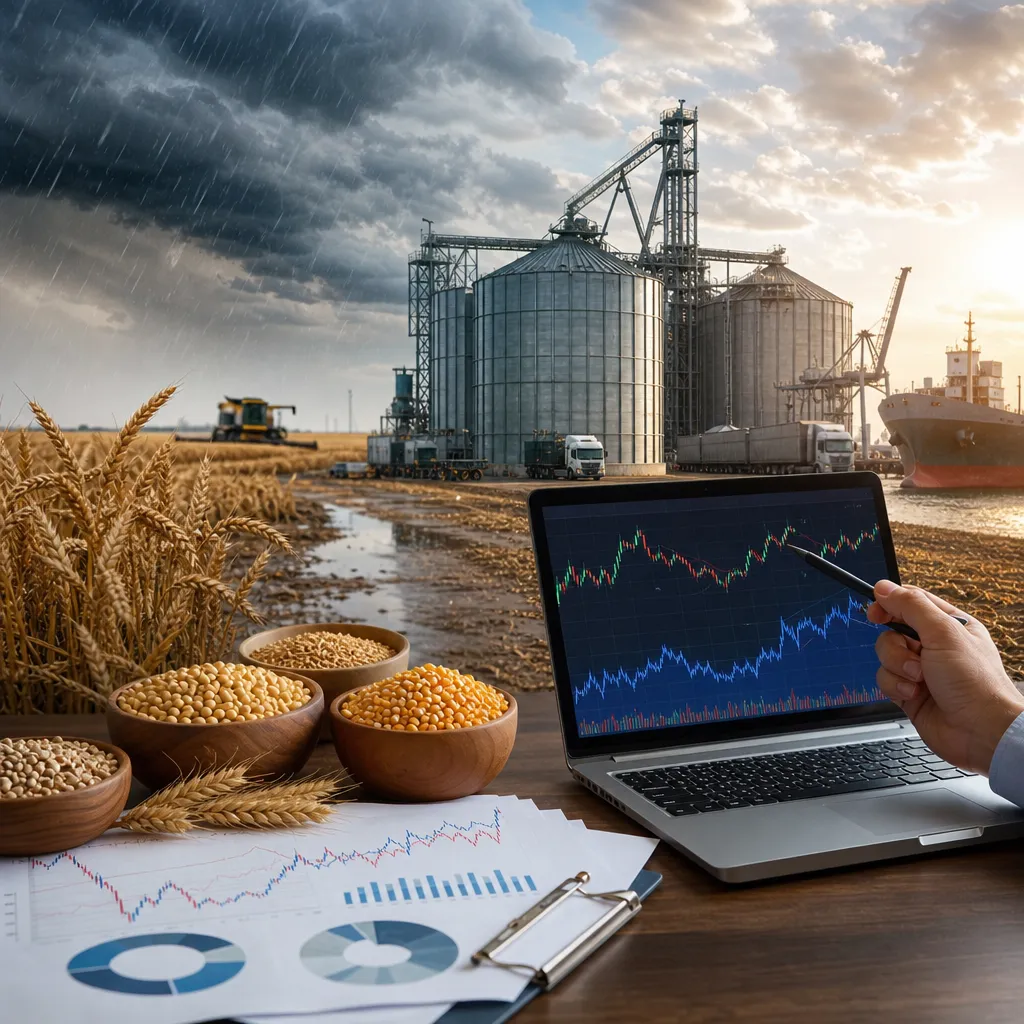
Rainfall is one of the fastest ways to change grain prices because it directly affects yield, crop condition, planting pace, harvest quality, river logistics, and export competitiveness. Too little rain can reduce production and lift prices; too much rain can damage quality, delay fieldwork, and also disrupt transport, with very different effects by crop and region. In practice, grain markets react not just to the amount of rain, but to when it falls, where it falls, and which crop stage it hits. To understand price moves correctly, a farmer, trader, buyer, or analyst has to connect rainfall data with local cash bids, exchange futures, crop reports, and basis.
Rainfall does not create one single “grain price.” Exchange futures for wheat, corn, soybeans, canola, rice, or rapeseed are quoted on regulated exchanges, while physical grain is bought and sold through elevators, cooperatives, merchants, mills, processors, feed companies, and exporters at local cash prices. Those local prices may rise less than futures, more than futures, or even move in the opposite direction if rainfall changes quality, freight, or nearby supply conditions. That distinction is essential before using rainfall news to make pricing or hedging decisions.
Why rainfall matters so much in grain markets
Rainfall affects grain prices through supply, quality, and logistics. The simplest channel is yield: if key production areas remain too dry during germination, vegetative growth, pollination, or grain fill, expected output falls and prices often strengthen. If long-awaited rain arrives at a critical stage, yield prospects can recover quickly and prices may retreat.
But the relationship is not linear. Moderate rain can be bullish in one region and bearish in another. For example, rain during planting may improve soil moisture for one crop while delaying seeding for another. Heavy rain near harvest can lower milling quality in wheat, stain grains, increase sprouting risk, reduce test weight, or create storage problems. In corn and soybeans, excessive rain can hurt stand establishment, increase disease pressure, and slow field access.
Markets therefore focus on three practical questions:
- Timing: Did rainfall come during planting, pollination, grain fill, or harvest?
- Coverage: Was it widespread enough to change production estimates, or only local?
- Follow-through: Does one rain event solve a moisture deficit, or is more rain still needed?
How rainfall feeds into grain prices in practice
Rainfall does not move prices by itself. It changes expectations, and those expectations are translated into bids and futures through the buying and selling decisions of commercial firms, hedge funds, processors, exporters, and farmers.
In futures markets, traders compare rainfall against expected supply. If weather turns drier in a major corn belt during pollination, market participants may buy corn futures because lower yield risk increases the chance of tighter ending stocks. If beneficial rain improves a soybean crop in a large exporting country, futures may weaken because production risk declines.
In the physical market, elevators and buyers adjust local bids based not only on futures but also on basis. Basis is the difference between local cash price and the relevant futures contract. Rainfall can change basis in several ways:
- Local drought may reduce nearby farmer selling, tightening basis.
- Harvest rain may lower quality, widening the spread between premium and discounted grain.
- Flooding may disrupt roads, rail, or barges, weakening bids at interior points.
- Rain in a competing export region may improve that region’s crop and pressure export basis elsewhere.
This is why a futures rally caused by drought does not automatically mean every farmer receives a higher local cash price. Quality discounts, freight disruption, and wider basis can offset part of the futures move.
| Rainfall situation | Typical price effect | Why it happens |
|---|---|---|
| Drought during key yield stage | Often bullish for futures and some cash markets | Lower output risk reduces expected supply |
| Timely widespread rain after dryness | Often bearish if crop potential recovers | Improved yield outlook increases expected supply |
| Excess rain during planting | Can be bullish or mixed | Delayed seeding may cut acreage or yield, but impacts vary by crop and calendar |
| Heavy rain near harvest | Mixed futures effect; large quality effect in cash market | Quality damage changes discounts and premiums more than headline production |
| Flooding affecting roads, rail, or barges | Local cash pressure or basis volatility | Transport disruption raises handling and freight constraints |
Rainfall and different grains: why crops react differently
Each grain has a different sensitivity to rainfall because agronomy, quality standards, and end-use markets differ.
Wheat
Wheat reacts strongly to rainfall timing. Dryness can reduce tillering and grain fill, while excess rain can increase disease pressure and damage quality before harvest. In milling markets, rainfall may create a bigger spread between feed wheat and higher-protein or sound milling wheat. A crop may still be physically large but lower in quality, which matters to mills and exporters.
Corn
Corn is especially sensitive to moisture stress around pollination and early grain fill. Rainfall deficits at that stage can sharply affect yield expectations. Excessive rain also matters by delaying planting, causing waterlogging, or limiting nitrogen uptake. Corn price reactions are often strongest when weather affects a major producing zone that dominates export supply.
Soybeans
Soybeans can compensate for stress better than some crops if rain returns in time, so traders often watch August weather closely in key producing regions. Rainfall affects not only bean yield but also crush demand expectations if supply changes alter meal and oil balances.
Rice
Rice is distinct because water management is part of the production system. Too little water can still be damaging, especially where irrigation is constrained, but too much rain can also affect harvest quality, milling yield, and logistics. Local government policy and irrigation infrastructure often matter as much as raw rainfall totals.
Canola, rapeseed, barley, oats, rye, sorghum, and sunflower seed
These crops respond differently by region and production system. For canola and rapeseed, flowering and pod fill moisture matters. For barley, rainfall can affect both yield and malting quality. Sorghum often performs better than corn in drier conditions, but severe moisture stress still reduces yield. In all these crops, rainfall effects on quality premiums can be as important as total output.
Where to check rainfall, crop conditions, and grain prices
Readers should combine weather information with official market data rather than relying on rainfall headlines alone.
For exchange-traded grain prices, futures quotes are normally found through exchange websites and broker market-data platforms. CME Group is the key reference for many globally followed contracts such as corn, soybeans, soybean meal, soybean oil, wheat, oats, rough rice, and canola-related risk comparisons through linked markets. In Europe, grain participants also watch exchange-traded contracts such as milling wheat and rapeseed where relevant regional exchanges list them.
For physical grain prices, farmers and buyers usually check:
- Local elevator or cooperative bid sheets
- Merchant procurement offices
- Processor bids from mills, crushers, feed manufacturers, or ethanol plants
- Regional grain brokers
- Government or quasi-official market reporting systems where available
Rainfall data and crop progress information are commonly checked through national weather agencies, agricultural ministries, and crop-monitoring services. In the United States, USDA reports are central because they connect weather impacts to crop condition, planting progress, yield expectations, export sales, and ending stocks.
| Type of information | Where it is normally found | How it is used |
|---|---|---|
| Futures prices | Commodity exchange websites and futures broker platforms | Benchmark pricing, hedging, spread analysis |
| Local cash bids | Elevators, cooperatives, merchants, processors | Actual farm-gate or delivery-point sale decisions |
| Crop progress and condition | Government agricultural reporting agencies | Assessing whether rainfall is changing crop potential |
| Supply and demand balance sheets | USDA, FAO, national agencies | Estimating stocks, trade, and broader price impact |
| Positions of speculative and commercial traders | CFTC Commitments of Traders for relevant US futures markets | Measuring whether weather risk is already heavily priced |
How farmers, traders, and buyers actually use rainfall information
Farmers use rainfall data mainly for production and marketing timing. If dryness threatens yield, some may slow forward sales until production risk is clearer. If timely rain improves prospects and lifts confidence about tonnage, they may hedge or contract additional bushels. In the physical market, many sales are made to local cooperatives, independent elevators, or processors under spot cash sales, forward contracts, basis contracts, hedge-to-arrive structures where available, or storage arrangements.
Commercial grain buyers use rainfall data to manage coverage. A feed mill, flour mill, crusher, or exporter may increase nearby purchases if rain is damaging quality or threatening supplies in its procurement zone. They may hedge futures exposure through a broker while continuing to negotiate physical grain directly with merchants or producers.
Traders and analysts use rainfall as an input, not a standalone signal. A practical workflow often looks like this:
- Check rainfall totals and forecasts in major producing regions.
- Compare them with the crop calendar for each grain.
- Review official crop condition and progress reports.
- Check futures market reaction and volume.
- Compare local basis and cash bids at elevators, ports, or processors.
- Assess whether logistics or quality, not just yield, are changing.
This process can be done partly online through exchange data, broker terminals, charting services, weather platforms, and government reports. Physical execution still takes place through a futures broker for hedging, or through a grain buyer, elevator, cooperative, or merchant for actual grain movement.
Rainfall, futures, options, and hedging
Rainfall risk is one reason grain users and producers hedge on futures exchanges. A futures contract is a standardized agreement traded on a regulated exchange, with contract size, quality specifications, delivery terms, and expiry defined by the exchange. The participant normally accesses it through a licensed futures broker and posts margin. That is financial trading, even if the hedge is linked to real grain ownership.
Options are also used to manage weather-driven uncertainty. A producer worried that drought could lower output may avoid overcommitting physical sales and may use put options differently from a fully hedged producer with secure production. A processor concerned that dry weather could raise replacement costs may use call options or futures to protect against upside price risk. The right choice depends on actual grain ownership, production certainty, basis exposure, and tolerance for option premium or margin calls.
The key risk is basis. Rainfall may move futures and local cash prices differently. A futures hedge reduces exposure to broad market direction, but it does not guarantee the final cash price because basis can widen or narrow. It also does not remove quality risk. If harvest rain downgrades wheat, the local discount for lower grade grain can still hurt the seller even if futures were hedged.
Physical grain trade: where rainfall shows up first
In the physical market, rainfall often shows up in premiums, discounts, and freight before it fully shows in benchmark prices. Farmers usually sell to a nearby delivery point: elevator, cooperative, processor, feed mill, miller, crusher, or merchant collection point. The buyer posts or negotiates a bid based on futures, basis, grade, moisture, foreign material, protein where relevant, and delivery period.
If rainfall causes quality uncertainty, buyers may tighten contract terms. They may specify max moisture, falling number for wheat where relevant, vomitoxin or other quality parameters where tested, or impose delivery windows to manage space. Grain going into storage may require drying, aeration, cleaning, and more careful monitoring, especially after wet harvest conditions.
Export trade adds another layer. Merchants and exporters need grain to meet vessel loading schedules and destination quality standards. If rainfall disrupts rail lines, inland roads, or barge systems, export basis and interior basis can diverge sharply. In that case, online price screens may not reflect the true cost of getting grain from farm to port.
Limits of rainfall analysis
Rainfall is a major driver, but not the only one. Grain prices also react to acreage, fertilizer costs, energy, currency movements, biofuel demand, government policy, export restrictions, animal feed demand, and macroeconomic positioning by funds. A market can rally on dryness and then fall if demand weakens or if another exporting country gets a bumper crop.
Rainfall data itself can mislead if used badly. A headline number may not show how much rain actually reached productive acreage, whether subsoil moisture recovered, or whether temperatures offset the benefit. One storm does not erase a season-long deficit. Likewise, “good rain” after irreversible crop damage may have little price value.
For that reason, the most reliable approach is to use rainfall as part of a broader balance-sheet framework: production risk, stocks-to-use, trade flows, and local basis structure.
Practical takeaway
Rainfall moves grain prices by changing production expectations, grain quality, and physical movement costs. To use that information properly, readers should separate exchange futures from local cash prices, check whether rainfall affects yield or quality, and confirm the impact through official crop reports and real bid changes from nearby buyers.
Online, rainfall-driven market analysis is found through exchange data, government reporting, weather services, and broker platforms. In the physical world, the real test is whether elevators, cooperatives, merchants, processors, and exporters change bids, basis, specifications, or delivery terms. That is where weather becomes an actual commercial price.
Where can I check grain prices after a major rainfall event?
Check futures prices on the relevant exchange or through a regulated broker platform, then compare them with local cash bids from elevators, cooperatives, merchants, mills, processors, or feed buyers. The futures move shows benchmark market reaction; the local bid shows what can actually be sold or bought in your area.
Does more rain always mean lower grain prices?
No. Rain can be bearish if it improves yield potential, but it can also be bullish if it delays planting, damages quality, or disrupts transport. The effect depends on crop stage, region, and whether the market is focused on quantity, quality, or logistics.
Why did futures rise but my local grain bid barely move?
Because local cash price includes basis, freight, storage, and quality. If rainfall widened basis, increased drying cost, or raised quality discounts, part of the futures rally may not reach the local bid.
Where does grain trading take place when weather risk increases?
Financial trading takes place on regulated futures exchanges through brokers. Physical grain trading takes place through elevators, cooperatives, grain merchants, processors, exporters, mills, and feed companies, usually by direct contract or spot cash transaction.
Can rainfall be hedged directly?
Most grain participants hedge the price effect of weather through futures or options rather than hedging rainfall itself. The hedge is normally placed on an exchange-listed grain contract through a broker, while the physical grain is sold or bought separately in the cash market.
Which reports are most useful for linking rainfall to grain prices?
USDA Crop Progress, USDA WASDE, USDA Export Sales, and CFTC Commitments of Traders are widely used for US-linked markets. National agricultural ministries and statistical agencies are also important in other regions, especially for crop condition, production revisions, and trade data.
How does rainfall affect stored grain?
Wet harvest conditions can raise moisture, increase drying needs, and reduce storability. Grain in on-farm bins or commercial warehouses may require more aeration and monitoring, and storage losses can increase if wet grain is not conditioned properly.
Is physical grain ever bought at the exact futures price?
No, not normally. Physical grain is typically priced as futures plus or minus basis, adjusted for grade, moisture, protein where relevant, freight, and delivery terms. The futures price is a benchmark, not the final local transaction price.
Sources
- USDA World Agricultural Supply and Demand Estimates
- CME Group agricultural futures contract information and market data
- U.S. Commodity Futures Trading Commission Commitments of Traders