




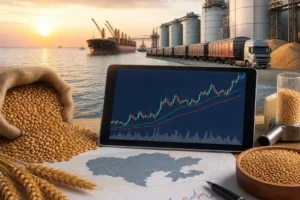

The Black Sea wheat market refers to the export and domestic wheat trade centered on the countries bordering or closely connected to the Black Sea, especially Russia, Ukraine, and Romania, with Bulgaria also relevant and Turkey important as both an importer and processor. In grain trade language, “Black Sea wheat” usually means milling wheat offered from this region into export channels, often competing directly with European Union, U.S., and sometimes Australian wheat in Mediterranean, Middle Eastern, African, and Asian destinations. It is one of the most watched wheat-origin markets in the world because the region combines large production potential, major export capacity, and frequent shifts in freight, currency, policy, and geopolitical risk.
For practical market use, Black Sea wheat is not a single exchange-traded instrument and not one uniform cash price. It is a network of inland farm and elevator markets, rail and river logistics, port elevator bids, export offers, and tender prices linked to international benchmarks. Anyone following this market needs to separate futures prices from physical export values, and FOB offers from farm-gate bids.
Because “current” Black Sea wheat prices change daily and differ by origin, protein, delivery month, and port, the most accurate approach is to identify the specific market first: Russian FOB Black Sea, Ukrainian export parity, Romanian port values, or inland domestic cash. Reliable price checking therefore starts with official exchanges for benchmarks and institutional or trade reporting sources for physical market context.
What the Black Sea wheat market means
Geographically, the Black Sea wheat market is a regional export market rather than one domestic marketplace. The core origins are:
- Russia, especially southern grain regions shipping through Black Sea and Azov outlets;
- Ukraine, historically a major wheat exporter via Black Sea ports and Danube-linked channels;
- Romania, an important European Union wheat producer and exporter through Constanța;
- Bulgaria, a smaller but relevant exporter within the same trade basin;
- Turkey, a major flour milling and wheat-importing country that strongly influences regional trade flows.
In commercial use, buyers often compare Black Sea wheat offers by origin and specification, especially protein content, test weight, moisture, and shipment period. Prices are usually discussed in U.S. dollars per metric ton for export trade, while domestic cash markets are commonly quoted in local currency per metric ton. Romania and Bulgaria also sit within the EU market structure, so euro-denominated trade and Euronext wheat futures are often relevant there.
The region matters because it can strongly influence world wheat export competition. When Black Sea supply is abundant and logistics are functioning, importers often see aggressive offers from the region. When weather, policy, insurance, port disruption, or freight constraints tighten supply, world wheat values can react quickly.
Where the market operates in practice
The Black Sea wheat market operates across several layers of physical trade.
Inland production areas
Wheat is first sold or stored in producing regions. Farmers may sell at harvest to local collectors, elevators, cooperatives, mills, or merchants. At this stage, prices are usually local cash bids in domestic currency, reflecting nearby supply, quality, and transport access.
Interior logistics corridors
Grain then moves by truck, rail, river barge where available, or combinations of these. Logistics are crucial in the Black Sea region because export competitiveness depends not only on wheat supply but also on movement from interior regions to ports. Congestion, wagon availability, border frictions, and fuel costs can all affect inland basis.
Port and export terminals
The best-known commercial price references are often port-based. Exporters bid for wheat delivered into port elevators or quote FOB values for loading onto oceangoing vessels. In Romania, Constanța is especially important. In the wider region, Danube transshipment points and Black Sea loading points can also affect export parity values.
Import tenders and destination markets
Black Sea wheat competes in international tenders issued by state grain agencies, mills, and private importers. Demand from North Africa, the Middle East, and parts of Asia often sets the practical test of competitiveness. In other words, Black Sea values are formed not only at the port but also against what destination buyers are willing to pay on a delivered basis.
| Market layer | Where it operates | Typical price form | Main users |
|---|---|---|---|
| Farm-gate/local cash | Producing districts inland | Local currency per metric ton | Farmers, collectors, mills, local merchants |
| Delivered inland buyer price | Elevators, mills, feed plants | Delivered price adjusted for freight and quality | Processors, domestic traders |
| Port bid/export parity | Port elevators and export channels | Delivered-to-port or export parity value | Exporters, merchants, large aggregators |
| FOB export offer | Black Sea loading ports | U.S. dollars per metric ton FOB | International traders, importers, brokers |
| CIF/destination tender price | Importing country port | Delivered import price including freight | State buyers, mills, importers |
How Black Sea wheat prices are formed
Black Sea wheat pricing is built through the interaction of global benchmarks and local physical conditions.
Futures price is the exchange-traded benchmark, such as Chicago wheat futures on CME Group or Euronext milling wheat futures for European trade. These are financial benchmarks and risk-management tools, not direct farm prices.
Cash bid is the price a local buyer offers for physical wheat at a specific place and quality. A farm-gate bid in southern Russia, a mill bid in Turkey, and a Romanian port bid can all differ sharply even on the same day.
FOB price means free on board at the exporting port. It reflects the value of wheat loaded onto a vessel at origin, before ocean freight to the destination.
CIF price means cost, insurance, and freight to the importing port. It adds freight and related costs to the export value.
Basis is the difference between the local cash price and the relevant futures benchmark. In Black Sea trade, basis can be influenced by port congestion, rail constraints, local quality, export demand, government policy, and currency moves. The same futures market can therefore correspond to very different local cash realities.
In practical terms, Black Sea wheat prices often reflect these factors:
- regional production prospects and harvest pace;
- protein content and milling quality;
- port access and loading capacity;
- freight and marine insurance conditions;
- currency movements against the U.S. dollar or euro;
- government export rules, inspections, or taxes where applicable;
- competition from EU, U.S., and other exporters;
- import tender demand from major destination countries.
Benchmark markets and why they matter
The Black Sea region does not have one universally dominant wheat futures contract of its own for daily international benchmark use. Instead, market participants usually compare physical offers against broader reference markets.
CME Group wheat futures, especially Chicago soft red winter wheat and Kansas City hard red winter wheat, are watched globally because they influence fund sentiment and broad wheat price direction.
Euronext milling wheat futures are especially relevant for Romania and Bulgaria because they sit inside the European Union trade environment and because Mediterranean export competition often overlaps with French and Romanian wheat.
These futures markets help with hedging and price discovery, but physical Black Sea trade remains highly origin-specific. A Russian FOB offer is not interchangeable with a Romanian FOB offer if quality, shipment timing, financing risk, or logistics differ.
| Price or market type | Where quoted | What it tells you | What it does not tell you |
|---|---|---|---|
| CME wheat futures | U.S. exchange benchmark | Global sentiment and hedge reference | Exact Black Sea cash or FOB export value |
| Euronext milling wheat futures | European benchmark | EU-related milling wheat value reference | Exact Russian or Ukrainian local price |
| Port bid | Origin export corridor | What exporters may pay near shipment points | What an inland farmer far from port will net |
| FOB offer | Black Sea origin port | Export competitiveness at vessel-loading point | Delivered destination cost including all later changes |
| Farm-gate cash bid | Local physical market | Immediate local selling opportunity | Tradable futures benchmark or export replacement value elsewhere |
Where to check Black Sea wheat prices and market information online
If a reader wants a reliable picture of the market without inventing a “live” number, the best approach is to combine benchmark futures with official crop and trade reporting.
Useful sources include:
- CME Group for U.S. wheat futures benchmarks;
- Euronext for European milling wheat futures benchmarks;
- USDA, especially World Agricultural Supply and Demand Estimates and Foreign Agricultural Service reporting, for production, exports, and world balance-sheet context;
- European Commission market observatories and trade information relevant to EU wheat origins such as Romania and Bulgaria;
- National statistics or agriculture ministries where available for crop progress, harvested area, and domestic production estimates;
- Merchants, port buyers, mills, and cooperatives for real physical bids in local markets.
For a farmer or merchant, the most useful “price check” is often not an exchange screen but a current bid from a local buyer or exporter. Exchange prices are essential for direction and hedging, but actual net selling value depends on basis, quality, drying, loading terms, and freight to the delivery point.
Readers should be careful not to treat a futures settlement or a media headline about “Black Sea wheat” as the exact price available at a farm, silo, or terminal. The physical market can move differently from futures, especially during harvest pressure or logistics disruption.
Supply, demand, and the main market drivers
On the supply side, Black Sea wheat depends heavily on weather during seeding, overwintering, spring development, and harvest. Dryness, winterkill risk, late frost, and excessive rain at harvest can change exportable quality as well as total output. Protein and milling quality matter because part of the crop may be downgraded into feed channels if conditions deteriorate.
On the demand side, export demand is often more price-sensitive than domestic consumption. Many destination buyers run tenders and compare origins closely. That means a small change in freight, insurance, currency, or origin risk can redirect business toward or away from the Black Sea.
Other major drivers include:
- Currency: when local currency weakens against the U.S. dollar, export offers may become more competitive, although inland costs and policy can offset this.
- Energy and fertilizer: these affect production costs and can influence acreage decisions and selling behavior.
- Government policy: export taxes, quotas, licensing, inspections, or trade restrictions can alter supply available to the world market.
- Logistics and security: rail bottlenecks, port damage, insurance costs, and corridor reliability can have immediate price effects.
- Competing exporters: crops in the EU, United States, Canada, and Australia shape how aggressively Black Sea wheat must be priced to win business.
How wheat is actually bought, sold, exported, and imported
Physical grain trade
Physical trade begins with contracts between grain owners and buyers. A farmer may sell ex-farm, delivered to an elevator, or delivered to a port-related collection point. Merchants and exporters assemble large volumes meeting a defined quality specification. Contracts usually address quantity, quality parameters, delivery window, pricing basis, and payment terms.
Exporters then build cargoes through inland procurement and terminal handling. Grain may be cleaned, blended, stored, and inspected before loading. International sales are commonly negotiated directly between trading houses and importers or through brokers. Large importers, including state purchasing agencies, may buy by tender.
For importers, the practical comparison is often between origins on a CIF basis. For exporters, the commercial calculation starts with origin procurement cost and works forward through handling and vessel-loading to a FOB offer.
Futures and options trading
Futures and options are different from physical grain ownership. A trader can buy or sell wheat futures through a broker without ever handling a ton of wheat. This is used for hedging price risk or for speculation on market direction.
An exporter, miller, or merchant may hedge with futures when exposed to changing prices between physical purchase and final sale. But hedging does not eliminate basis risk: the local Black Sea cash market can strengthen or weaken relative to the benchmark future.
Anyone using futures needs to understand margin requirements, leverage, contract expiry, and the fact that exchange positions can move sharply even when local physical trade is quiet. Monitoring futures online is easy; successfully connecting them to Black Sea physical trade requires discipline and local market knowledge.
Forecast outlook: what to watch next
The most useful way to think about the Black Sea wheat outlook is through scenarios rather than one fixed forecast.
- Bullish scenario: weather stress, lower milling quality, export restrictions, higher freight or insurance costs, or renewed logistics disruption reduce export availability and support prices.
- Neutral scenario: adequate production, manageable logistics, and normal importer demand keep Black Sea wheat competitive but tied closely to broader global benchmarks.
- Bearish scenario: large harvests, smooth port movement, weak importer demand, and strong competition among exporters pressure FOB offers and inland cash markets.
During the season, the most important indicators to watch are crop development reports, harvest pace, protein distribution, port lineups, policy announcements, and destination tender results. In this market, logistics and policy can matter almost as much as agronomy.
Practical FAQ
What is the main benchmark for Black Sea wheat prices?
There is no single perfect benchmark. Market participants usually watch CME wheat futures for global direction and Euronext milling wheat futures for European context, then compare those with actual Black Sea FOB offers and local cash bids.
Where can I check Black Sea wheat prices today?
Check benchmark futures on CME Group and Euronext, then use USDA and European Commission market information for context. For real physical pricing, the best source is current bids from local merchants, mills, cooperatives, or exporters in the specific origin and delivery location you care about.
Why is a Black Sea FOB price different from a farm-gate wheat price?
FOB is the export value at the port after inland transport, handling, storage, and export logistics. A farm-gate price is what the producer can receive locally before those costs are added, and it may also reflect weaker local competition or quality discounts.
In what currency is Black Sea wheat usually traded?
International export business is usually discussed in U.S. dollars per metric ton. Domestic cash markets are commonly priced in local currency per metric ton. In EU member states such as Romania and Bulgaria, euro-based trade references are also important.
How do importers buy Black Sea wheat?
Importers may buy directly from international merchants, through brokers, or via formal tenders. The key import comparison is often on a CIF basis, which includes freight to the destination port.
Can I trade Black Sea wheat online?
You can trade wheat futures and options online through a regulated broker, but that is financial exposure, not the same as owning physical Black Sea wheat. Physical trade normally takes place through merchants, exporters, processors, and negotiated contracts.
What are the biggest short-term price drivers in this region?
Weather, export policy, port logistics, freight and insurance costs, currency moves, and import tender activity are usually the biggest short-term drivers.
Does stronger futures pricing always mean higher Black Sea cash bids?
No. Local cash bids can rise less than futures, match them, or even fall if basis weakens because of harvest pressure, poor logistics, weaker export demand, or quality problems.
Sources
- USDA Foreign Agricultural Service
- CME Group
- European Commission