

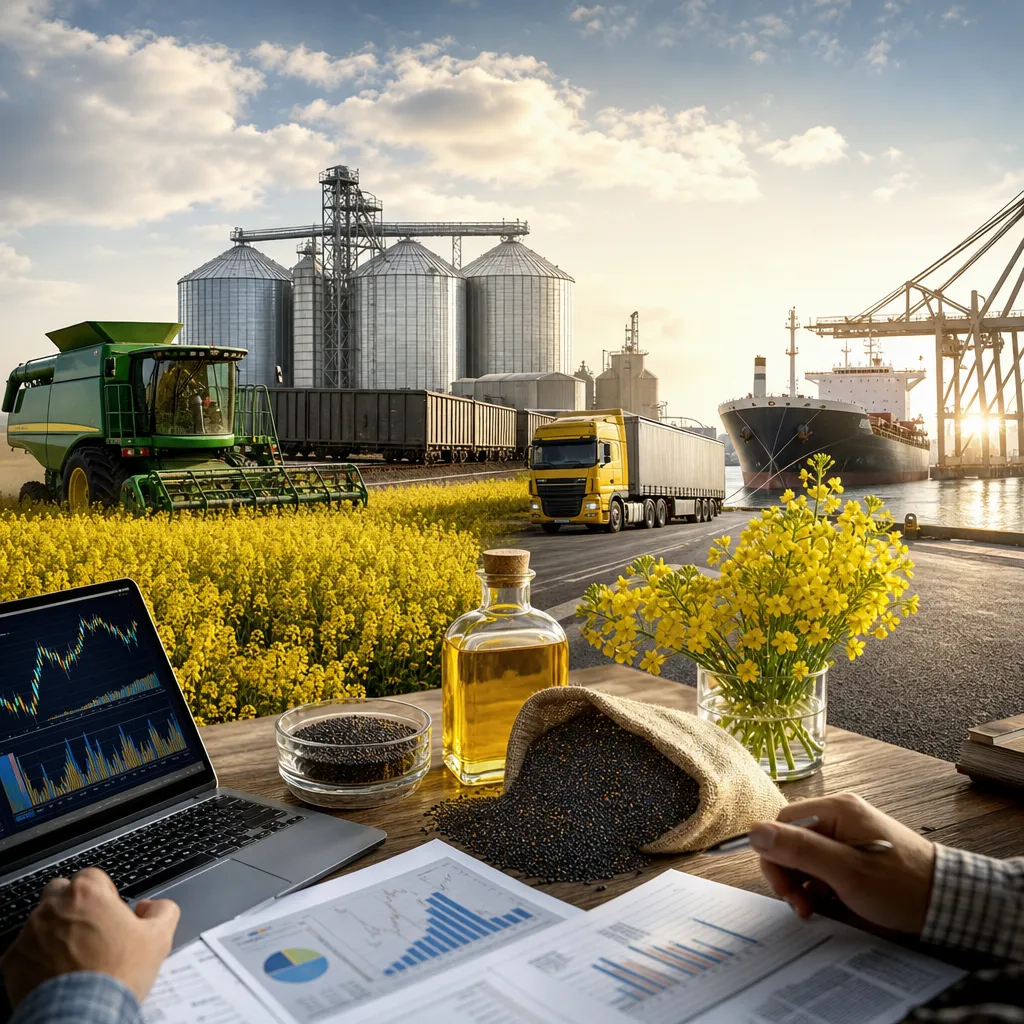
The EU rapeseed market is a regional oilseed market centered on the European Union’s large crushing, biodiesel, feed, and food sectors. In practice, “EU rapeseed supply and demand” means the balance between rapeseed production inside the EU, imports from outside the bloc, crushing demand from processors, and the use of rapeseed oil and meal in energy, feed, and food chains. The market operates across many member states, but pricing is strongly influenced by northwest European trade flows and by Euronext rapeseed futures, often still referred to as MATIF. Because the EU is both a major producer and a structural importer in many years, weather, policy, currency moves, and global oilseed competition all matter.
Rapeseed in the EU is usually discussed in metric tonnes, and physical prices are commonly expressed in euros per tonne. The most relevant benchmark for financial price discovery is the Euronext rapeseed futures contract, while real-world physical prices can also be quoted as ex-farm, delivered crusher, inland elevator, or FOB export values depending on location and transaction terms. Readers should treat futures as a benchmark, not as the exact price a farmer or crusher pays in a specific local market.
What the EU rapeseed market covers
Rapeseed is the main oilseed crop grown across much of the EU, especially in countries such as France, Germany, Poland, Romania, and the Czech Republic. It is crushed into rapeseed oil and rapeseed meal. The oil is used in food applications and, importantly, in biodiesel and renewable fuel chains; the meal is used in animal feed.
So when analysts discuss EU rapeseed supply and demand, they are usually looking at several linked questions:
- How large the EU crop is after planting, winter survival, spring growth, and harvest.
- How much rapeseed the EU imports from origins such as Ukraine, Australia, Canada, or others when trade conditions allow.
- How much crushers process into oil and meal.
- How biodiesel policy and vegetable oil demand affect crushing margins.
- How much substitution occurs versus soybeans, soybean oil, sunflower seed, and sunflower oil.
The market is therefore not just an agricultural crop market. It is also connected to energy policy, feed demand, freight, and currency.
Where the market operates inside Europe
The EU rapeseed market is not a single local cash market in one place. It is a network of farm-gate markets, inland elevators, crushers, feed compounders, biodiesel producers, ports, and import channels spread across the Union. France and Germany are especially important for production and processing, while major consumption and crushing also occur in other member states.
Northwest Europe matters because many trade references are formed around that zone, where physical trade, crushing, and futures participation are concentrated. Ports also matter because the EU often imports rapeseed or related vegetable oils and meals to fill supply gaps. Inland values in Central and Eastern Europe may trade at premiums or discounts to western benchmarks depending on harvest size, logistics, and local buyer competition.
The euro is the main pricing currency for the regional benchmark. However, cross-border trade can also be affected by exchange rates involving non-euro origins, especially when rapeseed is imported from countries whose trade is priced in U.S. dollars or local currencies. That means the EUR/USD exchange rate can indirectly influence landed EU supply costs.
| Market area | Role in the rapeseed chain | Typical price relevance |
|---|---|---|
| Farm-gate and local elevators | Primary origination from growers | Local cash bids, often linked to futures plus or minus basis |
| Crushing plants | Purchase seed and produce oil and meal | Delivered crusher prices reflect processing margins and nearby demand |
| Ports and import terminals | Receive imported seed or related products | CIF or port-delivered values influence inland replacement cost |
| Euronext futures market | Financial benchmark and hedging venue | Reference price for hedging and forward contracting |
How EU rapeseed prices are formed
EU rapeseed pricing starts with benchmark futures, but it does not end there. The Euronext rapeseed futures contract helps the market discover a widely watched reference value in euros per tonne. Physical transactions then build on that benchmark through a basis or premium/discount structure.
In practical terms, several different prices can exist on the same day:
- Futures price: the exchange-traded benchmark for a specific delivery month.
- Local cash bid: what a local buyer, cooperative, or merchant offers at a collecting point or ex-farm.
- Delivered crusher price: the value paid for rapeseed delivered to a processing plant.
- Export or port bid: a price tied to cargo trade, often at port or on an FOB/CIF basis when relevant.
- Forward contract price: a pre-agreed physical price for future delivery, sometimes fixed against futures.
Basis is the difference between the local physical price and the futures benchmark. Basis can strengthen or weaken depending on location, local supply, transport cost, quality specifications, storage capacity, and urgency of crusher demand. For example, when crushers need nearby seed and local farmer selling is slow, delivered basis can strengthen even if futures are unchanged. On the other hand, if harvest pressure is heavy and logistics are congested, farm-gate basis may weaken.
Quality also matters. Oil content, moisture, admixture, and other contractual criteria can change what a buyer is willing to pay. In rapeseed, oil value is commercially important because it affects crushing economics.
Main supply and demand drivers
EU rapeseed supply and demand is shaped by a combination of agronomic, industrial, and trade variables. The biggest drivers are usually the following:
- Planted area: autumn sowing conditions heavily influence next season’s production potential.
- Winter survival and spring weather: rapeseed is vulnerable to establishment problems, frost damage, and drought stress.
- Yield and harvest quality: final output depends on weather through flowering, pod fill, and harvest.
- Import availability: if the EU crop is not enough, imported rapeseed becomes critical.
- Crush demand: processor margins depend on rapeseed oil and meal values.
- Biofuel policy: renewable fuel demand can support rapeseed oil and therefore crushing demand.
- Competing oilseeds: soybean and sunflower markets affect substitution in both oil and meal markets.
- Energy prices and freight: these influence processing cost and import economics.
- Currency: a weaker euro can raise the cost of imported supply.
The EU often faces a structurally tight balance because local production may not fully satisfy crushing requirements. That makes imports important even in years with decent domestic crops. It also means that disruptions in external origins, freight flows, or trade policy can tighten the EU balance quickly.
| Factor | Typical effect on the market | Why it matters |
|---|---|---|
| Smaller EU harvest | Bullish for inland prices and import demand | Domestic crushers must compete harder for seed |
| Strong biodiesel demand | Supports rapeseed oil values and crush demand | Oil demand can improve crusher margins |
| Large imports at competitive prices | Can cap local premiums | Imported seed sets replacement value for crushers |
| Weak euro | Often supportive to EU prices | Imports become more expensive in euro terms |
| Heavy harvest selling | Can pressure nearby cash basis | Storage and logistics bottlenecks weaken local bids |
How physical rapeseed is actually bought and sold
Physical rapeseed trade in the EU usually takes place through cooperatives, private grain merchants, crushers, and occasionally through supply agreements tied to processors or feed manufacturers. Farmers rarely sell to the futures exchange directly as a physical outlet. Instead, they negotiate with a local buyer.
Common physical marketing structures include:
- Spot sales: seed is sold for nearby movement at the buyer’s current cash bid.
- Forward contracts: quantity, delivery period, and quality are agreed before harvest or before movement.
- Minimum price or formula contracts: in some commercial arrangements, the physical sale may be linked to a futures hedge or pricing formula.
- Delivered contracts: the seller delivers to a crusher, elevator, or port and is paid based on delivered terms.
Contract details matter. Buyers usually specify moisture, oil content, impurities, delivery window, weighing rules, and payment timing. Counterparty quality matters as well: a physical contract is a commercial obligation, not just a market view. For that reason, growers and traders normally assess the reliability, payment record, and claims process of the buyer.
Exports and imports are handled by merchants, trading houses, and processors with logistics capacity. At that level, transactions may be discussed on FOB, CIF, or delivered terms. A crusher may compare inland purchases with import replacement cost. If imported rapeseed lands more cheaply than nearby domestic supply, that can pressure inland bids.
How rapeseed is traded and hedged financially
Euronext rapeseed futures are the main exchange-based hedging tool for the EU market. These contracts are used by merchants, crushers, importers, exporters, and some larger producers or cooperatives to manage price risk. Speculators and investment traders also participate, but financial trading is distinct from physical ownership.
A practical distinction is essential:
- Physical market: ownership of actual seed changes hands through a commercial contract.
- Futures market: price risk is managed through exchange-traded contracts accessed via a broker.
For example, a merchant who buys rapeseed from farmers may sell futures to hedge the risk of falling prices before the seed is resold. A crusher that needs future supply may buy futures or use them in conjunction with cash purchases to manage margin risk. At expiry, many market participants offset their futures positions rather than making or taking delivery.
Using futures requires a brokerage account, margin, and daily mark-to-market discipline. It also introduces basis risk: even if futures move as expected, the local physical premium or discount may change. That is why hedging reduces benchmark price risk but does not perfectly lock every local cash outcome.
Where to check EU rapeseed market information online
Readers looking for live or current information should use official and market-specific sources rather than relying on a single quoted number. No single screen shows the exact cash price for every EU location because physical markets differ by country, region, and buyer.
The most useful places to check are:
- Euronext: for official rapeseed futures prices, contract months, and exchange market information.
- European Commission: for EU agricultural market reporting, oilseed context, and policy information relevant to biofuels and trade.
- Eurostat: for trade and production statistics across EU member states.
- USDA: for broad oilseed balance-sheet analysis and international supply-and-demand context.
- Local cooperatives, merchants, and crushers: for actual cash bids in a specific region.
When checking prices, always verify four things: the location, the unit, whether the value is futures or physical, and the delivery basis. A futures settlement in euros per tonne is not the same as a farm-gate bid, and a delivered crusher price is not the same as a port offer. Local transport, drying, quality deductions, and timing can materially change the final net price.
Practical market scenarios to watch
Forecasting EU rapeseed supply and demand is best done through scenarios rather than certainty. The market can shift quickly if weather, biofuel policy, or imports change.
Three practical scenarios are especially useful:
- Tight crop scenario: poor establishment, winter damage, or spring drought reduces production. In that case, crushers may rely more on imports and inland basis can strengthen near demand centers.
- Comfortable supply scenario: a good EU crop and smooth imports ease nearby tightness. Basis may soften, especially at harvest, unless crushing margins are very strong.
- Demand-led scenario: biodiesel demand and strong vegetable oil values support crushing even without a major crop problem. Prices can stay firm because oil demand improves the value of processing seed.
Readers should also monitor substitution. If soybean meal becomes cheaper relative to rapeseed meal, or if sunflower oil becomes more available, crushers and feed users may change their buying patterns. Rapeseed does not trade in isolation.
FAQ
What is the main benchmark for EU rapeseed prices?
The main benchmark is Euronext rapeseed futures, quoted in euros per tonne. It is the central financial reference for hedging and price discovery, but local physical prices can differ meaningfully from futures.
Are EU rapeseed prices the same across all member states?
No. Prices vary by region because of basis, transport cost, local crop size, buyer competition, and distance to crushers or ports. A bid in France can differ from a bid in Poland or Romania even when the same futures contract is used as a benchmark.
Where can I check current EU rapeseed prices?
For benchmark futures, check Euronext. For market context, use the European Commission, Eurostat, and USDA. For actual local cash bids, check with cooperatives, grain merchants, or processors in the relevant country or region.
Why is the EU often an importer of rapeseed?
Because EU crushing and consumption demand can exceed domestic production. In years when the crop is smaller or biodiesel demand is strong, imports become especially important to fill the supply gap.
How do crushers influence rapeseed prices?
Crushers buy seed and sell oil and meal. Their willingness to pay depends on processing margins, nearby seed availability, and demand for rapeseed oil and meal. Strong crush margins often support delivered seed prices.
Can a farmer hedge EU rapeseed using futures?
Yes, but normally through a broker or indirectly through a merchant or cooperative using a futures-linked contract. Futures hedge benchmark price risk, not every local basis change, so cash and futures do not always move one-for-one.
What units and currency are normally used?
The EU market is typically quoted in metric tonnes, with benchmark prices in euros per tonne. Some imported supply comparisons may also involve U.S. dollar-denominated trade, especially when looking at non-EU origins.
What are the most important price drivers to follow?
Watch EU planting and weather conditions, harvest quality, import availability, biodiesel policy, vegetable oil prices, crush margins, freight, and the euro exchange rate.
Sources
- Euronext
- European Commission
- USDA Foreign Agricultural Service