
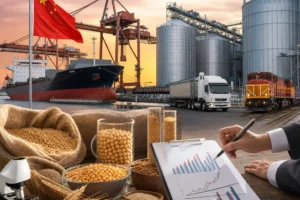









China’s grain export market is the part of the Chinese grain economy where grain is sold from China to overseas buyers. In practice, this is a narrower and more selective market than many readers expect, because China is better known globally as a very large producer and consumer of grain, and in several grains it is often a major importer rather than a consistent large-scale exporter. The export market therefore matters most in specific commodities, specific years, and specific border or port flows, not as a simple “China exports grain” story across all crops. To understand it properly, readers need to separate domestic Chinese grain pricing, futures pricing on Chinese exchanges, and export parity prices at ports.
Geographically, the market operates across mainland China, but exportable grain is linked especially to producing regions in the northeast and north, domestic logistics corridors, and seaports or border trade routes that can move grain to foreign buyers. Prices are usually discussed in renminbi, also called yuan, often per metric ton in the domestic market, while export trade is commonly assessed against international benchmarks and maritime trade terms such as FOB or CIF. The most relevant domestic exchanges for grain price discovery are the Dalian Commodity Exchange and Zhengzhou Commodity Exchange, but actual exports are negotiated in the physical market by merchants, processors, state-linked firms, and trading companies.
What the China grain export market actually means
The phrase China grain export market can refer to several related but different things. It may mean grain physically loaded in China and sold abroad. It may also mean the export competitiveness of Chinese grain compared with world prices. In market discussion, it can even refer to whether domestic Chinese corn, rice, wheat, or other grains are priced high enough or low enough to allow export business.
In practical terms, the export market is not one single nationwide price board. It is a chain that starts with grain in inland producing regions, moves through storage and transport networks, and ends at an export point or border transaction. A trader asking whether “China grain is exportable” is usually asking whether domestic acquisition cost, handling, transport, finance, and port costs together are below what an overseas buyer is willing to pay.
That is why the export market should be viewed as a relationship between Chinese domestic prices and international prices, not just as a headline about trade flows.
Where the market operates inside China
China’s grain economy is national in scale, but exportable grain tends to be connected to specific production and logistics regions. Northern and northeastern provinces are important in corn and other feed grain production. Major consuming areas and processing hubs are elsewhere, so domestic trade inside China is often larger and more important than export trade.
Exports, when they occur, may move through:
- Seaports serving international bulk or container trade.
- Border trade channels with neighboring countries.
- Specialized sales of rice, corn products, or other grain-related cargoes depending on policy and market conditions.
Because China is such a large domestic market, inland grain may be pulled toward feed mills, flour mills, starch processors, or state reserve channels before it is ever considered for export. This is a key difference from classic export-origin countries where port values dominate the whole pricing structure.
| Market layer | Where it operates | Why it matters |
|---|---|---|
| Farm and local procurement | Producing counties and grain collection areas | Starting point for physical supply and local cash pricing |
| Domestic wholesale and processing market | Feed, milling, storage, and industrial demand centers | Often determines whether grain stays in China rather than being exported |
| Futures market | Mainly Dalian Commodity Exchange and Zhengzhou Commodity Exchange | Provides benchmark price signals and hedging tools for some grain commodities |
| Export market | Ports, border trade channels, and export negotiation desks | Converts domestic grain values into FOB or delivered export offers |
China’s role in grain production, consumption, imports, and exports
China is one of the world’s largest grain producers and one of the world’s largest grain consumers. That alone explains why its export position is complex. A country can produce enormous crops and still be a limited exporter if domestic consumption is also enormous, if policy reserves are important, or if import demand exists for particular grain qualities or particular feed needs.
For many readers, the practical takeaway is this: China’s grain market is primarily a domestic balance-sheet market first, and an export market second. In some years or commodities, exports can rise; in others, imports or domestic demand become more important. This is especially true when feed demand, weather, policy changes, reserve management, or currency movements alter Chinese internal price relationships.
That is why analysts usually examine China grain exports together with:
- Domestic crop size and quality.
- Government policy and reserve management.
- Feed demand and industrial use.
- Import economics versus domestic procurement.
- International benchmark prices and freight.
How prices are formed in the China grain export market
Price formation starts with the local physical grain price inside China. That is the price paid to acquire grain from producers, collectors, warehouses, or domestic counterparties. From there, traders add transport, drying if needed, inspection, storage, finance, loading, and export handling costs. The resulting price is compared with what an overseas buyer will pay.
Several price concepts need to be separated clearly:
- Futures price: a price for a standardized exchange contract, not the exact value of a specific truckload or vessel parcel.
- Local cash price: the physical price in a producing or consuming area inside China.
- Delivered price: the cost of grain delivered to a mill, plant, warehouse, or port.
- FOB price: free on board at the export point, meaning the seller covers costs up to loading on the vessel.
- CIF price: cost, insurance, and freight to the destination port, typically more relevant for the importer’s landed comparison.
- Basis: the difference between a local cash price and a relevant futures benchmark.
In China, export prices may be influenced by domestic futures, but they are not determined by futures alone. Local cash markets can differ sharply from exchange prices because of quality, province-to-province movement costs, policy factors, storage availability, and buyer competition. A high futures market does not automatically mean profitable exports, and a low futures market does not guarantee that physical grain can be sourced cheaply enough for shipment.
| Price type | Usually quoted in | What it tells you |
|---|---|---|
| Domestic cash price | RMB per metric ton | What grain is worth in a Chinese local or regional physical market |
| Futures price | Exchange quotation by contract month | A benchmark for hedging and market expectations, not a direct farm-gate bid |
| Port delivered price | RMB per metric ton | Cost of assembling grain at the export point |
| FOB export offer | Usually U.S. dollars per metric ton in international trade discussion | Seller’s price to load grain onto the vessel at origin |
| CIF import comparison | Usually U.S. dollars per metric ton | What the buyer compares against other global suppliers at destination |
Which benchmarks matter most
For domestic Chinese grain, the most relevant exchange benchmarks are usually on the Dalian Commodity Exchange for some feed-related commodities and the Zhengzhou Commodity Exchange for some staple agricultural contracts. These exchanges are important for Chinese price discovery and hedging.
For international comparison, traders also watch major global benchmarks such as Chicago grain futures, depending on the commodity. The reason is simple: an export sale from China competes with offers from other origins. Even if the Chinese domestic market is quoted in renminbi and the export market is negotiated commercially, overseas buyers still compare the offer with rival supplies from major exporters.
Currency matters as well. Domestic costs are largely in renminbi, but many international grain trade conversations and vessel-based offers are benchmarked in U.S. dollars per metric ton. A change in the exchange rate can therefore alter export competitiveness even when domestic grain prices are unchanged.
Where to check China grain prices and market information online
If you want a reliable view of this market, use different sources for different layers of pricing. There is no single screen that perfectly shows the whole China grain export market.
For exchange prices and contract information, readers can check:
- Dalian Commodity Exchange for relevant agricultural futures and official contract data.
- Zhengzhou Commodity Exchange for relevant agricultural futures and market notices.
For official Chinese agricultural market information, readers can monitor:
- Ministry of Agriculture and Rural Affairs of the People’s Republic of China for policy, production, and market updates where available.
- National Bureau of Statistics of China for crop and economic context.
For international trade context and balance-sheet analysis, useful reference points include:
- USDA Foreign Agricultural Service for country reports and trade analysis.
- USDA WASDE and broader grain outlook material for world supply-demand context.
- FAO for international cereal market monitoring.
For real physical trade indications, market participants often rely on:
- Domestic merchants and processors quoting spot or delivered prices.
- Port market reports and trade press covering Chinese and Asian grain flows.
- Broker and analytics platforms that aggregate cash and futures signals.
A practical warning is essential: an exchange quote is not the same as a local procurement bid, and neither is the same as an export FOB offer. You need to know the commodity, quality, location, contract month or spot timing, currency, and unit before comparing prices.
How grain is actually bought, sold, exported, imported, or hedged
Physical grain trade
Physical grain in China is bought and sold through commercial channels such as collectors, warehouses, processors, feed mills, mills, merchants, and trading companies. For export business, a seller first needs grain that meets the buyer’s quality specification, then transport to the export point, then acceptable documentation and shipment terms.
A normal physical export workflow may include:
- Procurement from domestic origin or stocks.
- Quality testing and grading.
- Transport to storage or port.
- Commercial negotiation on quantity, quality, shipment window, and trade term.
- Export documentation, customs procedures, and loading.
- Payment under agreed commercial terms.
The commercial contract matters as much as the headline price. Moisture limits, foreign material, test weight, contamination rules, origin requirements, and shipment timing can all change the final net value.
Futures and options use
Futures and options are financial tools, not the same thing as owning exportable grain. A processor, merchant, or trader may hedge price risk on an exchange while separately buying or selling physical grain. That hedge can reduce exposure to adverse price moves, but it does not remove logistics risk, quality risk, policy risk, or basis risk.
Access to futures markets normally takes place through a regulated broker or futures company, subject to account rules, margin requirements, and exchange procedures. A trader can monitor exchange prices online, but the hedge only reflects the standardized contract. The physical export cargo may still price differently because of basis, freight, and quality differences.
Main drivers of China grain export competitiveness
China’s grain export potential changes with domestic and international conditions. The key drivers are not mysterious, but they interact in ways that can quickly open or close export opportunities.
| Driver | Possible effect | Why it matters |
|---|---|---|
| Domestic crop size and quality | Can increase or reduce exportable surplus | A large crop does not automatically mean exports if local demand is strong |
| Government policy | Can support, limit, or redirect trade flows | Reserve policy, trade administration, and food security priorities are important in China |
| Feed and milling demand | Higher domestic use can reduce export availability | China’s internal market is so large that domestic demand often dominates |
| Currency movement | Can improve or worsen export competitiveness | Costs are often in RMB while export comparisons are often in dollars |
| Freight and logistics | Can make export business workable or uneconomic | Inland transport and port costs are critical in any export parity calculation |
| World benchmark prices | Affect buyer willingness to source from China | China competes against major exporting origins |
Practical reading of the market: what matters most for users
If you are a commercial buyer or seller, focus first on the physical market. Ask where the grain is located, in what quality, in what quantity, and at what delivered cost. Then compare that with a realistic export sale price after handling and freight. This is the only way to judge whether export business exists.
If you are a market analyst, compare Chinese domestic prices, exchange benchmarks, world benchmarks, and currency moves together. Looking at only one of these can give the wrong conclusion.
If you are a hedger, remember that futures protect against part of the price risk but not all commercial risk. Basis can widen or narrow, logistics can change, and policy can move the market independently of standard exchange signals.
If you are simply checking “today’s China grain export price,” be careful. There is usually no single universal live export price for all Chinese grain. The right question is: which commodity, what quality, which origin, which port, what delivery month, and which trade term?
FAQ
Is China mainly a grain exporter or importer?
China is primarily a very large grain producer and consumer. Depending on the commodity and the year, it may import heavily, export selectively, or do both in different products. The domestic market is usually more important than the export market.
What currency and unit are usually used in the China grain market?
Domestic grain is commonly discussed in renminbi per metric ton. Export comparisons are often made in U.S. dollars per metric ton, especially for FOB or CIF business.
Where can I check Chinese grain futures prices?
The main official exchange sources are the Dalian Commodity Exchange and the Zhengzhou Commodity Exchange. These provide contract-related market information, but they do not replace local physical cash bids.
Are Chinese futures prices the same as export prices?
No. Futures are standardized financial benchmarks. Export prices reflect physical grain acquisition, quality, transport, storage, port costs, documentation, and international buyer demand.
How is grain physically exported from China?
Grain is procured in the domestic market, tested for quality, transported to a storage or export point, sold under a commercial contract, cleared for export, and loaded for shipment. The exact route depends on commodity, destination, and policy conditions.
What is the most important price concept for export competitiveness?
Export parity is the key idea. A trader compares total domestic acquisition and logistics cost with the price obtainable from the overseas buyer. If the export sale does not cover those costs and margin needs, the grain is not competitive for export.
Why can local Chinese cash prices differ from futures?
Because local prices reflect basis, quality, province or port location, transport costs, storage conditions, local supply-demand, and buyer competition. Futures are only one part of the pricing picture.
What are the main risks in trading this market?
Major risks include price volatility, basis changes, quality disputes, logistics delays, policy shifts, currency moves, and counterparty performance. Hedging can reduce some price risk but not all commercial risk.
Sources
- Dalian Commodity Exchange
- Zhengzhou Commodity Exchange
- USDA Foreign Agricultural Service